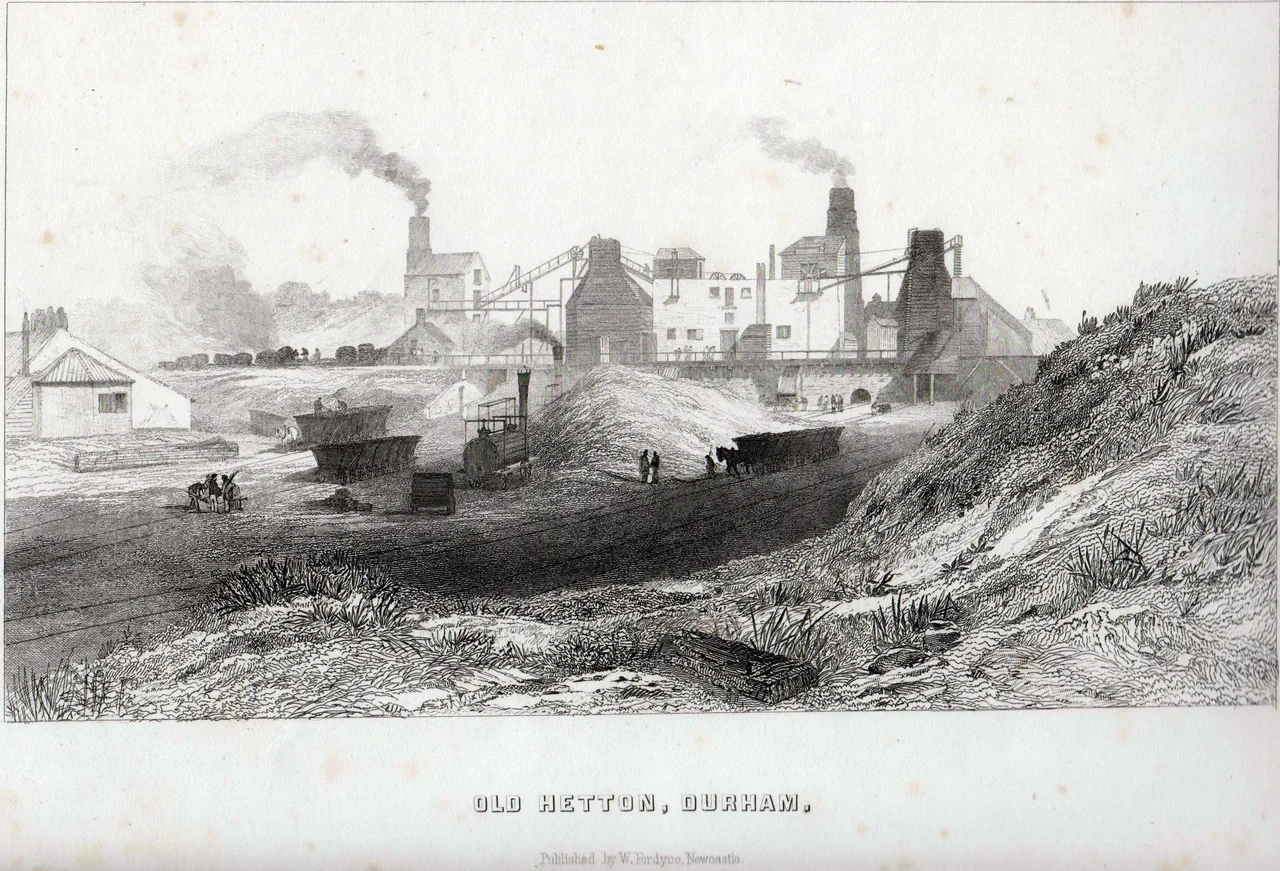

Hetton colliery railway
Three years before George Stephenson's celebrated Stockton and Darlington Railway carried its famous first passenger train, he had already built something arguably more radical. The Hetton Colliery Railway opened in 1822 to haul coal from a pit south of Houghton-le-Spring to the River Wear, eight miles away. It was the first railway designed from the very start to operate without animal power. No horses, no oxen. Steam locomotives where the gradient allowed, stationary engines on inclines where it did not, gravity working downhill. By the time the line closed in 1959, it was recognised as the oldest mineral railway in Great Britain.
A Survey in 1816
The story begins with a survey, completed in April 1816, that suggested a railway could be built between the pits at Hetton and the staithes on the River Wear. Three years later the Hetton Coal Company was established as a partnership, which made it the first major company in County Durham. On 13 May 1821 the company signed a mining lease with Lyon, the local landowner. Two engineers worked on the project: George Stephenson, already known for his work at Killingworth, and Nicholas Wood, his collaborator. The route was challenging. From the colliery at Hetton, the line had to climb over Warden Law, a substantial hill, before descending to the river. Animal traction would not do for that profile, so Stephenson designed something new.
Stationary Engines and Steam Locomotives
The Hetton solution combined several technologies. Where the route ran level or with a slight gradient, steam locomotives hauled the coal trucks. Where it climbed steeply, particularly over Warden Law Hill, pairs of stationary reciprocating engines were installed. Each engine could produce up to 44.7 kilowatts of power. They pulled groups of eight wagons up the incline on a cable system. Where the line descended toward the river, gravity did the work, with brakemen riding the wagons. The integration of these different systems on a single line was an engineering first. It was the design template that Stephenson would later refine for the Stockton and Darlington Railway in 1825. Hetton was the prototype.
The World's Oldest Working Locomotive
By 1902 The Engineer magazine noted that one of the original Stephenson-built locomotives was still hauling coal trucks at Hetton, eighty years after the line opened. The publication called it "now the oldest working locomotive in the world." Whether the surviving engine is truly an original 1822 Stephenson is disputed. Some historians have argued it may be an 1850s-era replica built at the behest of Sir Lindsay Wood, the colliery owner who took an interest in preserving the line's heritage. In 1884 the company acquired limited liability and built two additional locomotives, named Lyons and Eppleton. These featured a gear-driven 0-4-0T wheel arrangement and vertically mounted boilers, improvements over the originals. The original batch continued to be used alongside the newer engines for decades. At least one of them was still in active service at the start of the 20th century.
The Slow Closure
The Hetton Colliery Railway closed to most traffic in 1959, by which point the mining industry around Houghton-le-Spring was already in decline. The final section, from Silksworth Colliery to Railway Row coal land sale, hung on until 1972. By then the County Durham coalfield itself was contracting fast, the larger pits closing one after another. Coal mining in the area is now entirely gone. The Hetton line was a creature of the industry it served, born to move coal and dying when the coal stopped moving. But the trackbed survived. Multiple stretches of the former line have been converted into the Stephenson Trail, a combined pedestrian and cycle route that traces the original alignment between the village of Hetton-le-Hole and the Wear staithes.
A Quiet First
The Stockton and Darlington Railway, opened in 1825, became famous as the world's first public steam-hauled railway. It carried passengers as well as freight and inaugurated the modern railway age in the public imagination. The Hetton Colliery Railway was older by three years but was a private line, hauling coal for one company, and so it never carried the same cultural weight. Yet it was here that Stephenson first proved a railway could be designed entirely around mechanical power. Every steam locomotive that ran on Britain's main-line railways for the next 140 years, every electric train running on the same routes today, every freight wagon, every metro and tram, trace their lineage in part through Hetton. Three years before Locomotion No. 1 made its famous run, the noise of a new age was already echoing across the hills south of Houghton-le-Spring.
From the Air
The Hetton Colliery Railway alignment ran between roughly 54.82 degrees north, 1.44 degrees west, in the area between Hetton-le-Hole and the River Wear north-east of Houghton-le-Spring. Newcastle Airport (ICAO: EGNT) is 13 miles north-west. Teesside International (EGNV) is 25 miles south. From the air the alignment is no longer a continuous railway but can be traced through the Stephenson Trail's path through suburban and post-industrial landscape. Houghton-le-Spring is the most prominent settlement; Hetton-le-Hole sits to the south. The A1(M) motorway runs about 5 miles west. The North Sea coast is about 5 miles east, with the conurbations of Sunderland and Seaham visible on a clear day. The terrain is open with low rolling hills; Warden Law, the hill that required Stephenson's stationary engines, is still a noticeable feature at 218 metres. Coastal weather influences include sea fog and frequent low stratus.
Nearby Stories
- Hadrian's Wall Path 1.8 km away
- Killingworth 2.2 km away
- Allenheads 9.2 km away
- Nine Standards Rigg 11 km away
- Catterick Bridge Explosion 12 km away
- Rosedale Abbey 19 km away
- Saltburn Pier 20 km away
- Alexander L. Kielland (Platform) 306 km away