
Hierakonpolis
On a slab of dark green stone, carved more than five thousand years ago, a king raises a mace to strike a kneeling enemy. He wears the tall white crown of Upper Egypt. On the reverse, the same king - now crowned with the red crown of the north - strides past rows of beheaded foes. This object, the Narmer Palette, is often called the first page of Egyptian history: the moment a single ruler claims both halves of the land. It was dug out of the ground at a place the Egyptians called Nekhen and the Greeks called Hierakonpolis, the City of the Falcon. Long before the pyramids, this dusty stretch of Upper Egypt was where the idea of Egypt itself took shape.
Before the Pharaohs
People settled at Nekhen astonishingly early. The first communities here may date back to around 4400 BC or even earlier, in the cultures archaeologists call Badarian and Amratian - farmers and herders living along the river terraces in the centuries before writing. By about 3400 BC the place had swelled into one of the largest towns in the Nile Valley, home to somewhere between 5,000 and 10,000 people. It was, in effect, a city before cities were supposed to exist - with breweries, temples, workshops, and cemeteries, a center of power and wealth in the long prehistoric run-up to the first dynasties. To stand at Nekhen is to stand at the very beginning of pharaonic civilization, in the world that produced its founders.
The City of the Falcon
Nekhen was sacred to Horus, the falcon-god, and claimed to be his earthly home - the place where, in myth, his body was entombed. Here the Egyptians raised one of their oldest temples, a mound-shrine to the falcon that would be rebuilt again and again across the millennia. That religious pull outlasted the town's earthly importance. Even after Nekhen had faded politically, its falcon sanctuary remained a touchstone of Egyptian kingship, still in use as late as the Ptolemaic period - because Horus was the god in whom every pharaoh's right to rule was rooted. Buried beneath the temple, archaeologists found the so-called Main Deposit, a cache of ritual objects that included the Narmer Palette and other treasures of the dawn age.
The Oldest Painted Tomb
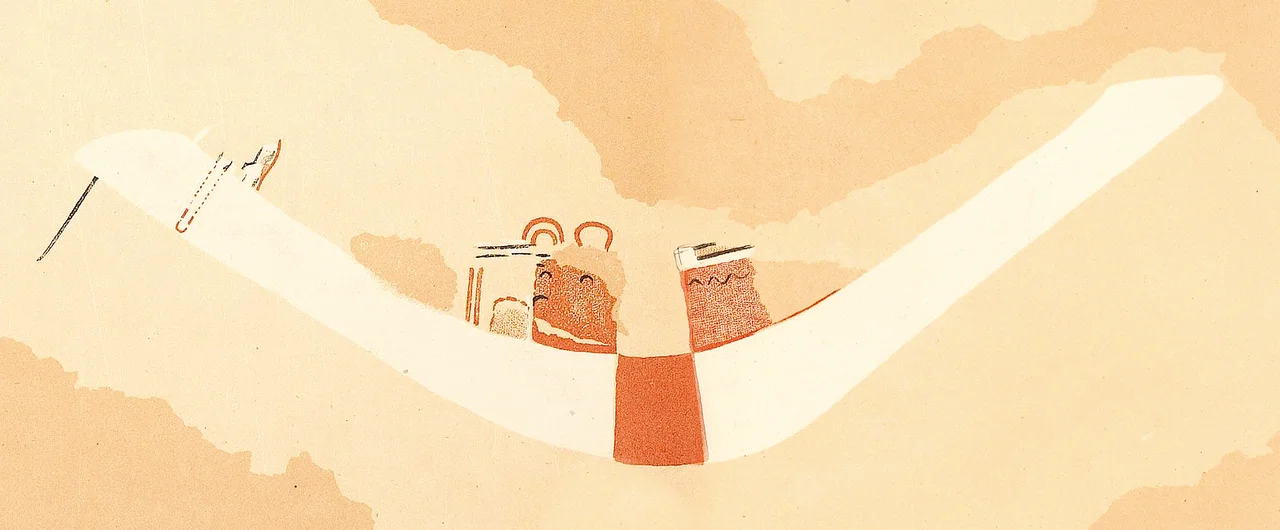
Among Nekhen's most remarkable finds is Tomb 100, the oldest known Egyptian tomb decorated with a painted mural - its plastered walls covered, around 3500 to 3200 BC, with images that would echo through Egyptian art for the next three thousand years. The scene shows a procession of boats, human figures, and animals: gazelles, ibexes, ostriches, and lionesses. Some elements seem to look beyond Egypt entirely. A motif of a hero standing between two beasts recalls the art of distant Mesopotamia, hinting that even at this early date, ideas and images traveled vast distances along trade routes connecting the Nile to the wider ancient world. These walls are, in a real sense, the first chapter of a tradition of tomb painting that would one day fill the Valley of the Kings.
The World's First Zoo
In 2009, excavators at Nekhen uncovered something no one expected: a menagerie dating to around 3500 BC, the oldest known animal collection in the world. The bones told an extraordinary story. Buried here were creatures kept by the town's early elite - hippopotami, crocodiles, a leopard, hartebeest, even elephants and baboons - exotic and dangerous animals gathered, fed, and displayed as symbols of power. Some bore healed fractures, evidence that they had been held captive and cared for over time rather than simply hunted. Five and a half thousand years ago, the rulers of this prehistoric city were already doing what rulers have done ever since: collecting wild beasts to advertise their command over the natural world.
Digging Up a Beginning
Nekhen has drawn archaeologists for well over a century, and the digging has not always been gentle. The first major excavators, James Quibell and Frederick Green, uncovered the Main Deposit in 1897–98 but recorded their work so carelessly that scholars still argue over exactly where the Narmer Palette was found. Later teams did better. A massive mud-brick enclosure on the site, long mislabeled a fort, turns out to be a ritual structure raised by King Khasekhemwy of the Second Dynasty, one of the oldest free-standing brick monuments anywhere. In recent decades an international expedition - led for years by the Egyptologist Renee Friedman - has worked to excavate, interpret, and shore up the crumbling remains. Slowly, patiently, they keep recovering the story of how a scattering of riverside villages became the first great civilization of the Nile.
From the Air
Hierakonpolis (ancient Nekhen) lies at 25.10 degrees N, 32.78 degrees E, on the west bank of the Nile, about 100 km south of Luxor and roughly 13 km north of Edfu. From altitude the site appears as low desert mounds and excavation areas just west of the narrow cultivated strip, set back from the river where the floodplain meets the dunes - subtle and easy to miss compared with the standing temples downstream. The most visible feature is the large rectangular mud-brick enclosure (the so-called fort) on the desert edge. Nearest airports are Luxor International (ICAO HELX) about 100 km north and Aswan International (HESN) about 90 km south. The hot-desert climate gives near-constant clear skies; the pale archaeological terrain shows best in low, raking morning or late-afternoon light from 2,000-4,000 ft AGL.
Nearby Stories
- Luxor 48 km away
- Elephantine 77 km away
- Temple of Seti I (Abydos) 106 km away
- Abydos, Egypt 133 km away
- Mersa Gawasis 152 km away
- Wadi El Gemal National Park 174 km away
- Qasr Ibrim 240 km away
- Berenice Troglodytica 245 km away