
High Speed 2
Somewhere under the Chiltern Hills, the longest railway tunnel in the United Kingdom is being completed. It is 9.8 miles long, twin-bored, with two tunnel-boring machines named Florence and Cecilia that started in summer 2021 and finished their drives in 2024. Above them, on the surface, are beech woods and chalk grassland that the trains will never disturb because the trains will be moving at 360 kilometres per hour fifty metres below. Florence and Cecilia weighed two thousand tonnes each. They moved fifteen metres per day. The dirt they extracted is being spread back onto the land they passed under, soil heaped over green cut-and-cover sections so that the route disappears into farmland once the work is done. High Speed 2 is the most expensive infrastructure project in British history. It will, when it opens sometime in the 2030s, connect London Euston to Birmingham Curzon Street in around forty-five minutes. Whether it will ever go further than that is, as of 2026, no longer planned.
The Plan, the Reality
When HS2 was announced by the Brown government in 2009, the plan was a Y-shaped network. The western arm would run from London through Birmingham to Manchester, with a connection to the West Coast Main Line for Glasgow. The eastern arm would run from London through Birmingham to a terminus in Leeds, via a parkway station near Toton between Nottingham and Derby, then continue north for upgraded services to Newcastle. The total budget when Parliament approved Phase 1 in 2017 was £55.7 billion. By 2021 it was over £100 billion. By July 2023 the Infrastructure and Projects Authority gave the project a red rating, meaning 'successful delivery appears to be unachievable.' On 4 October 2023, at the Conservative Party Conference, Prime Minister Rishi Sunak announced from the stage in Manchester - the city he was cancelling the line to - that Phase 2 would be abandoned. Only the London-to-Handsacre core, with the Birmingham branch, would proceed. The cancellation was symbolic in a way that left almost everyone uncomfortable.
Under the Chilterns
Britain doesn't have much room for new infrastructure, which is one reason high-speed rail came so late here. The HS2 route from London Euston runs north-west into a twin tunnel through inner London, surfaces at Old Oak Common station in West London, then dives into an eight-mile bored tunnel under Ruislip and the Colne Valley. It crosses the Colne Valley Regional Park on a 2.1-mile viaduct - the longest railway viaduct in the United Kingdom - then enters the Chiltern Tunnel near West Hyde. Inside, the line passes more than fifty metres below the chalk surface for nearly ten miles, emerging near South Heath, north-west of Amersham. From there it runs roughly parallel to the A413 and the London-to-Aylesbury railway, dipping through covered cuttings, viaducts, and green tunnels until it reaches the open Buckinghamshire countryside around Quainton. The route was designed to minimise visual impact in the Chilterns Area of Outstanding Natural Beauty - the longest tunnel anywhere in the project, drilled in the country's most expensive landscape to drill under.
Old Oak Common
The most consequential station on HS2 is one most travellers have not yet heard of. Old Oak Common, in a former rail freight site in west London north of Wormwood Scrubs, will be a massive interchange where HS2 meets the Elizabeth line, the Great Western Main Line, and the Heathrow Express. It is being built underground, sixteen platforms, fourteen of them dedicated to HS2 and Great Western services. When it opens around 2030, before the Euston tunnels are complete, it will function as HS2's initial London terminus. Passengers will alight here, transfer onto the Elizabeth line, and be in central London or Heathrow within a quarter-hour. The Euston connection is the politically difficult part - the original design was scrapped in 2023, and the planned eleven platforms reduced to six. The tunnel to Euston is being built. The station above it is, as of 2026, an exposed pit waiting for a decision.
What HS2 Is Really For
The strongest case for HS2 was never speed. London to Birmingham is already an hour and twenty minutes by existing Pendolino train. The case was capacity. The West Coast Main Line, which connects London with Birmingham, Manchester, Liverpool and Glasgow, is the busiest mixed-traffic railway in Europe. It carries inter-city express trains, regional commuter services, and freight, all on the same tracks. By the late 2010s it was at saturation - delays cascaded, freight could not get paths during the day, commuter services were squeezed. The original argument for HS2 was that taking express trains off the WCML and onto new dedicated track would free the existing lines for vastly more local and freight services. The benefits were always cumulative and indirect. Take away the northern branches and you take away most of the capacity argument. What remains is a fast line from London to Birmingham, useful but not transformative, the most expensive railway in British history.
Florence, Cecilia, and What Comes Next
The tunnel-boring machines are named after women - it's a railway tradition going back to the British engineers who dug the Channel Tunnel and named one of their machines after Adelaide. Florence was named for Florence Nightingale; Cecilia for Cecilia Payne-Gaposchkin, the astronomer who first proved the Sun is made mostly of hydrogen. They finished their drives in 2024. The Colne Valley Viaduct is largely built. The track-laying is underway across the green corridor of north Buckinghamshire. In March 2025 the new chief executive of HS2 Ltd, Mark Wild, wrote to the Transport Secretary that 'the organisation has failed in its mission to control costs and deliver to schedule.' The 2033 completion target was officially abandoned. The Birmingham-to-Handsacre section was deferred four years in October 2025. The trains will run, eventually, between London and Birmingham. When, exactly, no one will now say. There is something to be said for honesty about that. The country has stopped pretending it knows.
From the Air
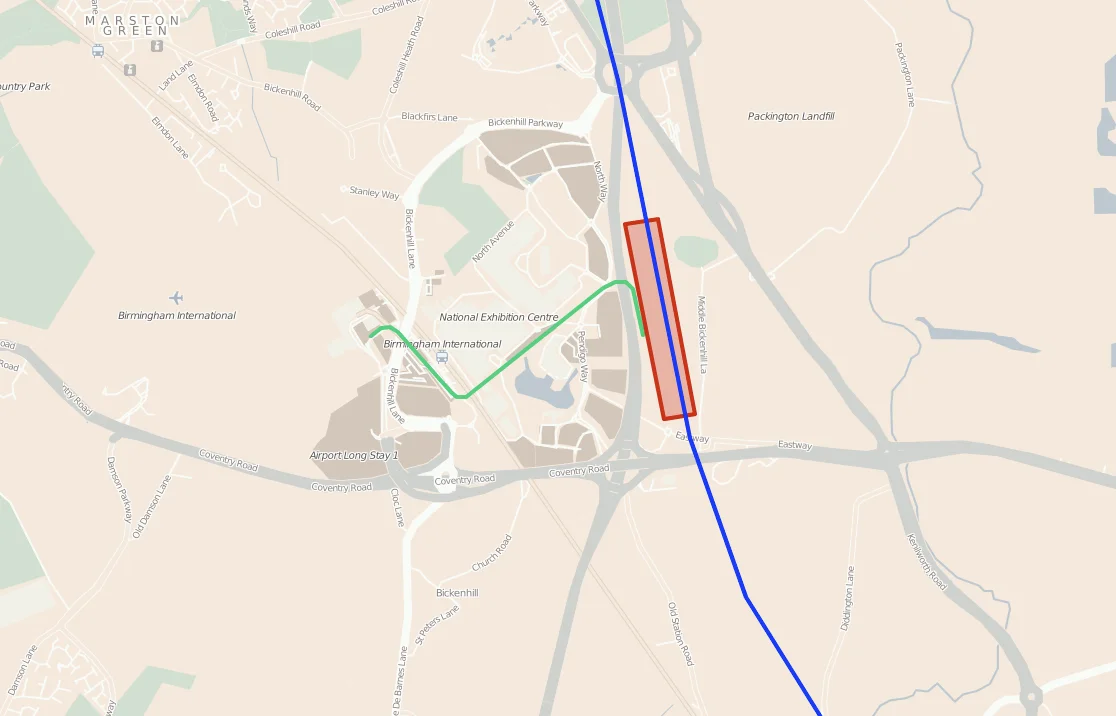
HS2 traverses south-east England from London Euston (51.53°N, 0.13°W) to Handsacre, Staffordshire (52.74°N, 1.86°W), a route of about 140 nautical miles. From altitude during construction, the project is visible as a long, narrow corridor of disturbed land snaking northwest from London. Most distinctive landmarks: the Colne Valley Viaduct (51.59°N, 0.49°W), a 3,400-metre concrete structure visible as a long, low arched line crossing the lakes and gravel pits of the Colne Valley; the Chiltern Tunnel southern portal near West Hyde; the northern portal near South Heath, west of Amersham; the Old Oak Common construction site in west London (51.53°N, 0.26°W), an enormous excavation pit. The route then traces a corridor through rural north Buckinghamshire, west of Aylesbury, across south Northamptonshire and Warwickshire. Birmingham Curzon Street terminal is at 52.48°N, 1.89°W. Birmingham Interchange station sits beside Birmingham Airport (EGBB) at Bickenhill. Nearest airports along the route: Booker / Wycombe Air Park (EGTB), Oxford (EGTK), Coventry (EGBE), Birmingham (EGBB). Recommended viewing altitude is 3,000 to 5,000 feet AGL outside the London TMA, with clearance required in controlled airspace around London and Birmingham.
Nearby Stories
- Woking Palace 2.7 km away
- Wanstead Roman Villa 3.9 km away
- River Lea 7.6 km away
- Waytemore Castle 11 km away
- Sevenoaks 14 km away
- Abingdon-on-Thames 18 km away
- Death of Harry Dunn 19 km away
- Highclere Castle 21 km away