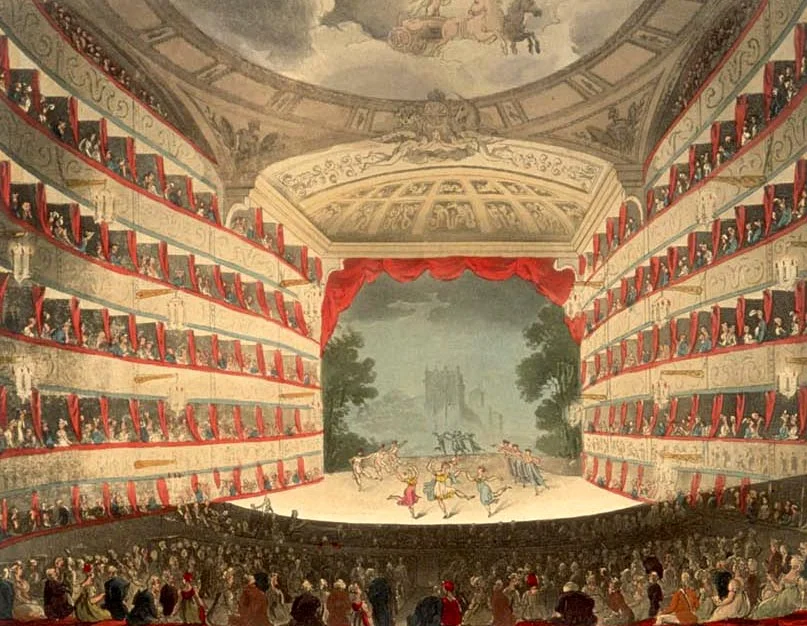

His Majesty's Theatre, London
On 24 February 1711, a young German composer named George Frideric Handel made his English debut at a theatre on the Haymarket with an opera called Rinaldo. The cast featured two of the greatest castrato singers of the era, Nicolo Grimaldi and Valentino Urbani. It was the first Italian opera composed specifically for the London stage, and it ran for fifteen performances, a remarkable run by the standards of the day. Handel returned to that same Haymarket theatre again and again, conducting more than twenty-five of his original operas over the next three decades. The theatre has stood on this site since 1705, though it has been rebuilt four times. Its name has changed with the gender of the monarch on the throne: Queen's Theatre under Anne, King's Theatre under the Georges, Her Majesty's Theatre under Victoria, His Majesty's Theatre under the kings, then Her Majesty's again under Elizabeth, and back to His Majesty's after the coronation of Charles III in 2023.
Vanbrugh's Folly
John Vanbrugh, the playwright and architect, opened the theatre in 1705 as the Queen's Theatre. He had hoped to build a centre for English opera and drama. The reality was less elegant. Congreve, his partner, departed early. As Vanbrugh became more involved in his enormous architectural commission for Blenheim Palace, his management of the Queen's Theatre grew, in one historian's words, increasingly chaotic, showing "numerous signs of confusion, inefficiency, missed opportunities, and bad judgement." By May 1707, Vanbrugh was facing mounting losses. He sold a fourteen-year lease to Owen Swiny and quit active management. In 1708, the authorities enforced a provision banning the theatre from staging plays without music. The actors moved to the Theatre Royal, Drury Lane, and the Queen's Theatre committed itself to Italian opera. The shift was reluctant but turned out to be the making of the venue. Some plays were licensed again in 1709, the acoustics were modified, but after that the theatre belonged to opera, sometimes called the Haymarket Opera House.
Handel and Heidegger
Owen Swiny eventually fled abroad to escape his creditors. John James Heidegger took over and from 1719 began extending the stage through arches into the houses south of the theatre. Under Heidegger's management, Handel conducted his great operas year after year through 1739, with Handel formally partnering in the management from 1729 to 1734. The composer wrote the incidental music for a 1710 revival of Ben Jonson's The Alchemist and provided much else besides. When George I came to the throne in 1714, the theatre was renamed the King's Theatre, a name it kept through every male monarch until Queen Victoria's accession in 1837. In 1762, Johann Christian Bach, the youngest son of Johann Sebastian, came to London and premiered three operas at the theatre. The first, Orione, opened on 19 February 1763, and the success established Bach's reputation in England. He went on to become music master to Queen Charlotte.
Sheridan, Mozart, and the Arcade
In 1778, the lease passed to Thomas Harris, manager of Covent Garden, and the playwright Richard Brinsley Sheridan, who together paid £22,000 and commissioned Robert Adam to remodel the interior. The theatre returned exclusively to opera in 1794. London's first performances of Mozart's La clemenza di Tito (1806), Cosi fan tutte and The Magic Flute (both 1811), and Don Giovanni (1816) all took place here. Between 1816 and 1818, the architect John Nash and George Repton altered the facade and increased the auditorium's capacity to 2,500. As part of the same works, they added a shopping arcade behind the theatre called the Royal Opera Arcade. That arcade has survived every fire and rebuild and still exists today, running along the rear of the present building.
Lind Mania
Pierre Francois Laporte took over management in 1828, introducing London to operas by Vincenzo Bellini and Gaetano Donizetti for the first time. Under his management, singers including Giulia Grisi, Pauline Viardot, Giovanni Battista Rubini, Luigi Lablache, and the tenor known simply as Mario made their London debuts. Then, in 1842, Benjamin Lumley took the reins. He commissioned Verdi's I masnadieri, which received its world premiere on 22 July 1847 with the Swedish soprano Jenny Lind in the role of Amalia. Lind's success at Her Majesty's was so extraordinary it became known as "Lind mania," with crowds gathering for the chance to hear her sing. Verdi himself conducted. Lind retired from opera entirely in 1849, just two years later, a blow Lumley never fully recovered from. In July 1850, the Cuban soprano Donna Maria Martinez appeared and was dubbed "the Black Malibran" by the press, with audiences described as "vehemently applauded and encouraged." Ballet flourished here in the same period under the master Jules Perrot, who staged Pas de Quatre in 1845 and worked with Fanny Cerrito, Carlotta Grisi, and Marie Taglioni.
Fire and Rebirth
On the night of 6 December 1867, the theatre was destroyed by fire, thought to have been caused by an overheated stove. Only the bare walls remained. Most of the adjacent shops in Pall Mall and the Clergy Club hotel in Charles Street, now Charles II Street, were also damaged. The new theatre that rose from the ashes was designed to be much less susceptible to fire, with brick firewalls, iron roof trusses, and Dennett's patent gypsum-cement floors. The building stood dark until 1874, then reopened to perform the London premiere of Bizet's Carmen on 22 June 1878. The Carl Rosa Opera Company played seasons here from 1879 to 1882. Sarah Bernhardt appeared in La dame aux camelias in 1886. By 1889, the theatre had even hosted a boxing tournament. The building closed in 1890. The third theatre had become outmoded, the Crown desired the entire block rebuilt, and in 1892 the theatre was demolished. The current fourth building rose in 1897, designed for opera but eventually finding its longest tenant: from 1986, Andrew Lloyd Webber's The Phantom of the Opera, one of the longest-running productions in West End history. Three centuries of singers, dancers, composers, and impresarios have stood on this same Haymarket corner. The crown changes. The opera continues.
From the Air
His Majesty's Theatre stands at 51.5081°N, 0.132°W on Haymarket in the heart of London's West End, just south of Piccadilly Circus. Best viewed from 1,500-2,500 feet AGL. Nearby airports include London City (EGLC) 7 nm east, London Heathrow (EGLL) 13 nm west, and London Biggin Hill (EGKB) 12 nm southeast. The theatre faces the curve of Haymarket; Trafalgar Square lies four blocks south, and the Theatre Royal Haymarket stands directly opposite.
Nearby Stories
- Stevenage 5.7 km away
- Malling Abbey 5.7 km away
- 1952 Farnborough Airshow Crash 7.7 km away
- Ingatestone Hall 8.2 km away
- Hellfire Caves 9.1 km away
- The Carrington Event: The Solar Storm That Could Happen Again 9.8 km away
- Bletchley Park 16 km away
- Castle Hedingham 23 km away