
HM Prison Dartmoor
Above the entrance, carved into the granite, are two Latin words from Virgil's Aeneid: Parcere Subiectis. Spare the vanquished. The prison was built in 1809 to hold men taken in a war they had already lost, and the inscription was meant to suggest a certain civilized restraint. For most of the next two centuries, that promise was kept only in pieces. The prisoners on the other side of those granite walls have included thousands of French sailors taken in the Napoleonic Wars, around 6,500 American seamen from the War of 1812, conscientious objectors during the First World War, and a long roll of British convicts. The walls themselves are now made famous by the rocks they were quarried from - the granite of Dartmoor leaks radon, and in 2024 the prison closed for mitigation works that may take years to complete.
Built for Napoleon's Sailors
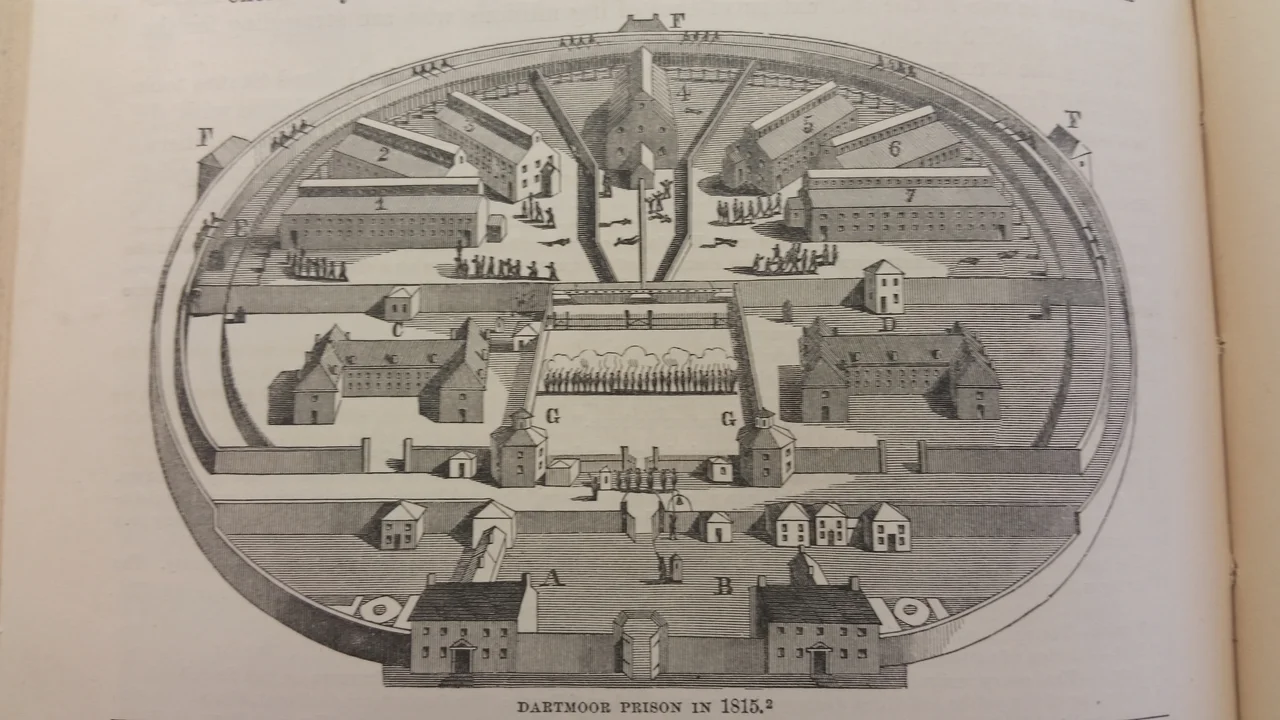
By 1805, the United Kingdom was deep into the Napoleonic Wars and overwhelmed by the prisoners those wars produced. Thousands of French captives were being held on derelict ships - prison hulks - moored in British harbors, including just off the Royal Naval dockyard at Devonport. The conditions on the hulks were appalling and the security was poor. A purpose-built prison far from any port seemed the answer. The site chosen was the high empty centre of Dartmoor, near a hamlet that would grow into Princetown. The architect Daniel Asher Alexander designed a circular layout, ringed by tall granite walls and manned by hundreds of armed militia sentries. Local labour began construction in 1806. Three years later the first French prisoners arrived. By the end of 1809 the prison was full.
American Sailors, 1813 to 1815
When the United States went to war with Britain in 1812, Dartmoor began receiving a second nationality of captives. Between the spring of 1813 and March 1815, about 6,500 American sailors passed through its gates - some taken in naval engagements, others impressed American seamen who had been serving on British ships and were now formally discharged. The food was bad and the roofs leaked. The British remained in nominal charge, but the prisoners organized their own internal life: courts, a marketplace, a theatre, a gambling room. About 1,000 of the Americans held at Dartmoor were Black. The historian Nicholas Guyatt, working through the prison's General Entry Book, identified 829 sailors of color registered by the end of October 1814 alone. They formed one of the largest documented free Black communities under British custody in this period.
The Massacre of 1815
The Treaty of Ghent was signed on 24 December 1814, ending the war. The American prisoners remained at Dartmoor anyway. The British government declined to release anyone until the United States Senate ratified the treaty, which it did on 17 February 1815. Then there were no ships waiting to take the men home. As the weeks dragged on into April, frustration boiled over. On 4 April a contractor tried to substitute damaged hardtack for soft bread and was forced to back down by the prisoners. Two days later, on 6 April, the commandant Captain T. G. Shortland - convinced incorrectly that the men were planning a breakout - ordered his troops to fire on a crowd in the prison yard. Seven Americans were killed and over thirty wounded. By the time the survivors finally sailed home that summer, at least 270 Americans and 1,200 French had died in the prison from disease, exposure, and the events of 6 April. The dead were buried in shallow graves on the moor. In about 1852 their remains were exhumed and reinterred in two cemeteries behind the prison, where they lie today.
Convicts and Conscientious Objectors
After the last French and American prisoners went home, Dartmoor stood empty for 35 years. In 1850 work began to rebuild it for British civilian convicts. The first arrived in 1851. For the next sixty years it was one of the toughest prisons in the country. Then in 1917, in the middle of the First World War, the criminals were moved out and the building was reopened as a Home Office Work Centre for conscientious objectors - men who had refused on grounds of conscience to fight, released here from harsher prisons elsewhere. The cells were left unlocked. Inmates wore their own clothes. They could walk into Princetown in their off-duty hours. The arrangement broke down in the autumn of 1917 after one prisoner attacked a popular guard with a razor blade, another was roughly handled while being taken to solitary, and fifty men refused orders at parade. The governor and his staff barricaded themselves in an unused part of the building while prisoners freed the men in solitary, damaged property, and were eventually fired on by a guard - one prisoner shot, no staff hurt.
Modern Years and the Radon
Dartmoor returned to civilian convict use and remained so through most of the 20th century. The 2001 Board of Visitors report condemned the sanitation. In 2002 the Prison Reform Trust warned the building might be in breach of the Human Rights Act 1998 because of overcrowding. The prison was redesignated Category C - non-violent offenders, white-collar prisoners, and a holding population convicted of sexual offences for whom Dartmoor offers no treatment programmes. The Ministry of Justice announced in 2015 that the lease would not be renewed; in 2019 a 2023 closing was announced; in 2021 that was reversed; in 2023 a new 25-year lease was signed with the Duchy of Cornwall, which owns the site and which a 2026 Public Accounts Committee report criticized the deal. The deeper problem is geology. The granite that makes the walls and the bedrock beneath the prison decay slowly into radon gas, and concentrations 14 times the legal limit have been measured inside. In 2023, 96 inmates were evacuated. In 2024 the prison closed for mitigation works, with no reopening date set. By 2025 around 500 former inmates and staff - many citing serious health problems including cancers - were preparing to sue the Ministry of Justice. The Dartmoor Prison Museum, set in the old dairy buildings, has stayed open through the closure.
From the Air
HMP Dartmoor sits at 50.550N, 3.996W in the village of Princetown, near the geographic centre of Dartmoor National Park at about 415m elevation. The Grade II listed prison and its surrounding walls are the dominant built feature on the high moor and read clearly from the air. Recommended viewing altitude 2,000-3,500 feet AGL. Nearest airport Exeter (EGTE) about 22nm east-northeast; Plymouth (EGHO) about 13nm south-southwest. Note the Dartmoor live-fire training areas to the north of Princetown - check NOTAMs before low-level operations. The high moor is notorious for rapid weather changes; visibility can collapse to under 1,000m within minutes.
Nearby Stories
- Bodmin Moor 4.1 km away
- South Devon Railway sea wall 4.8 km away
- Tiverton Castle 12 km away
- Hope Cove Lifeboat Station 14 km away
- Caerhays Castle 20 km away
- Holsworthy 22 km away
- HMS Formidable (1898) 32 km away
- HMS Montagu 41 km away