
HMS Agamemnon (1781)
Horatio Nelson commanded many ships, but he loved only one. HMS Agamemnon, a 64-gun ship of the line launched in 1781, was the vessel he called his favorite, the one he captained for three years and three months as a younger man making his name in the Mediterranean. Her own crew, unimpressed by the fashion for classical names, are said to have rechristened her with a nickname of their own. She fought from the American Revolution through Trafalgar, took on a Spanish four-decker and won, and outlived the admiral who adored her. And then, far from England, she ran out of luck in the brown waters off Uruguay, where her bones still lie beneath the estuary of the Río de la Plata.
Nelson's Favorite
Agamemnon was ordered in 1777 from the shipbuilder Henry Adams at Bucklers Hard, a small yard on the Beaulieu River, and built from oak felled in the surrounding New Forest. She cost just over £38,000 and was launched in April 1781. The future Lord Nelson took command in January 1793 and held it for more than three years, and the bond formed then never broke. Even as the ship aged into a leaky, repair-hungry burden that the navy nearly scrapped in 1802, Nelson's regard for her endured. She was, in the language of his biographers, simply his favorite, the deck where a rising officer had felt most himself.
A Hard Life Under Sail
Few ships were worked harder. Agamemnon helped capture French convoys in the Bay of Biscay, fought at the Battle of the Saintes in 1782, and carried Nelson's seamen ashore to take the Corsican town of Bastia after a 40-day siege. She chased the French at the Battle of Genoa and ran aground at the first Battle of Copenhagen in 1801, flying signals of distress as the battle roared past her stranded hull. Twice she nearly foundered on rocks off Cornwall, limping into port lashed to other vessels to keep from sinking. Her timbers were never sound for long. The navy patched her, refitted her, and sent her back out, because a fighting ship, even a tired one, was too valuable to waste.
Trafalgar
On 21 October 1805, Agamemnon took her place eighth in Nelson's weather column at the Battle of Trafalgar. In the smoke and thunder she came up against the Santísima Trinidad, the largest warship afloat, a Spanish four-decker that dwarfed her. Agamemnon poured fire into the giant until it was dismasted and broken. By the time the Spanish ship struck her colors, 216 of her crew were dead, a toll that measures the savagery of close-range gunnery between wooden walls. Agamemnon herself came through with just two men killed and eight wounded. Below decks on a nearby ship, Nelson lay dying. His favorite vessel had outfought one of the mightiest ships in the world, and survived to mourn him.
The End off Maldonado
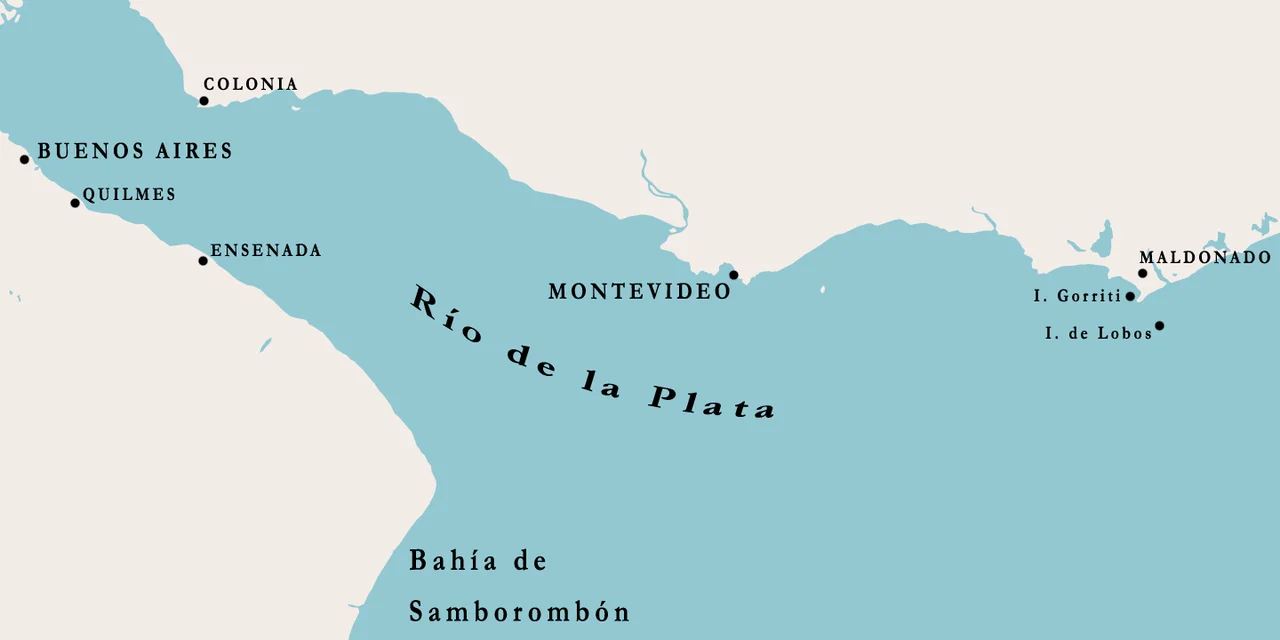
Agamemnon's last years carried her to South American waters off Brazil and the Río de la Plata. By 1809 she was worn out, her defects catalogued in detail by her own carpenter. In June, working between Gorriti Island and the shore near Maldonado, she struck an uncharted shoal. Captain Jonas Rose tried everything, hauling on anchors to drag her free, but her dropped anchor had pierced her own hull, and she would not move. On 17 June, listing hard to starboard, she was abandoned. Crucially, no one died. Every member of the crew and most of the ship's stores were taken off safely by boats from the squadron, and a court-martial honorably cleared Rose, blaming the ship's decrepit condition rather than the man. In 1993 a sonar operator named Crayton Fenn located her wreck north of Gorriti Island, and divers later recovered her artifacts, including one of her cannons and a seal bearing the name Nelson.
From the Air
The wreck of HMS Agamemnon lies at approximately 34.933 degrees south, 54.981 degrees west, in the shallows north of Gorriti Island off Maldonado and Punta del Este, within the estuary of the Río de la Plata. There is nothing to see on the surface, but the location is a navigational landmark of historical weight: small Gorriti Island and the Punta del Este peninsula frame the waters where Nelson's favorite ship met her end. The nearest airport is Capitán de Corbeta Carlos A. Curbelo International (ICAO: SULS) at Laguna del Sauce, roughly 20 km west. Montevideo's Carrasco International (ICAO: SUMU) lies about 110 km west. The estuary water reads brown against the Atlantic blue offshore, marking the threshold where river becomes sea.
Nearby Stories
- Laguna de Rocha 19 km away
- Minas 34 km away
- 2012 Air Class Líneas Aéreas Fairchild Swearingen Metroliner crash 37 km away
- La Paloma 40 km away
- Battle of Sarandí 141 km away
- Tronador (rocket) 154 km away
- Mundo Marino 204 km away
- South Georgia Island 2539 km away