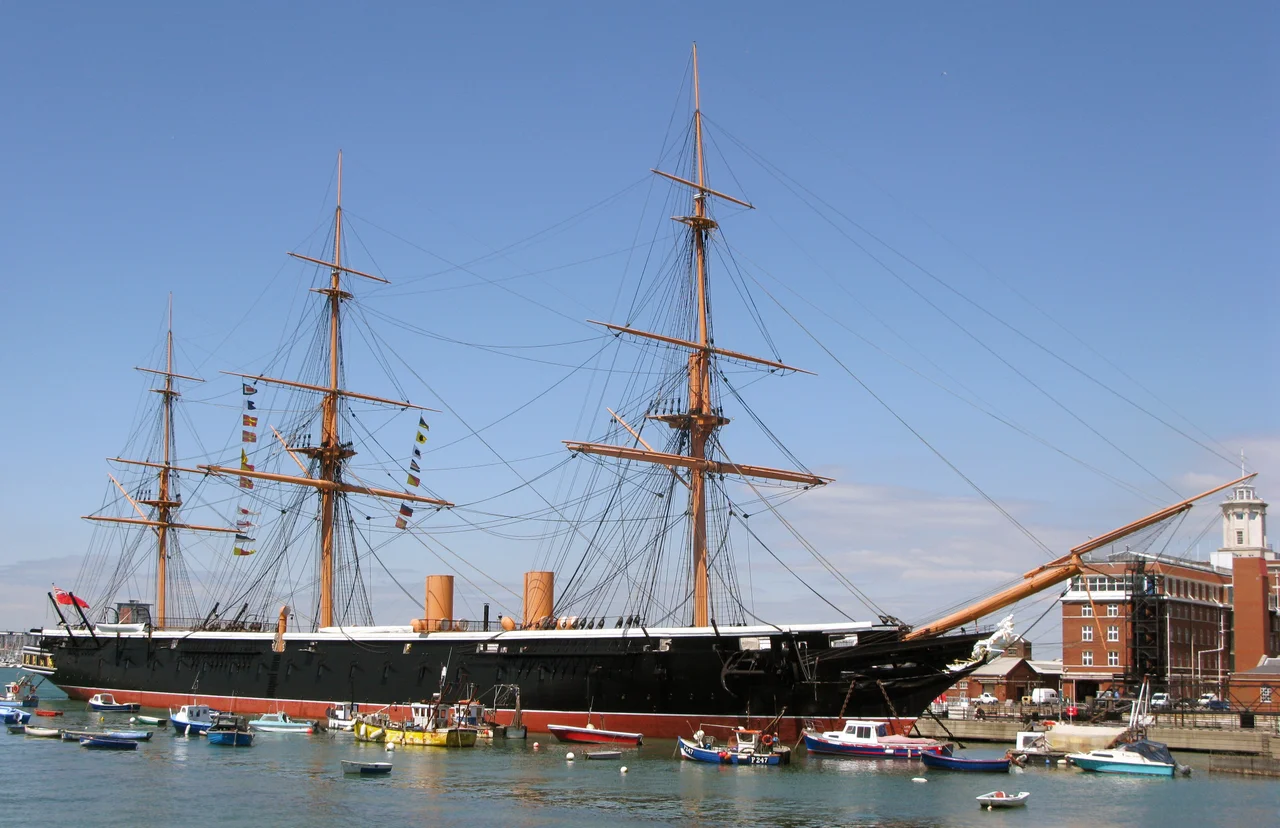

HMS Warrior (1860)
Queen Victoria herself wrote to the Admiralty to ask whether Britain was ready for war. The French had launched Gloire in 1859, an ocean-going wooden ship sheathed in iron, and overnight the Royal Navy's wooden fleet looked obsolete. The answer Britain gave was unprecedented in size, in cost, and in conception. She was christened Warrior, and she would be the longest, fastest, most heavily armoured warship in the world.
Built to Answer France
On 11 May 1859, the order went to the Thames Ironworks at Blackwall. The Chief Constructor Isaac Watts and Chief Engineer Thomas Lloyd designed her around a wrought-iron hull backed by teak, with a central armoured citadel protecting the guns. Construction nearly bankrupted the builders, who survived only because the Admiralty granted them fifty thousand pounds to continue. She was launched on 29 December 1860, during the coldest winter in fifty years, frozen so firmly to her slipway that hydraulic rams, extra tugs, and dockworkers running side to side on the upper deck were needed to rock her free. When she finally took the water, she had cost almost twice as much as a wooden ship of the line - and was completely obsolete the day she launched no other vessel in the world.
A Floating Citadel
Warrior carried forty guns behind plates of wrought iron hammered rather than rolled - an old technique applied to a new purpose. Tests at Shoeburyness in October 1861 declared her armour "practically invulnerable to the ordnance at the time in use." She combined steam and sail. Her two-cylinder trunk engine drove a hoisting propeller so massive that six hundred men were needed to crank it up into the hull when she ran under canvas alone. Under sail and steam together, racing from Portsmouth to Plymouth against the tide, she once made fourteen and a half knots. Her gunnery lieutenant in 1863, a young officer named Jacky Fisher, later wrote that contemporaries did not grasp what they were seeing: "It certainly was not appreciated that this, our first armourclad ship of war, would cause a fundamental change in what had been in vogue for something like a thousand years."
Life Between the Guns
Fifty officers and 656 ratings made her a small floating town. The men slept in hammocks slung between the guns, eighteen of them packed between each pair, while the captain enjoyed two spacious cabins at the stern. The crew raised the heaviest manually hauled anchors in maritime history, hand over hand. In March 1863, Warrior escorted the royal yacht bringing Princess Alexandra of Denmark to marry the future Edward VII. The princess sent word that she was "much pleased" with the crew, and Captain Cochrane had the message engraved on a brass plate fixed to the ship's wheel. Later that year, when the Channel Fleet toured British ports, three hundred thousand people came aboard, sometimes thirteen thousand in a single day.
Obsolescence Comes Quickly
The revolution Warrior began turned on her with brutal speed. Within ten years, mastless capital ships with rotating turrets made her broadside arrangement old-fashioned. In 1875 she was relegated to the reserve as a guardship at Portland. Reclassifications followed without alteration: screw battleship third class in 1887, first-class armoured cruiser in 1892. She was struck off in 1900. Then began a long humiliation. She became a depot ship for destroyers, then a torpedo-school hulk renamed Vernon III so her real name could go to a newer cruiser. In 1942, with another war on, she was renamed once more - Oil Fuel Hulk C77 - and spent the next decades at Llanion Cove in Pembrokeshire pumping diesel into 5,000 passing ships. The first ironclad was now a jetty.
Resurrection at Hartlepool
By the 1960s she was a rusting embarrassment. The Duke of Edinburgh chaired a 1968 meeting to consider her fate, and a year later the Maritime Trust was founded. In August 1979 the Royal Navy finally gave her up, and she was towed north to Hartlepool, where a nine-million-pound restoration would take eight years. Engines were replaced with steel replicas that turn slowly under electrical power. Original 68-pounder and 110-pounder guns were borrowed from the Woolwich Rotunda and the States of Jersey to serve as moulds for fibreglass copies. The figurehead, lost to rot in the 1960s, was carved anew on the Isle of Wight by Jack Whitehead and Norman Gaches; the work was so dramatic the BBC filmed its progress on Blue Peter. On 12 June 1987, Warrior left Hartlepool under tow and four days later entered Portsmouth Harbour, met by ninety boats and thousands of cheering spectators.
A Ship Worth Remembering
She has been berthed in the Portsmouth Historic Dockyard since 1987, alongside Nelson's HMS Victory and the Tudor Mary Rose. Half a million people pass through the dockyard each year. Patron of the trust that cared for her is Princess Alexandra of Kent, descendant of the Danish princess who once sent her thanks across the deck. In 2017 the National Museum of the Royal Navy took her into its fleet. Today couples marry in her wardroom and visitors duck between her cannon, but underneath the polish she remains what she was at launch: a calculated answer to a French provocation, the ship that ended a thousand years of wooden walls.
From the Air
HMS Warrior is berthed in Portsmouth Harbour at 50.798°N, 1.109°W, alongside HMS Victory and the Mary Rose in the Historic Dockyard. Best viewed from low altitude on approach to Southampton (EGHI) or Solent Airport (EGHF). Portsmouth and Gosport flank the harbour; the Spinnaker Tower is the obvious vertical landmark to the south.
Nearby Stories
- 1958 BOAC Bristol Britannia Crash 6.1 km away
- The Salisbury Museum 10 km away
- Hampshire 11 km away
- Amberley Museum & Heritage Centre 24 km away
- Charterhouse School 25 km away
- HMS Warrior (1917) 33 km away
- Operation Donnerkeil 74 km away
- D-Day: The Longest Day 138 km away