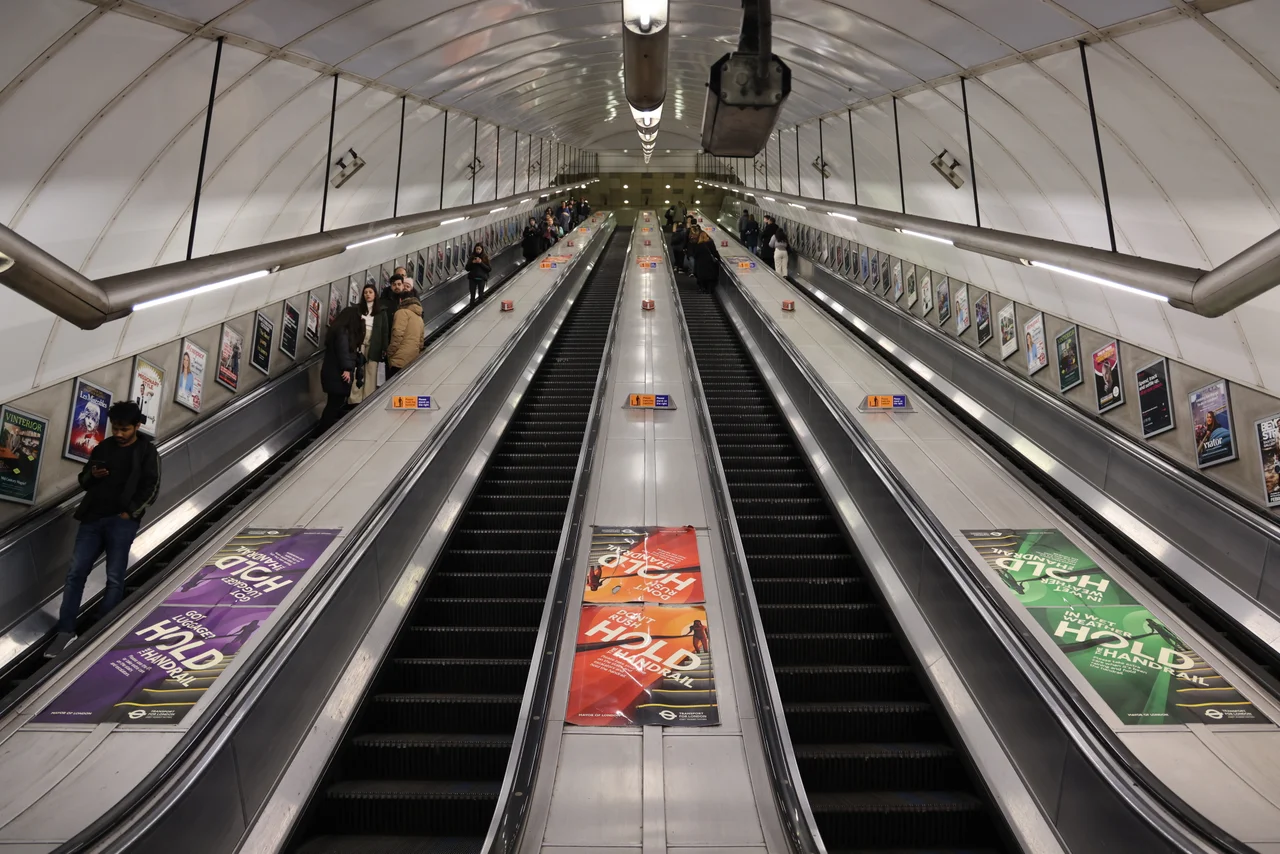

Holborn Tube Station
When the Blitz began in September 1940, London needed somewhere safe to store irreplaceable objects. The branch line tunnels beneath Holborn station, running to Aldwych, were closed to passengers and partly fitted out as an air-raid shelter. They were also used for another purpose: to store items from the British Museum a short walk away, including the Elgin Marbles. The ancient Greek sculptures, removed from the Parthenon in the early 19th century and the subject of diplomatic controversy ever since, spent the war years in a disused Underground tunnel beneath central London.
Junction of Two Railways
Holborn station opened in 1906, designed by architect Leslie Green, who typically used a distinctive ox-blood terracotta style for stations along the Great Northern, Piccadilly and Brompton Railway. Holborn was an exception: London County Council planning regulations required the facade to use Portland stone instead, making it unique among Green's stations. The station sits at the junction of two earlier railway schemes whose tunnels were merged here: the Great Northern and Strand Railway, with planned routes from the north, and the Brompton and Piccadilly Circus Railway from the south. The American entrepreneur Charles Yerkes — who had transformed Chicago's traction system — brought both companies under his control and forced their merger. The complex geometry of their connection at Holborn, where one southbound tunnel runs at a lower level to pass beneath branch tunnels, created a layout that still requires passengers to pass through a single intermediate concourse, which Transport for London identifies as a capacity bottleneck.
The Branch to Nowhere
The short branch from Holborn to Aldwych was always an oddity. Its annual ridership in 1929 was just over a million passengers, generating takings of £4,500. The branch was considered for closure in 1929 and again in 1933. It was temporarily closed on 22 September 1940 during the Blitz, reopened in 1946, reduced to peak hours only in 1958, and stripped of Saturday service in 1962. It finally closed on 30 September 1994. The original 1907 lifts at Aldwych required replacement at a cost of £3 million; only 450 passengers used the station each day, and it was losing £150,000 per year. Two platforms remain, closed to the public but accessible on London Transport Museum's Hidden London guided tours.
A Particle Physicist's Dream
Patrick Blackett, who won the Nobel Prize in Physics in 1948 for his development of the Wilson cloud chamber and its application to nuclear physics and cosmic radiation research, once developed plans to install a cosmic ray detector on an abandoned platform at Holborn station. The plans followed a falling-out with his mentor Lord Rutherford at Cambridge. They included an 11-ton magnet and a cloud chamber, and the London tabloid press responded to the proposal by calling Blackett a "new 'Sherlock Holmes', hunting beneath the streets of London for clues about the mysteries of the universe." The plans were never carried out. The platforms went unused for other purposes.
Underground Fame
The disused branch platforms at Holborn have served a more visible purpose as filming locations. Because they preserve a 1906 Underground station largely unchanged, they double convincingly as any generic London Underground platform in music videos and films. Howard Jones filmed "New Song" here; Leftfield used it for "Release the Pressure"; Suede for "Saturday Night"; Aqua for "Turn Back Time." The station's wartime history appears in Geoffrey Household's novel Rogue Male, in which enemy agents pursue the protagonist through Holborn's escalators, passageways, and shuttle service in the years before the Second World War. Today the station serves the Central and Piccadilly lines, sits in fare zone 1, and remains one of central London's busiest interchange points — even as the tunnels beneath it hold a history most passengers never see.
From the Air
Holborn station is at approximately 51.517°N, 0.120°W, at the junction of High Holborn and Kingsway in central London. The station entrance's ox-blood terracotta facade is a street-level landmark. The British Museum is a short walk to the north; Lincoln's Inn Fields lies to the southwest. Nearest airports: London City (EGLC, approximately 8nm east-southeast). At 2,000 feet AGL, the station sits within the dense urban core of central London; the green rectangle of Lincoln's Inn Fields is visible to the southwest.
Nearby Stories
- Stevenage 5.7 km away
- Malling Abbey 5.7 km away
- 1952 Farnborough Airshow Crash 7.7 km away
- Ingatestone Hall 8.2 km away
- Hellfire Caves 9.1 km away
- The Carrington Event: The Solar Storm That Could Happen Again 9.8 km away
- Bletchley Park 16 km away
- Castle Hedingham 23 km away