elevation.jpg)
Holy Trinity Church, Sunderland
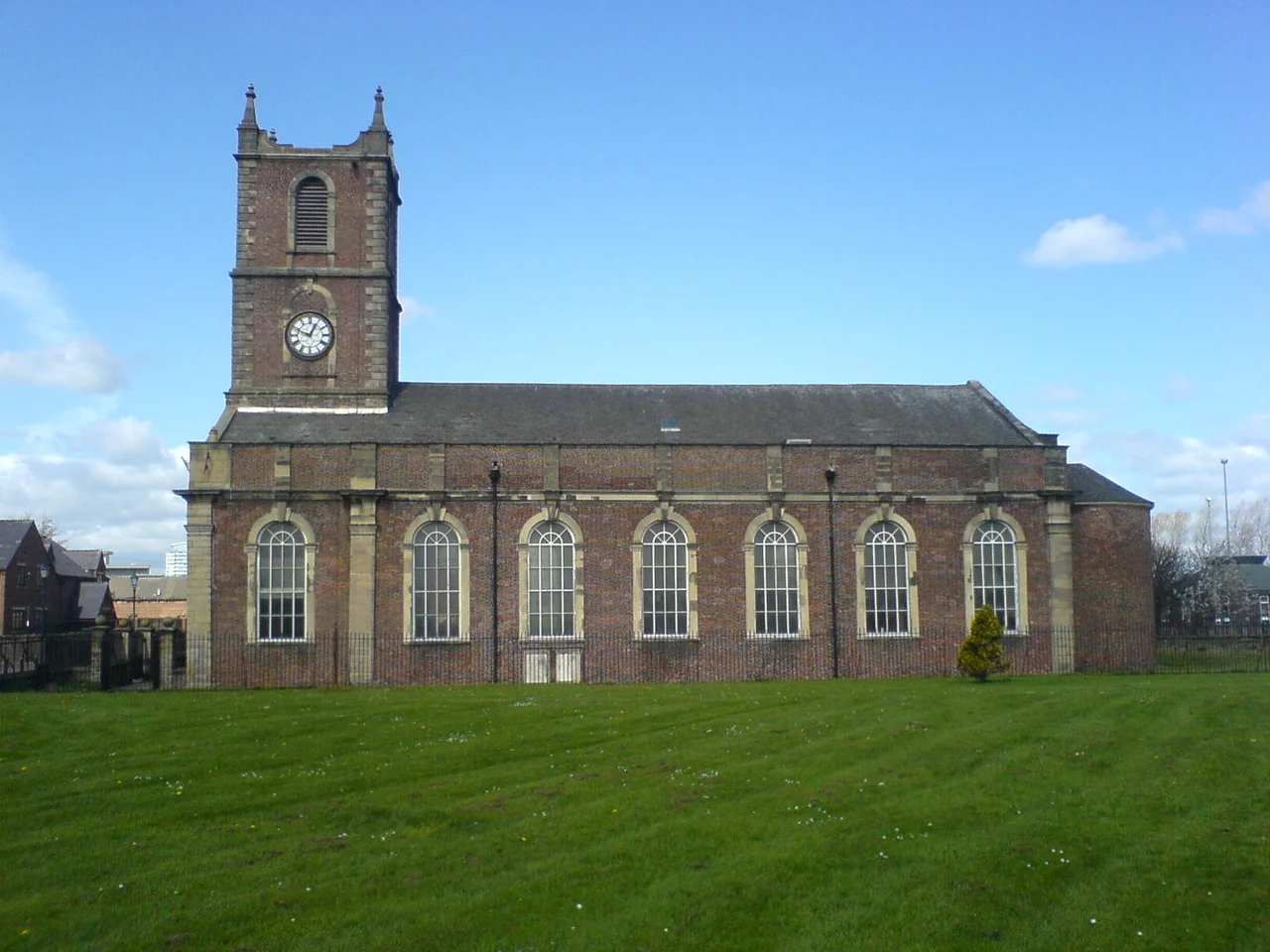
On 2 June 1719, Jonathan Chambers married Elizabeth Hutchinson in a freshly consecrated brick church on the south bank of the River Wear. Theirs is the first marriage recorded in the parish register of Holy Trinity, Sunderland. The building was less than a year old. Around it stretched a town whose entire future depended on what came in and out of the river: coal, ships, glass, salt, ideas. Three hundred and seven years later, the church no longer holds services. It hosts artists instead. The town outside is unrecognisable. The bricks are exactly where the Georgian masons set them.
The Rector Who Paid With His Own Money
Daniel Newcombe, rector of Holy Trinity in the 1730s, looked at his church and decided something was missing. The original 1719 plan had given the building no chancel - the eastern projection that traditionally holds the altar in an Anglican church. Newcombe had almost certainly helped design the building in the first place, and the omission may have nagged at him. In 1735 he commissioned an apse: large, nearly circular, fitted with a tall Venetian window. He paid for the work himself. That apse still anchors the eastern end of the building today, a piece of one man's quiet correction made permanent. A stained-glass Venetian window depicting the Ascension was added to the east face in 1857, manufactured by James Hartley's local glassworks - Sunderland glass for a Sunderland church, looking inland from the river that built both.
The Hero of Camperdown
Jack Crawford was born in Sunderland in 1775. At twenty-two, he was serving aboard HMS Venerable as the British North Sea Fleet engaged the Dutch off Camperdown in October 1797. Cannon fire smashed Venerable's main topmast and brought down Admiral Adam Duncan's command flag - the universal signal of surrender in age-of-sail combat. With the battle still raging, Crawford climbed the splintered remnants of the mast and nailed the flag back to the top. The British won. The phrase to nail one's colours to the mast entered the English language permanently afterward, drawn at least partly from what Jack Crawford did. Sunderland honoured him with a silver medal. London granted him a government pension of £30 a year. By the 1820s, the pension had not kept pace with prices and Crawford was destitute. He died of cholera on 10 November 1831 and was buried in an unmarked pauper's grave in Holy Trinity's churchyard. A headstone was erected in his honour in 1888. His memorial stands here still.
Donnison's Cottage, Donnison's School
Next to the church stands a small cottage that was once a school. Elizabeth Donnison left money in her will in 1764 to educate poor girls of Sunderland - reading, writing, sewing, the practical literacy that allowed daughters of dock workers and sailmakers to keep their own household accounts. Donnison School operated for over a century. It closed sometime between 1905 and 1910 and the cottage was given over to the church caretaker. In 1978 the building was Grade II listed, and in 2007 it reopened as the Donnison School Heritage and Education Centre. The girls' school is gone, but the building still teaches.
Seventeen Nineteen
Holy Trinity no longer holds regular services. The congregation that once filled its pews dissolved as the East End of Sunderland depopulated through the twentieth century. The Churches Conservation Trust now cares for the fabric. The building reopened in 2021 under the name Seventeen Nineteen - the year of that first recorded marriage - as a community venue and arts centre. Concerts happen in the nave. Weddings still take place beneath Newcombe's apse, just no longer as Church of England sacraments. The Georgian shell that stood at the centre of old Sunderland now stands at the centre of something newer - the city's attempt to reuse what it could not afford to demolish and would not bear to lose.
From the Air
Holy Trinity Church sits at 54.908 N, 1.369 W in Sunderland's East End, just south of the River Wear and a short walk from the South Docks. Cruise at 2,500-3,500 feet for orientation; the church's square tower and circular apse make it identifiable from the air, set apart from surrounding Victorian terraces. Newcastle International (EGNT) is 17 nautical miles north-north-west; Durham Tees Valley (EGNV) 23 nautical miles south. The Stadium of Light sits across the river to the north. The neighbourhood reads cleanest in late-afternoon light off the North Sea, when the brick warms and the river silver behind it.
Nearby Stories
- Seaton Carew 2.7 km away
- HMS Unity (N66) 6 km away
- George Stephenson's Birthplace 6.1 km away
- Raby Castle 9 km away
- Cragside 15 km away
- Whitby Abbey 21 km away
- German submarine U-2367 46 km away
- Alexander L. Kielland (Platform) 277 km away