
Horning
Horning means 'the folk who live on the high ground between the rivers' - and a thousand years ago that description was politics. In 1020, King Canute gave the manor to a newly founded abbey at St Benet at Hulme just downriver. The Bishop of Norwich, as Abbot of St Benet's, is still technically Lord of the Manor today. A village can be very old without being remote. Horning is both.
Canute's Gift
By 1020 the Danish king Canute had been on the English throne for four years. His grant of Horning to the new abbey at St Benet was the kind of administrative act medieval kings used to consolidate authority and reward loyalty. St Benet's Abbey itself dates back to the 9th century in its earliest form, and its ruins still stand at Thurne Mouth within Horning parish. Medieval finds at the abbey site include two papal seals - bullae that once secured letters from Rome to the East Anglian monastery. St Benet's was also where John of Oxnead composed his Chronicle in the 13th century, a record of national events from a Norfolk vantage point. The abbey was a place of pilgrimage. The village grew up alongside it.
The Domesday Census
Horning appears in the Domesday Book of 1086 as 'Horningam'. The Norman surveyors recorded 18 villagers, 11 smallholders, 4 cattle, 10 pigs, 360 sheep, and a taxable value of £4. The sheep tell the story - this was sheep country long before it was tourist country, and the wool clip drove the local economy through the late Middle Ages. Earthworks running alongside the River Bure may date from the early Saxon period. A Bronze Age ring ditch nearby has been identified as a possible burial pit. Neolithic and Bronze Age artefacts have surfaced repeatedly during local excavations. Layer beneath layer, Horning has been inhabited for longer than England has had a name.
The Ferry Inn, 1941
On 26 April 1941, a single German Luftwaffe aircraft dropped fifteen bombs on Horning and the surrounding area. Most fell harmlessly into the marshes. One hit the ferry. One hit the Ferry Inn. Inside, twenty-four people were drinking when the bomb came through the roof. Twenty-one of them were killed. The village had to absorb a loss that would shake a much larger town - in a single moment, a village of about a thousand people lost more than two percent of its population, almost all of them adults gathered in a pub on a Saturday evening. Three weeks later the Ferry Inn was open again, with a makeshift bar. The decision says something about Norfolk and about the war. Life resumed because the alternative was unthinkable.
Arthur Ransome's Village
Arthur Ransome wrote two of his Swallows and Amazons books - Coot Club and The Big Six - while staying in Horning. The village appears in both books, and the river settings he describes match the actual Bure with unsettling precision. Generations of children have grown up reading Ransome and meeting fictional versions of Horning's bridges, broads and reedbeds. The 1984 BBC television series Swallows and Amazons Forever! was based on the books. The 2015 film 45 Years was shot in Horning village and on the river itself. The veteran radio presenter Keith Skues lives in the village, with a personal record collection said to number around 300,000 discs. The Swan Inn pub building dates back to 1696, with the current early 19th-century structure built around the older bones.
Riverside Life
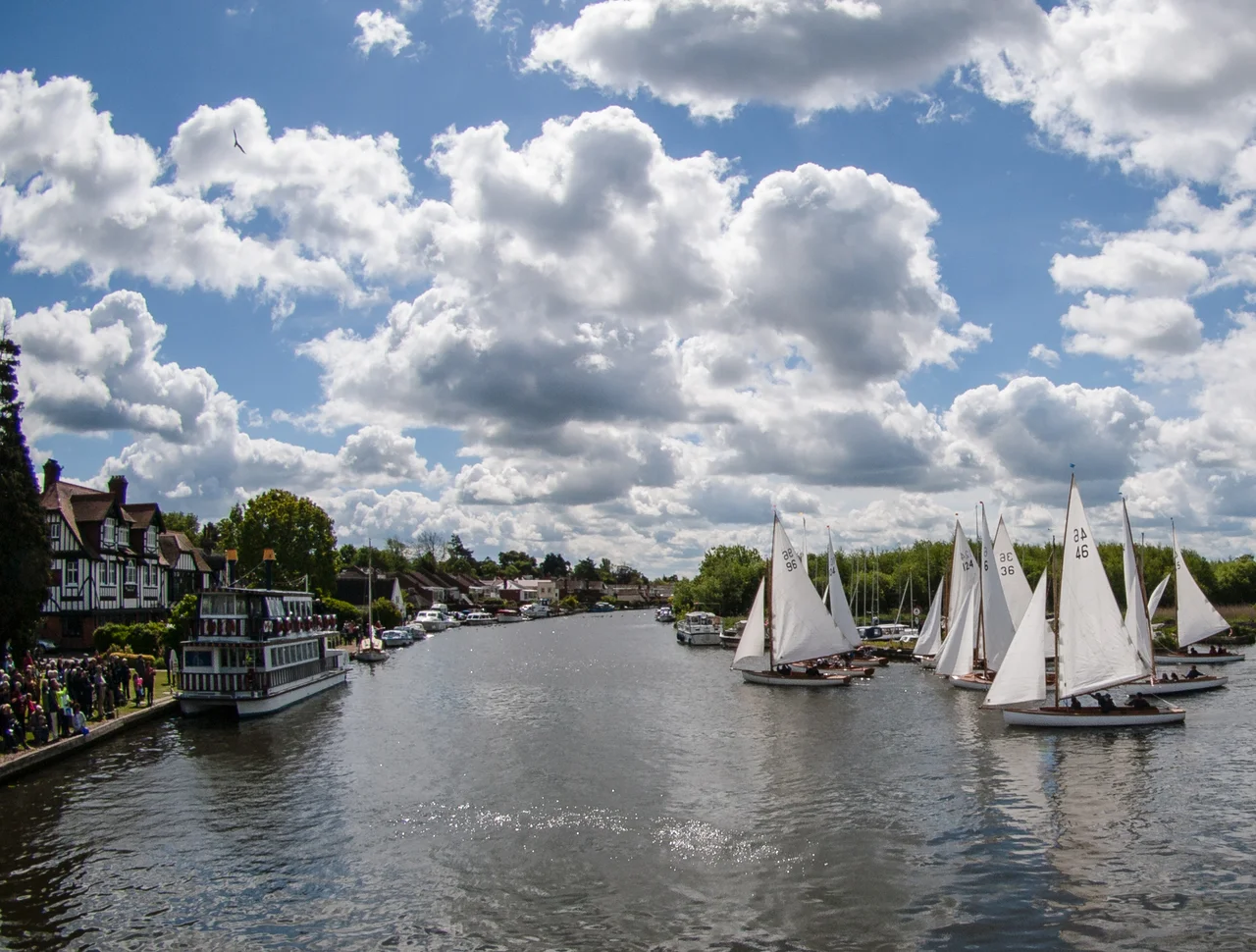
Horning sits on the north bank of the River Bure between Wroxham and Ludham, on a single long street that traces the riverside. Thatched roofs cluster around the village green; the Swan Inn anchors one end of Lower Street. A ferry has crossed the river here for more than a thousand years - the current Horning Foot Ferry runs on weekends, carrying passengers, cycles and dogs across to Woodbastwick Staithe. The village is a busy gateway to the Broads National Park: two marinas, several boatyards, a sailing club, a Mississippi-style cruise boat called Southern Comfort that leaves from the staithe beside the Swan. North of the village lies the Bewilderwood theme park, voted best large attraction in the East of England in 2009. From Horning the Bure runs navigable all the way to the North Sea at Great Yarmouth - the village remains, as it has always been, a place where the rivers meet the high ground and the people who live on it.
From the Air
Horning sits at 52.7 N, 1.467 E in the Norfolk Broads National Park, on the north bank of the River Bure between Wroxham and Ludham. From altitude the village strings along the riverside with thatched roofs visible among trees and boats on the water. The ruined St Benet's Abbey appears as a clearing with a windmill tower further downstream toward Thurne Mouth. Norwich Airport (EGSH) is 9 nm west, London Stansted (EGSS) about 73 nm southwest. Best viewed at 1,000-2,000 feet on routes across the Broads.
Nearby Stories
- Redgrave and Lopham Fens 2.7 km away
- Cley next the Sea 4.8 km away
- East Dereham Windmill 7.1 km away
- Dunwich 12 km away
- Cromer Lighthouse 18 km away
- Battle of Lowestoft 58 km away
- Southern Bight 62 km away
- SM U-97 90 km away