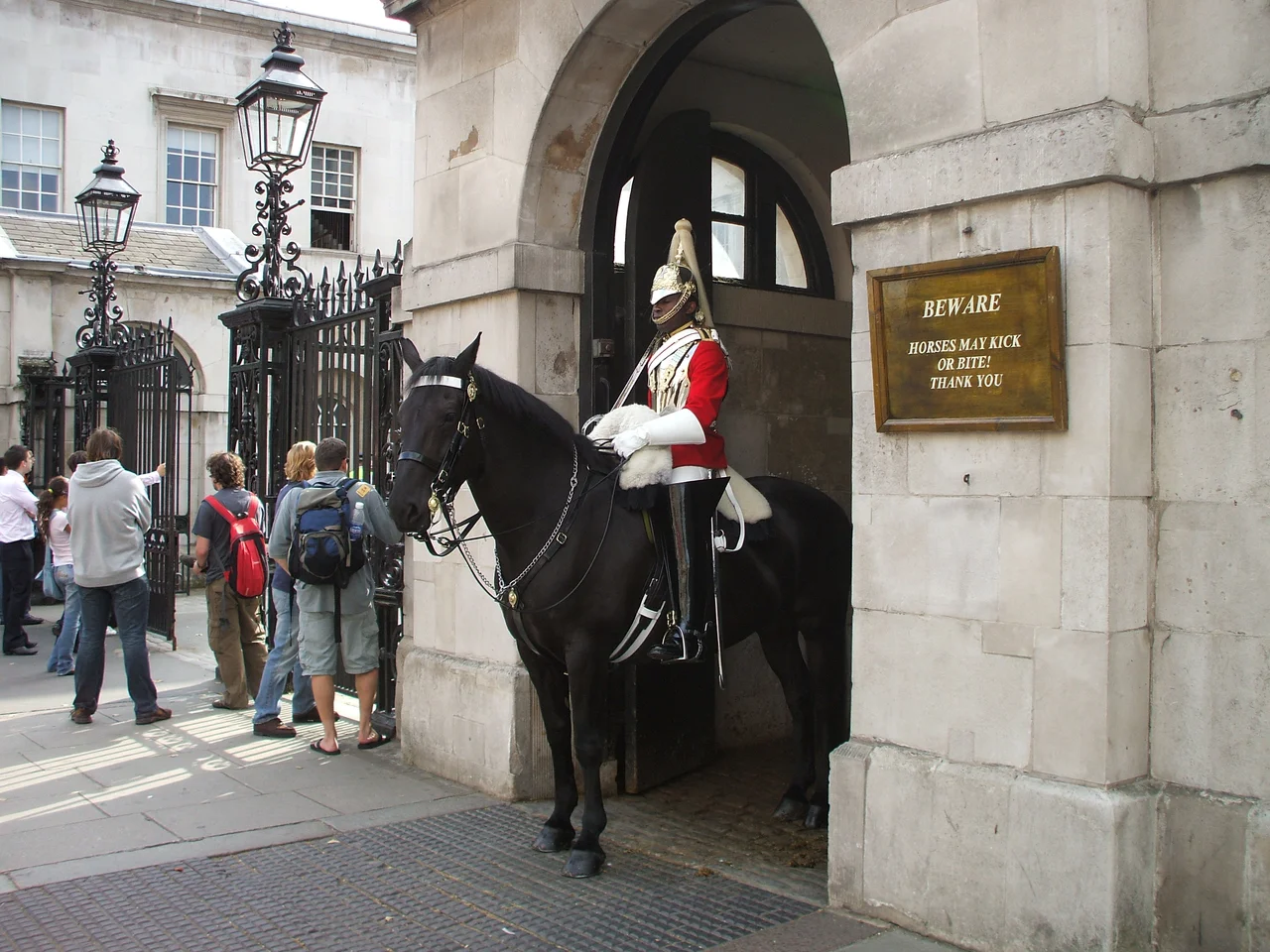

Horse Guards (building)
Queen Victoria was not amused. In 1894, she discovered that the Household Cavalry stationed at Horse Guards were spending their afternoons drinking and gambling rather than standing watch. Her response was characteristic: she ordered a four o'clock inspection every single day for the next hundred years. The punishment officially expired in 1994, but Queen Elizabeth II chose to continue it anyway, out of respect for tradition. At Horse Guards, tradition is not a relic — it is the point.
Three Centuries of Command
The building standing on Whitehall today replaced a smaller predecessor commissioned by King Charles II in 1663, itself built on the tiltyard of the old Palace of Whitehall. By the mid-18th century, that first building had become cramped and dangerous — falling masonry reportedly threatened the sentries posted beneath it. In 1745, King George II commissioned a replacement in the fashionable Palladian style, designed by architect William Kent. Kent died before construction was finished, but his vision survived him. The new building opened gradually from 1755 and cost £65,000, roughly sixteen times the price of its predecessor. For more than a century afterward, the phrase 'Horse Guards' served as common shorthand for the British Army's high command — the way 'Pentagon' or 'Whitehall' still function today. Wellington served here twice as Commander-in-Chief, in 1827–28 and again from 1842 until his death in 1852. On the night before his state funeral, his coffin rested in the room that had been his office — a space originally designed for courts-martial.
A Clock That Keeps History
The clock set into the turret above the central arch has two faces, one looking toward Whitehall, the other toward Horse Guards Parade. Each dial measures seven feet across. The current mechanism dates from 1815–16, rebuilt by Benjamin Lewis Vulliamy, clockmaker to King George III, though the original was installed in 1756. Before Big Ben's clock was completed in 1859, this was the principal public timepiece for the whole of Westminster. Look closely at the Roman numeral II on the Whitehall face and you'll notice a dark stain above it — said to mark the time at which King Charles I was executed in 1649, in the roadway outside. Whether or not the stain is what legend claims, the story has been repeated for so long it has become part of the building's identity. Every year, the Trooping the Colour ceremony begins precisely when this clock strikes eleven.
The Living Garrison
Horse Guards remains an active military installation, not a preserved relic. Each morning, the mounted King's Life Guard rides from Hyde Park Barracks in Knightsbridge — down Constitution Hill, along The Mall — to arrive at the arch for the changing of the guard at 11 a.m. The Life Guards wear red tunics with white plumed helmets; the Blues and Royals wear blue with red plumes. When the sovereign is in London, the escort is larger: one officer and twelve other ranks, a Long Guard. When the monarch is away, a Short Guard of two NCOs and ten troopers suffices. Two mounted sentries stand at the Whitehall entrance from 10 a.m. to 4 p.m., changed every hour. Inside, through a glazed partition, visitors to the Household Cavalry Museum can watch the working stables — a window onto military life that has continued largely unchanged since the 18th century. The exhibits include ceremonial uniforms, royal standards, and silverware by Fabergé.
The Arch Between Worlds
Horse Guards also functions as something more understated than its military purpose: a gateway between two very different versions of London. Walk through the central arch and you move from the formal stone canyon of Whitehall — government buildings, black cars, the weight of official life — into the green openness of St James's Park. The transition is immediate and striking. Entry through this arch once required an ivory pass issued by the court; today only the sovereign may drive through without permission. Plastic passes have replaced ivory, but the right of passage remains. The Household Cavalry Museum, occupying part of the building, gives civilians their best legitimate reason to linger — though the building's architecture alone, with its Ionic colonnades and clock-tower centerpiece, repays attention. This is Palladian restraint applied to imperial purpose, and it wears that combination with practiced ease.
From the Air
Horse Guards is located at 51.5047°N, 0.1272°W in central Westminster, between Whitehall and St James's Park. From the air, look for the distinctive Palladian courtyard opening onto the broad parade ground to the west, with the green of St James's Park beyond. The building sits just north of Downing Street and south of Trafalgar Square. Nearest airport is London City (LCY), approximately 12km to the east. Best viewed at 1,000–2,000 feet in clear conditions.
Nearby Stories
- Stevenage 5.7 km away
- Malling Abbey 5.7 km away
- 1952 Farnborough Airshow Crash 7.7 km away
- Ingatestone Hall 8.2 km away
- Hellfire Caves 9.1 km away
- The Carrington Event: The Solar Storm That Could Happen Again 9.8 km away
- Bletchley Park 16 km away
- Castle Hedingham 23 km away