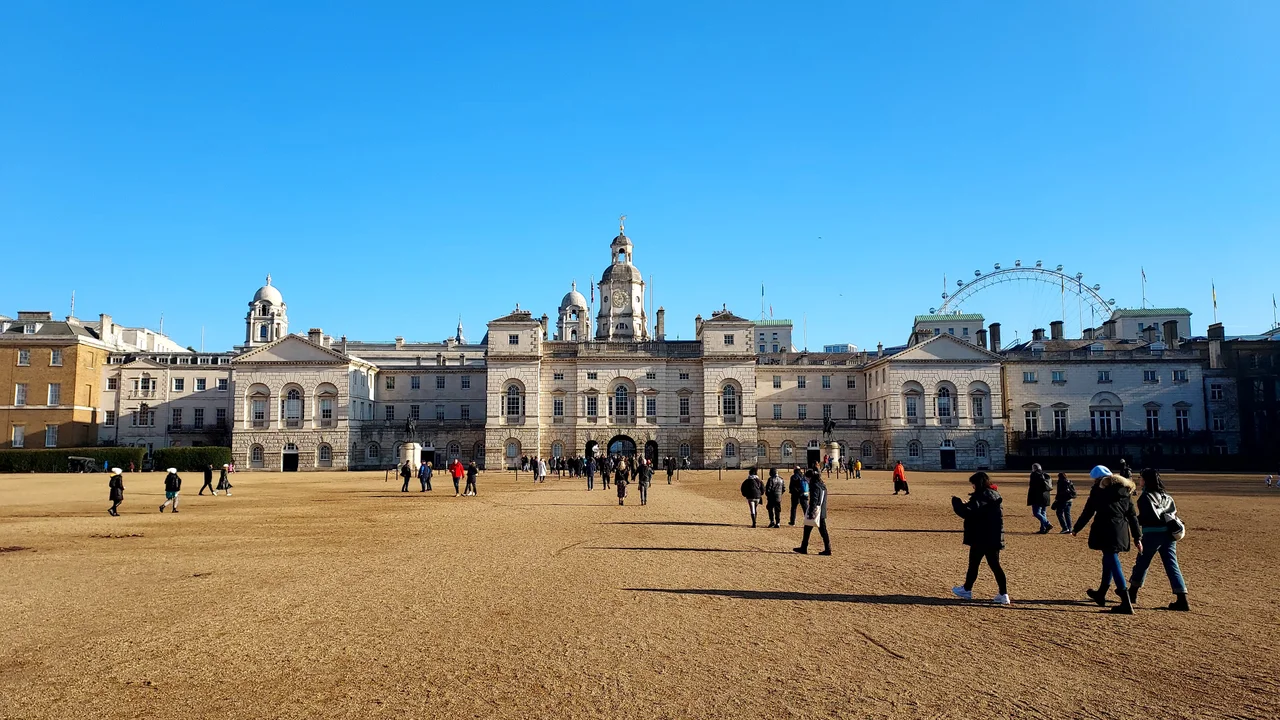

Horse Guards Parade
For much of the late 20th century, one of Britain's most historic open spaces was quietly used as a car park. About 500 senior civil servants held permits to park at Horse Guards Parade, a privilege known as the 'Great Perk.' They parked on ground where Henry VIII had once watched jousting tournaments, where Elizabeth I had celebrated birthdays, where Wellington had commanded an empire. The IRA's mortar attack on Downing Street in 1991, launched from a vehicle in nearby Horse Guards Avenue, finally prompted serious scrutiny of the arrangement. By the mid-1990s, public pressure had ended the practice. The parade ground was returned to its proper purpose.
From Tiltyard to Parade Ground
The broad rectangular space behind Whitehall has been used for public spectacle since the days of the Palace of Whitehall, when it served as the tiltyard — a court for tournaments including jousting — during the reign of Henry VIII. Later, Queen Elizabeth I held birthday celebrations here. After the Palace burned in 1698 and the court moved away, the area became a parade and ceremonial ground, a function it has maintained ever since. Enclosed to the north by the Admiralty buildings, to the east by Horse Guards itself and Dover House, and to the south by the Cabinet Office and the garden walls of 10 Downing Street, the parade ground occupies a slot of London where government, military, and monarchy converge. The west side opens freely onto Horse Guards Road and St James's Park beyond — a deliberate connection between the formal and the pastoral.
The Ring of Memory
Walk the perimeter of the parade ground and you move through centuries of British military history. To the west, beside St James's Park, the Guards Memorial by sculptor Gilbert Ledward commemorates those who died at the First Battle of Ypres and other First World War engagements. To the north stands the Royal Naval Division War Memorial, designed by Edwin Lutyens in 1925, removed before the Second World War and rededicated in 2003. On the east side, equestrian statues of Field Marshals Roberts and Wolseley rise above the ground. Among the trophies collected along the east wall is a Turkish cannon cast in 1524 — inscribed 'by Murad son of Abdullah, chief gunner' — captured in Egypt in 1801. The Cádiz Memorial nearby, a French mortar mounted on a brass cast monster, marks the lifting of the Siege of Cádiz in 1812. To the south, statues of Field Marshal Kitchener and Admiral Mountbatten complete the martial survey.
Trooping the Colour
Each June, Horse Guards Parade is transformed by the Trooping the Colour ceremony, which has marked the sovereign's official birthday since the 18th century. Around 1,400 soldiers take part. In the weeks before the main event, two dress rehearsals are held — the Major General's Review and the Colonel's Review — each with its own hierarchy of salutes and ceremonies. On the day itself, grandstands fill with ticket-holders who secured seats through ballot. The regimental colour of one of the five Guards regiments is 'trooped' — marched along the assembled ranks — before the foot and horse guards march past the monarch. The ceremony begins when the Horse Guards clock strikes eleven. When it ends, the Household Cavalry escorts the Royal Family back along The Mall to Buckingham Palace. The crowd that gathers to watch the troops march in and out pays nothing; for this part, the street belongs to everyone.
An Unlikely Olympic Venue
In the summer of 2012, something unexpected arrived at Horse Guards Parade: beach volleyball. For the London Olympics, temporary courts and seating designed by the firm Populous were installed, creating a venue with a capacity of 15,000 — two tiers deep, with floodlight towers at each corner. Six additional practice courts were laid out in St James's Park next door. The incongruity was part of the appeal. Players dove for balls in the shadow of Admiralty buildings and memorial statues, with the Horse Guards clock visible from courtside. Most matches were played on the central court; some were played on a second court on day six of the competition. The venue was dismantled after the Games, leaving no permanent trace — though photographs of volleyball players set against the Palladian backdrop of Horse Guards became some of the more memorable images of those Olympics.
From the Air
Horse Guards Parade is located at 51.5047°N, 0.1283°W in central Westminster, immediately west of the Horse Guards building. From the air, it appears as a large open rectangle between Whitehall and St James's Park, clearly visible against the surrounding density of government buildings. Look for the green of the park to the west and the distinctive courtyard of Horse Guards to the east. Nearest airports are London City (LCY) 12km east and Heathrow (LHR) 24km west. Best viewed at 1,000–2,000 feet.
Nearby Stories
- Stevenage 5.7 km away
- Malling Abbey 5.7 km away
- 1952 Farnborough Airshow Crash 7.7 km away
- Ingatestone Hall 8.2 km away
- Hellfire Caves 9.1 km away
- The Carrington Event: The Solar Storm That Could Happen Again 9.8 km away
- Bletchley Park 16 km away
- Castle Hedingham 23 km away