.jpg)
Hotel de Inmigrantes
Five days. That was the time a new arrival was allowed to stay here for free, fed and sheltered while the country decided where they would go and what they would become. For more than a million people between 1911 and 1953, the Hotel de Inmigrantes was the threshold between an old life left behind in Europe and an unwritten one waiting somewhere in Argentina. They stepped off ships onto the docks of Buenos Aires carrying suitcases, children, and a few words of a language they did not yet speak, and they walked through these doors.
Born of Fear and Hope
The hotel rose from a paradox. Argentina wanted immigrants desperately, courting Europeans to fill its empty pampas and growing cities. But cholera had ridden the migrant ships before, the 1860s and 1870s epidemics arriving with the newcomers, and the state was terrified of disease crossing its borders. So between 1905 and 1911 the government built a complex on the port that was part welcome center, part medical quarantine, part bureaucratic machine. The Hungarian architect Juan Kronfuss gave it the scale of a citadel, and it was among the first structures in Buenos Aires raised in reinforced concrete. The planners deliberately refused to call it an asylum, fearing the word's association with beggars and the poor. They wanted arrivals to feel they were entering the promise of a new world, not a poorhouse.
Three Thousand Strangers
At full capacity the hotel held three thousand people at once, and in its busiest years the rooms never emptied. Families slept in dormitories segregated by sex, ate in enormous dining halls, and waited. Doctors examined them. Officials recorded their names, ages, trades, and the villages they had fled. Between 1881 and 1914 alone, more than four million immigrants reached Argentina, among them two million Italians and 1.4 million Spaniards, alongside Jews from the Russian Empire, Syrians and Lebanese, Poles, Germans, and Armenians. Most spent only a handful of nights here before scattering across the country to harvest wheat, lay rail, sew clothes, and raise children who would call themselves Argentine. The hotel was a place of profound disorientation and equally profound possibility, and the people who passed through it were neither statistics nor a faceless tide. They were the grandparents of a nation.
A Building That Remembers
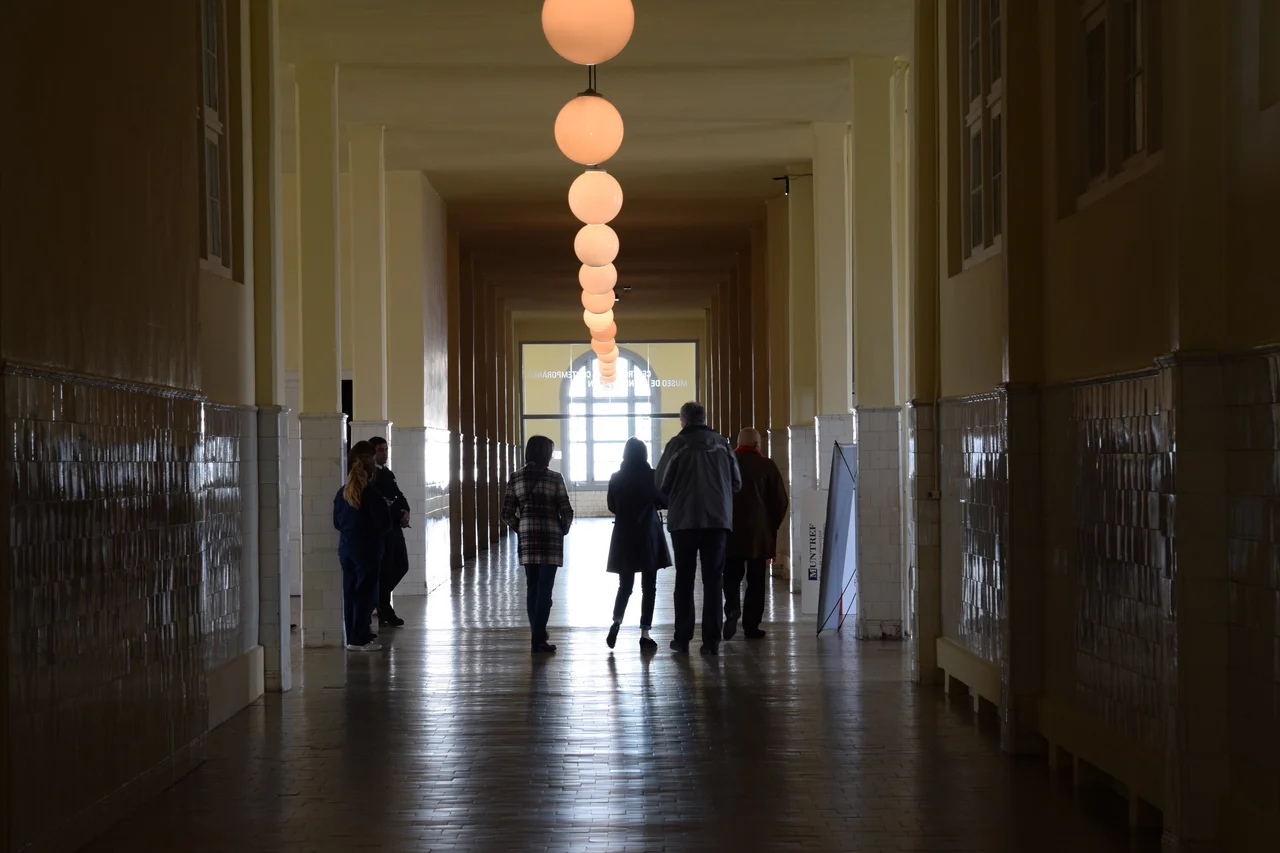
When the great waves of immigration receded, the hotel fell silent and eventually closed. Rather than demolish it, Argentina turned the building over to memory. Today it houses the National Museum of Immigration, free to enter, with permanent exhibits like "Italians and Spaniards in Argentina" and the pointedly named "For All the Men of the World." The National University of Tres de Febrero runs a contemporary art center in the same halls, its rotating exhibitions often circling back to migration as a living theme. Most movingly, the museum is digitizing roughly five million immigration records spanning 1882 to 1960. For descendants across the Americas, a name typed into a database can resolve into an ancestor, a ship, a date, a moment when a family's entire future hinged on walking through these doors.
The Edge of the Water
Stand at the hotel today and the geography still tells the story. It sits at the lip of the Río de la Plata, the immense brown estuary that immigrants crossed at the end of voyages lasting weeks. The river is so wide here that the far shore vanishes, and arrivals often mistook it for open sea. The first thing a new Argentine saw was this water, the docks, and the brick mass of the hostel waiting to receive them. Everything that followed, in Buenos Aires and beyond, began at this seam between the river and the land.
From the Air
The Hotel de Inmigrantes sits on the Buenos Aires waterfront at 34.585°S, 58.373°W, on the edge of the Río de la Plata in the Retiro port district, just north of Puerto Madero's restored docklands. From the air it reads as a long rectangular brick complex hard against the river's edge, with the vast tea-colored expanse of the estuary stretching east toward Uruguay until the far bank disappears. Best appreciated at lower altitudes (1,500-3,000 ft) in the clear, dry air of an autumn morning. Aeroparque Jorge Newbery (ICAO: SABE), Argentina's busy domestic hub, lies barely 3 km north along the same shoreline; the international gateway Ministro Pistarini at Ezeiza (ICAO: SAEZ) is about 30 km to the southwest. Approaching from the river offers the immigrant's own vantage, the city rising from the water exactly as four million newcomers first saw it.
Nearby Stories
- Ezeiza Massacre 1.9 km away
- Luján, Buenos Aires 5.1 km away
- Curutchet House 13 km away
- Colonia del Sacramento 17 km away
- Martín García Island 28 km away
- Atucha Nuclear Power Plant 37 km away
- Lobos 43 km away
- Cry of Asencio 87 km away