
Howden
In 1080, William the Conqueror gave Howden away. The recipient was the Bishop of Durham, who promptly conferred the church on the monks of Durham but kept the manor for himself. The arrangement stuck so firmly that the wapentake of Howdenshire remained an exclave of County Durham - an enclave of one diocese surrounded by another - until 1846. The name itself is older still. It comes from the Old English heafoddenu, "head valley," though the country here is so flat you have to squint to find a valley at all. The town has always been an island of consequence in level country: a royal manor, a minster town, a horse-fair capital, an airship factory, and now, improbably, the operational centre of the Press Association.
Royal Connections
The town's royal connections stretch back further than the Conquest. King Edgar gave the manor of Howden to his first wife Ethelfleda in 959. In 1191 the future King John spent Christmas at Howden; nine years later, now crowned, he granted the town its annual fair. That fair grew, over the centuries, into one of the largest horse markets in Britain. At its height it attracted dealers from across the United Kingdom; estimates suggest up to 4,000 horses were displayed for sale each day, total sales value reaching 200,000 pounds. The fair eventually died, but its memory shapes the town centre still - Hailgate, Bridgegate, and the broad market place where the dealing was done. A more recent royal connection: Prince Charles opened the Press Association's new Operations Centre on Bridgegate in 2003, on the site of the old Georgian police station.
The Minster's Town
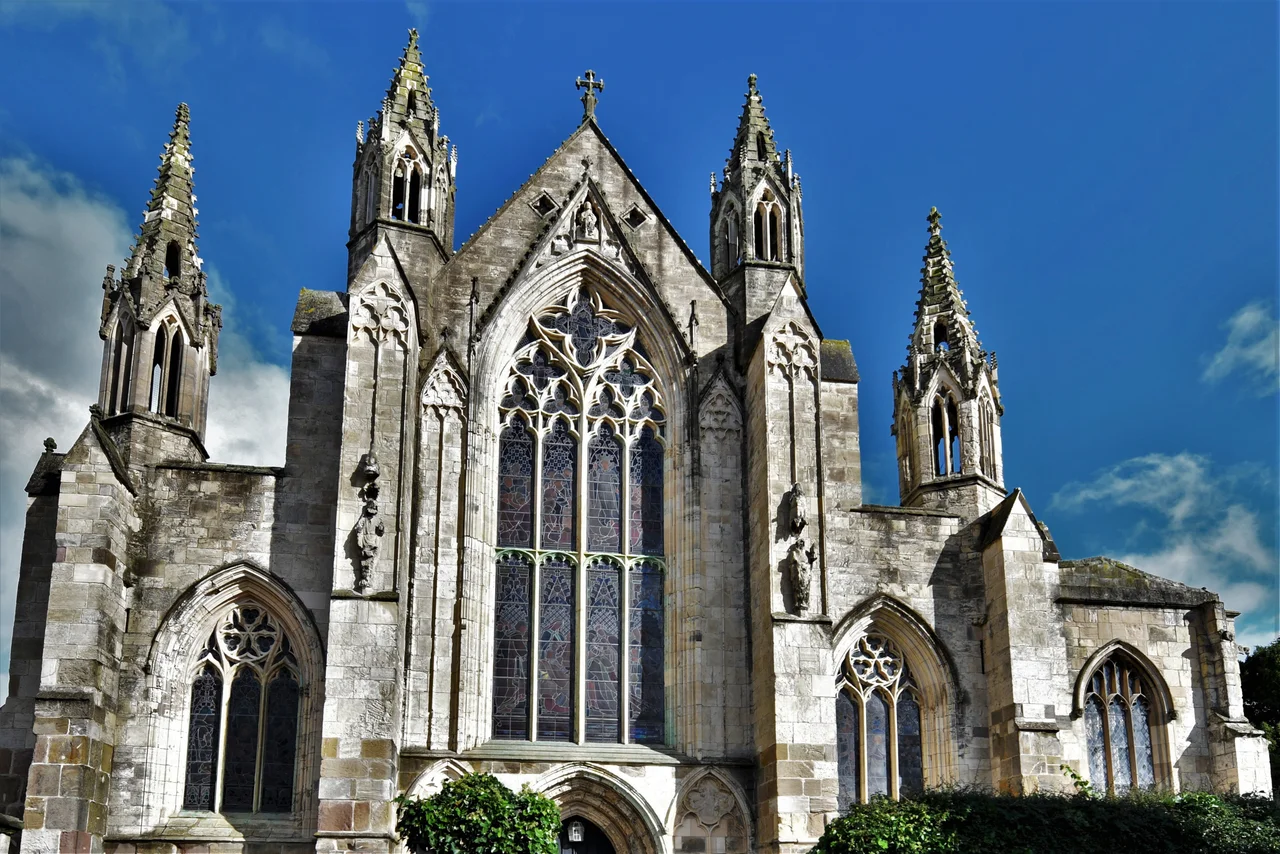
Howden Minster dominates the town, and not only physically. The story of John of Howden - the thirteenth-century canon who funded the original choir, was buried in it in 1275, and is said to have raised his arms from his open coffin during his own requiem mass to greet the host - made Howden a pilgrimage destination. Pilgrim donations funded the completion of the rest of the minster, fulfilling a prophecy attributed to John himself that he would continue to support his church from beyond the grave. The Catholic Church never canonised him officially, but locally his sainthood was settled. The minster's renovations finished in 1932, and ever since its bells have struck every fifteen minutes - a soundtrack to the town that older residents now take for granted and visitors notice immediately. The Catholic Church of the Sacred Heart, opened in 1850, is an early work of Joseph Aloysius Hansom, who would later design the cab that bears his name and Arundel Cathedral. The Sacred Heart is modest but unmistakably his.
The Airship Years
During the First World War the British Admiralty needed an east-coast airship station to protect shipping from German U-boats. RNAS Howden opened in 1916, just east of the town, with vast airship hangars. After the war the station was sold off, then bought back in 1924 by Vickers under the Imperial Airship Scheme for the construction of the R100. The R100 was an enormous experimental rigid airship, and the team that designed it included a young engineer named Nevil Shute Norway - later, simply, Nevil Shute - who worked under Barnes Wallis, the man who would go on to design the Vickers Wellington bomber and the bouncing bomb. Shute lived at 78 Hailgate during the project. A blue plaque marks the house. Howden's residents do not entirely forgive Shute, however, for his autobiography Slide Rule, in which he wrote disparagingly of the local farm girls. The passage has been quoted back at him for nearly a century. R100 itself flew successfully to Canada and back in 1930 but was broken up after her sister-ship R101 crashed in France.
What Came After
Howden has always rolled its identity over - market town, minster town, horse-fair capital, airship town - and after the Second World War it slipped quietly into a kind of stasis. Two Co-op stores, two banks, the bells of the minster every quarter-hour. Then in 2003 the Press Association moved its main Operations Centre to the town, bringing several hundred employees and a Controlled Parking Zone. Ebuyer.com relocated its headquarters from Sheffield to a warehouse on Ferry Road, close to Howdendyke. Wren Kitchens built next door. The town's population reached 4,142 at the 2011 census, modest growth from 3,810 a decade earlier. David Davis, the constituency MP, holds the Goole and Pocklington seat. And in another curious echo of the past, A. J. P. Taylor is widely believed to have spent the night of 24 June 1954 at the Wellington Hotel, breaking a water jug and a shaving mirror. He actually stayed next door at Bowman's Hotel, broke neither object, but did break his wrist falling from an unusually high bed. The town's stories have a habit of being almost true.
From the Air
Howden sits at 53.74 degrees north, 0.86 degrees west, in the flat agricultural Vale of York, just north of the M62 between junctions 36 and 37, and 3 miles north of Goole across the River Ouse. The 135-foot crossing tower of Howden Minster is the most prominent landmark, visible from many miles in clear weather. The M62 Ouse Bridge to the south is an unmistakable feature. Recommended viewing altitude: 1,500 to 3,500 feet AGL. The nearest controlled airfield is Humberside Airport (EGNJ), about 20 nautical miles east-southeast. Leeds Bradford (EGNM) is 31 nm west-northwest. The disused airship hangars at the former RNAS Howden site east of town are long gone, but the airfield outline survives in aerial photographs.
Nearby Stories
- Battle of Stamford Bridge 3.8 km away
- Albert Hall Music Hall 4.6 km away
- Darnall Works 5.2 km away
- Wakefield 6 km away
- Knaresborough Castle 6.2 km away
- Gainsborough Old Hall 7.8 km away
- Skipsea Castle 8 km away
- Battle of Winceby 34 km away