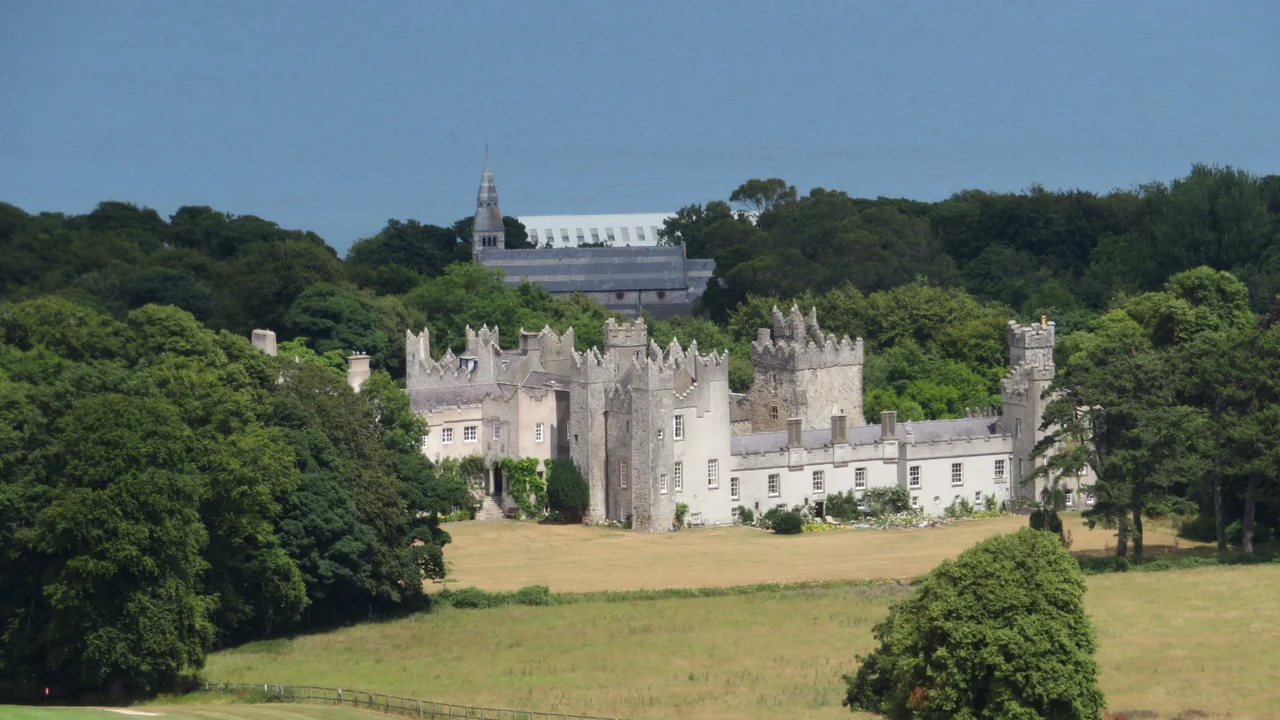

Howth Castle
In 1576 the pirate queen Grainne O'Malley sailed her ship into Howth harbour, walked up to the gates of Howth Castle and asked for hospitality. She was turned away - the Earl was at dinner, the gates were closed, the customary rules of Irish welcome had been forgotten. So she sailed back to her ship with the Earl's grandson and heir, whom she had quietly abducted on the way out. The ransom she set was not gold. It was a promise that the gates of Howth Castle would never again be closed at mealtimes, and that an extra place at dinner would always be set for an unexpected guest. The St Lawrence family kept that promise for the next four hundred and forty-three years.
Eight Centuries Above the Bay
The St Lawrence family arrived in 1177 with the Norman invasion - Almeric Tristram, the first Lord of Howth, came across with John de Courcy and was granted the peninsula after a battle near the Baily lighthouse. The first castle was a wooden structure on Tower Hill, overlooking Balscadden Bay. Around 1235 the family moved the timber castle to the current site. The first stone castle followed in the next century, and the oldest fabric still standing - the keep and gate tower - dates from around 1450. The family kept the place for 842 years, the title Lord Howth becoming Baron Howth in 1425, then Earl of Howth in 1767, the title finally expiring in 1909 when the male line ran out and the estate passed to female-line heirs, the Gaisford-St Lawrence family. They held it until 2019, when the property finally left the bloodline and was sold to Tetrarch Capital.
Lutyens and the Library
In 1911 Edwin Lutyens - the architect who would soon design the Cenotaph in London and the Viceroy's House in New Delhi - was brought in to restyle the medieval castle. Lutyens kept the bones and reworked the surfaces, creating among other things a library that became one of the great rooms of Irish country house design. Into that library was moved a marble fireplace salvaged from Killester House, a dower house of the Howth estate that fell into dereliction and was eventually demolished; windows and woodwork from Killester were also rescued and built into Howth. When most of the castle's interiors were sold at auction in September 2021, after the sale to Tetrarch, the Lutyens library went under the hammer along with centuries of accumulated furniture and art. The new owners intended to redevelop the hotel and golf courses as a luxury resort, with seven acres near the castle gate sold on for residential development.
Rhododendrons and Beech Hedges
The grounds outside the castle have always been the point as much as the building itself. The rhododendron walks, wild and overgrown, climb the slopes above the castle and bloom each summer in extraordinary mass colour. Some of the oldest beech hedges in Ireland, planted in 1710, still mark the formal boundaries. In 1892 the writer Rosa Mulholland described the demesne as "a prim garden with swan-inhabited pond and plashing fountain, encircled by dark beautiful woods full of lofty cathedral-like aisles, moss carpeted, and echoing with the cawing of rooks." The Bloody Stream runs in front of the castle. A formal garden runs behind it, with a walk cutting through to the Swan Pond. In the twentieth century the seventeenth-century classical landscape was substantially modified to accommodate the Deer Park golf courses and an associated hotel. Out in the wilder parts of the estate, where walking trails are open to the public under a Special Amenity Area Order, you can still find Aideen's Grave - a collapsed three-thousand-year-old portal tomb said in Irish legend to hold the remains of Aideen, wife of Oscar son of Oisin.
Howth Castle and Environs
James Joyce begins and ends Finnegans Wake at "Howth Castle and Environs" - the initials HCE, which appear throughout the novel and form the name of its main character Humphrey Chimpden Earwicker, are Joyce's private monument to the castle and the peninsula. Joyce sprinkled more than a dozen references to Howth across Ulysses as well, including to the rhododendron walks near the castle. W. B. Yeats, writing his Reveries over Childhood and Youth in 1916, recalled sleeping "among the rhododendrons and rocks in the wilder part of the grounds of Howth Castle." Roger Corman and Francis Ford Coppola used the castle in 1963 for their black-and-white horror film Dementia 13, where it played the fictional Castle Haloran. Sergio Leone filmed flashback scenes here for Duck, You Sucker. Whit Stillman used it as the exterior for his Jane Austen adaptation Love and Friendship. Even a 2021 Hallmark romance, As Luck Would Have It, found its way through the gate. Eight hundred and forty-two years on, the castle is still earning its keep by being itself.
Racecourse and Restoration
In 1829 the third Earl of Howth, Thomas St Lawrence, who was particularly mad for horses, established a racecourse in the castle grounds. Howth Park Racecourse ran from the back gate lodge on Carrickbrack Road, down past what is now Santa Sabina school, around Corr Castle and back up the Howth Road. The races drew the leading owners, trainers and jockeys of the day, including Lord Sligo, the Lord Lieutenant of Ireland, and entire racing clubs from the Curragh. From 1834 a Tradesmen's Cup was added; from 1839 a Citizens' Plate; the famous St Lawrence Stakes and the Vaughan Goblet anchored the calendar. Then in 1842 the meetings stopped, likely in mourning for Emily, the first wife of the Earl, who had died. The Famine arrived three years later. Racing resumed in 1853 at Baldoyle, just up the coast, but never returned to Howth. Today the volunteer-run National Transport Museum of Ireland occupies part of the castle grounds, exhibiting old lorries, fire engines, and the beautifully restored Hill of Howth No. 9 Tram - one of the last echoes of the tramway that once climbed the Hill from harbour to Summit.
From the Air
Howth Castle sits at approximately 53.3863 degrees N, 6.0790 degrees W, on the western flank of Howth Head peninsula at the north end of Dublin Bay. From the air the estate is identifiable as the large green wedge between Howth village and the suburbs of Sutton, with its golf course fairways visible as the obvious open landscape. Ireland's Eye lies offshore to the north. Dublin Airport (EIDW) is roughly 13 km west; aircraft approaching EIDW from the east frequently overfly Howth Head. Best viewed in clear conditions at altitudes that allow the peninsula's distinctive head shape to register against Dublin Bay.
Nearby Stories
- Wicklow Mountains 12 km away
- Mornington 14 km away
- German submarine U-1051 16 km away
- Abbey of Kells 18 km away
- Irish Military Intelligence Service 20 km away
- HMS Manners (K568) 37 km away
- Templemore 42 km away
- Irish Sea Bridge 43 km away