
Huánuco Pampa
Four thousand buildings, and almost nobody lived there. Huánuco Pampa rises on a plateau at 3,625 meters, ravines falling away on every side, and most of its rooms stood empty most of the time. The Incas did not build this city for housing. They built it for display - for pilgrims and laborers rotating through obligatory service, for state ceremonies staged atop a stone platform, for the spectacle of an empire that needed to look as enormous as it felt. This was the Architecture of Power, and at Huánuco Pampa the power is still legible in the stone.
A Plaza Bigger Than Convention Centers
The central plaza at Huánuco Pampa measures 550 meters by 350 meters. That is more than 19 hectares of level ground at high altitude - enough space to swallow most modern stadiums whole. At its center rose the ushnu, a solid platform built of finely fitted Imperial Inca masonry where officials presided over state ceremonies. The Qhapaq Ñan, the great Inca highway running from Cusco to Quito, passed through this plaza on a southeast-to-northwest axis, just as it did in the capital itself. From the ushnu, speakers could address thousands at once. When the empire needed to show its scale, this was the stage on which it performed.
The Casa del Inca
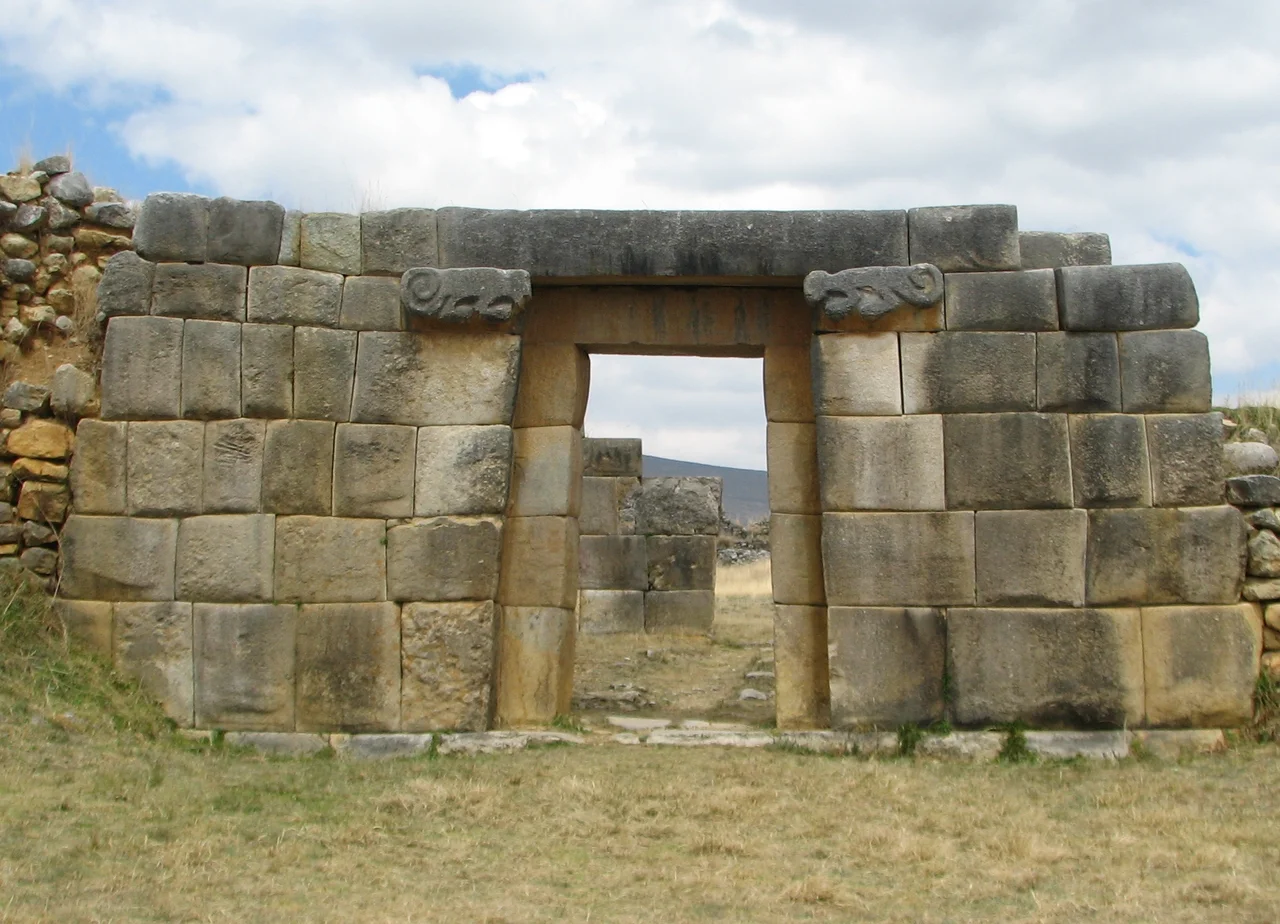
On the eastern side of the plaza stood the Casa del Inca, a compound of fifteen structures opening onto a central courtyard. To enter, visitors passed through gates of precisely cut stone - the finest Imperial masonry - flanked by carved pumas. Inside lay houses, baths built in the Imperial style, terraces, sunken gardens, and pools. A temple was begun but never finished; the city was abandoned before the stonemasons could complete it. Connecting walls were built of pirqa, fieldstone set in mud - a reminder that the Incas graded their architecture as carefully as their social ranks. The best stone was reserved for the spaces where power and ceremony actually happened.
Twelve Slices of an Empire
Pathways radiate outward from the plaza in twelve directions, dividing the city into wedges. Dr. Craig Morris, who led the modern archaeological project here, believed the design reflected the relationships among the ethnic groups the Inca administered from this place - at least five peoples, possibly more, all woven into the geometry of the site itself. Most residents were not permanent. They rotated through, fulfilling mit'a labor obligations or attending ceremonies, then returned home. The exception was the Aqllakuna, the chosen women who served the state and its religion, and whose workshops produced the textiles that bound the empire together more tightly than any road.
The Granary of an Empire
Nearly 500 storehouses - the article counts 497 qullqas - stand in precise rows on the hillside above the city. Huánuco Pampa fed its province and perhaps far beyond. Root crops, wrapped in straw and bound with rope, filled rectangular storehouses and made up 50 to 80 percent of the space. Shelled maize went into great jars in circular buildings with stone floors. The engineering was specialized, adapted to what each crop needed to stay edible through a bad year. In an empire without markets or money, these storehouses were the visible guarantee that the state would feed you - as long as the state remained strong.
Briefly Spanish, Then Abandoned
On August 15, 1539, Gómez de Alvarado rode into Huánuco Pampa with his Almagrista soldiers and founded a Spanish city on the plateau. It did not last. The cold at 3,625 meters was merciless, the wind constant, and Illa Tupac - one of Manco Inca's captains - was still in the mountains, raiding Spanish columns. Within two years the settlers moved the city down into the warmer Pillco valley on the Huallaga River, where Huánuco sits today. The plateau emptied. The plaza went quiet. The storehouses stood open to the weather. What you see now, spread across two square kilometers of high grass, is what the Incas left when their empire broke - and what the Spanish walked away from when they chose comfort over conquest.
From the Air
Huánuco Pampa sits at 9.83°S, 76.75°W, on a high plateau at 3,625 meters overlooking the Vizcarra River near La Unión in central Peru. From altitude the immense rectangular plaza remains visible - a dark geometric bruise on the pampa - with storehouse rows stepping up the hillside to its west. The nearest airport is Alférez FAP David Figueroa Fernandini (SPHU) at Huánuco, about 130 km east in the lower valley; Lima's Jorge Chávez International (SPJC) lies 280 km southwest. Fly the Andes in the dry season (May-September) for clear views; the rainy months from November to April bring heavy cloud cover over the cordillera.
Nearby Stories
- Lake Palcacocha 11 km away
- Huánuco 20 km away
- Huaraz 32 km away
- Inca Civil War 33 km away
- Raura Mountain Range 49 km away
- Huaricanga 69 km away
- Mantaro River 100 km away
- Huacrachuco 105 km away