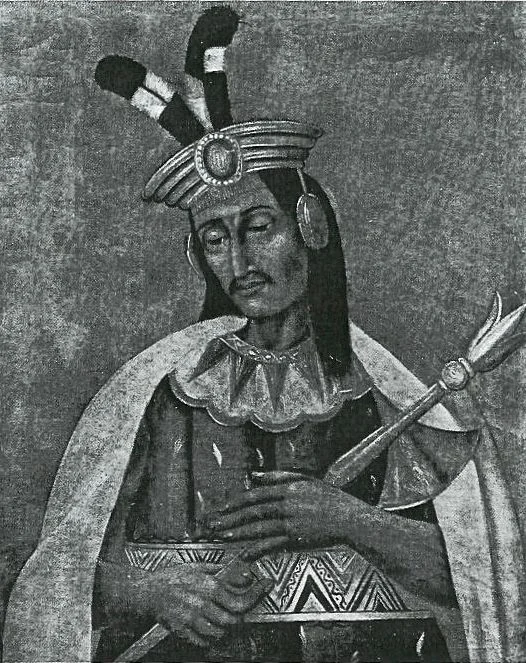

Inca Civil War
The emperor died of smallpox. That was the first catastrophe. Huayna Capac never saw a Spaniard in person, but the disease they carried had already crossed the isthmus ahead of them, and in 1527 it killed him in Tumebamba before he could settle the succession. His named heir, Ninan Cuyochi, died in the same epidemic. That left two of his other sons - Huáscar in Cusco and Atahualpa in the north - staring at each other across the ruins of their father's empire with no clear rules for what to do next. What followed between 1529 and 1532 would gut the Inca military, kill hundreds of thousands, and leave a victor so exhausted he walked into a trap set by 168 Spanish soldiers with horses.
The Question With No Answer
The Incas had no fixed rule of succession. When a sovereign died, nobles chose the next emperor from among the dead man's sons. Huáscar had Cusco's nobility behind him - his mother was part of the Capac Ayllu panaka of Topa Inca, he was technically legitimate through the incestuous royal marriage custom that kept authority tightly held, and the religious establishment backed him. Atahualpa had the armies. The veterans who had spent two decades campaigning in the north with Huayna Capac were stationed around Tumebamba and Quito, their loyalty to Atahualpa rather than to the distant capital. The French historian Henri Favre read the conflict as a war between panakas - not just the two brothers' households but the Hurin (lower) and Hanan (upper) moieties of Cusco, a fault line older than the brothers themselves. The succession question triggered the split. It did not cause it.
Messengers in Dresses
Huáscar took the throne but proved unstable. Sources describe him as ill-tempered, suspicious, contemptuous of custom - the wrong man to calm nervous provincial governors. When Atahualpa's diplomatic overtures arrived in Cusco, Huáscar had some of the messengers killed and sent others back dressed as women, an insult calculated for maximum offense. Atahualpa declared war. His generals - Chalcuchimac, Quizquiz, and Rumiñawi - were northerners with career reputations, and they moved south in coordinated campaigns. Early on, Huáscar's forces captured Atahualpa and imprisoned him. During the victory celebrations a woman was allowed in to visit him, and - according to the chronicles - she smuggled a tool with which he drilled through his cell wall and escaped. The war restarted with Atahualpa leading from the front.
The March South
From 1531 through 1532, the armies fought battle after battle across what is now Ecuador and northern Peru. Atahualpa won them all. At Ambato he consolidated his gains. At Cajamarca he added new levies. He offered Huáscar's defeated soldiers peaceful terms first and killed them en masse when they refused. The Cañari people, who had supported Huáscar, suffered a massacre that the local population never forgot - later, the Cañari would be among the first Andean peoples to side with Pizarro against the Inca. In January 1532, only miles from Cusco, Huáscar's retreat was cut off at Quipaipan. His army was annihilated. Quizquiz took Cusco and purged it of Huáscar's supporters. Atahualpa had won.
The 168 at Cajamarca
Before Atahualpa could return to Cusco and take the fringe of imperial power, he paused at Cajamarca to deal with a small band of foreigners who had marched inland from the coast. On November 16, 1532, Francisco Pizarro's 168 Spaniards ambushed the Inca and his retinue in the plaza of Cajamarca. They captured him alive. The same day, somewhere in transit, Huáscar was killed on Atahualpa's orders - drowned, the chronicles say, so he could not be used against his brother by the Spanish. Pizarro promised freedom for a ransom: a room filled once with gold and twice with silver. The Inca delivered. On August 29, 1533, Pizarro's men strangled Atahualpa in the plaza anyway. The war Huáscar had started five years earlier ended with both brothers dead and the empire in the hands of people nobody had seen coming.
What the Numbers Mean
Nobody knows how many people died in the Inca Civil War. The pre-contact population of the empire is estimated at somewhere between 6 and 14 million. The initial smallpox epidemic killed at least 200,000. The combined catastrophe of civil war, epidemic, and Spanish conquest reduced the Andean population by roughly 95 percent over the following century. These are not abstractions - they are farmers, potters, weavers, soldiers, priests, and children whose names are mostly gone from any written record. The civil war did not cause the fall of the Inca by itself. The Spanish would have come anyway, with their diseases and their horses and their steel. But the war left an empire exhausted, divided, and full of conquered peoples looking for allies against their own imperial overlords. Pizarro walked through a door the Inca had already cracked open.
From the Air
The civil war's geographic heart is centered at 9.40°S, 76.00°W in central Peru, but its battles stretched across the Andes from Quito (Ecuador) south to Cusco. Key sites visible from altitude: Cajamarca in the northern highlands (where the war effectively ended and Pizarro captured Atahualpa), Cusco in the southern highlands (the imperial capital seized by Quizquiz), and the Callejón de Huaylas valley that saw several major engagements. The Andes run roughly northwest-to-southeast through Peru at 4,000-6,000 meter peaks. Lima's Jorge Chávez International (SPJC) is the main hub; regional airports include Cajamarca's Armando Revoredo Iglesias (CJA/SPJI) and Cusco's Alejandro Velasco Astete (CUZ/SPZO). Dry season (May-September) offers clearest cordillera views.
Nearby Stories
- Huánuco Pampa 22 km away
- Huánuco 32 km away
- La Unión, Huánuco 49 km away
- Huacrachuco 82 km away
- Oxapampa 103 km away
- Pucallpa 142 km away
- La Merced 186 km away
- Cordillera Negra 198 km away