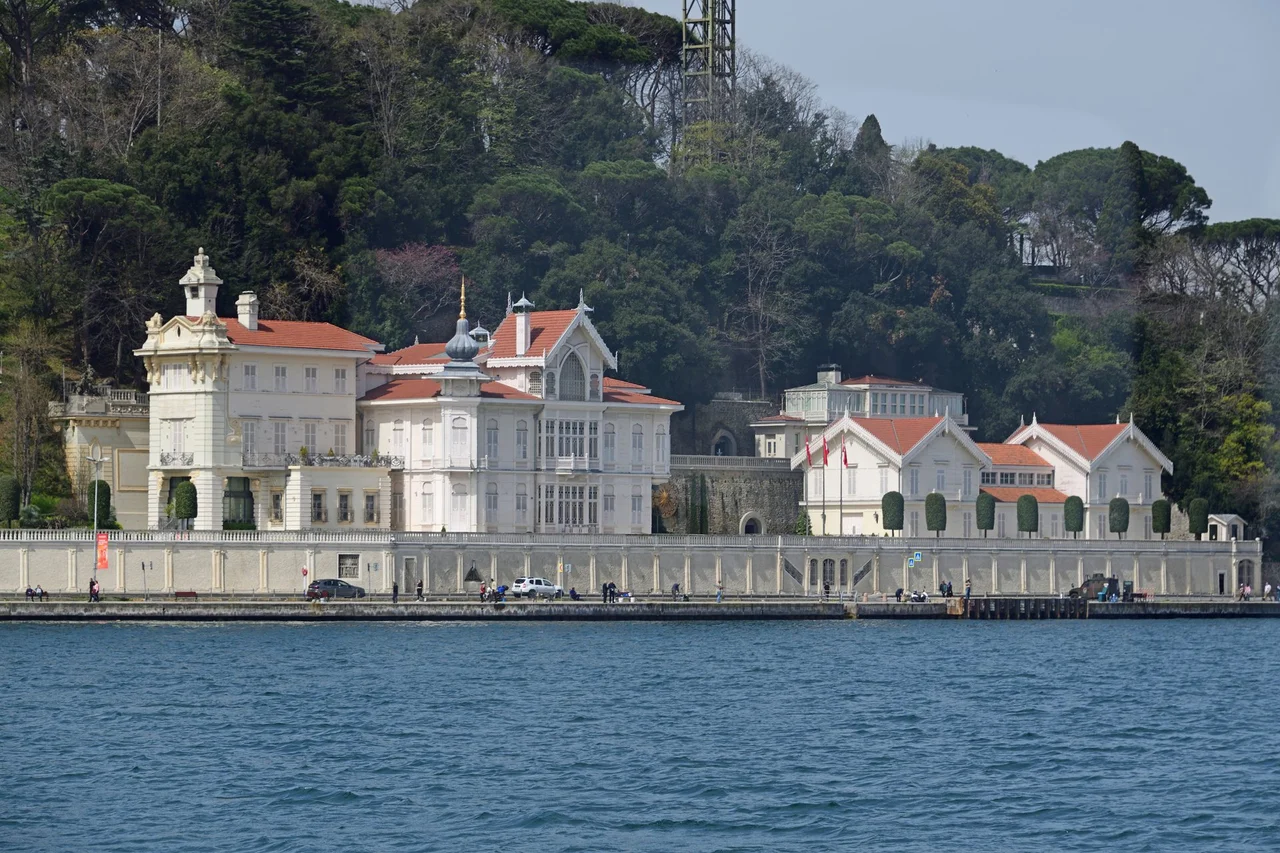

Huber Mansion
The man who bought this property in 1890 was Auguste Huber, a representative of the German armaments manufacturer Krupp in Istanbul — a city then at the center of an imperial arms trade that would, within thirty years, help tear Europe apart. He chose the site for a practical reason: it stood close to the German embassy's Bosphorus summer building. What he built on that land, however, was anything but practical. The mansion that rose at Yeniköy was an Art Nouveau confection overlooking the strait, set within 34 hectares of wooded gardens, with a silhouette that blended Ottoman, Italian, and European decorative languages into something entirely its own.
A Villa for the Strait
Yeniköy is one of the old Bosphorus villages strung along the European shore between Istanbul and the Black Sea — a district of waterfront mansions called yalıs, summer embassies, and ferry landings that defined the social geography of late Ottoman Istanbul. Auguste Huber's choice of location placed him among the diplomatic and commercial elite who spent summers on the water while their business interests concentrated in the city's commercial districts. The mansion's wooded setting — 34 hectares, an extraordinary expanse even by Bosphorus standards — made it one of the largest green private holdings along the strait. Huber also redesigned the gardens, which would later attract Ottoman Sultan Abdulhamid II as a summer visitor.
Raimondo D'Aronco and the Art Nouveau Turn
In 1906, Auguste Huber engaged Raimondo D'Aronco to expand and redesign the mansion. D'Aronco was Italy's foremost Art Nouveau architect, who had spent years working in Istanbul as chief architect to the Ottoman court — he served as chief architect of the 1902 Turin International Exposition of Decorative Arts and left an indelible mark on the city's late imperial architecture. What D'Aronco brought to Huber's property was characteristic of his Istanbul work: a synthesis that refused to settle into any single tradition. Visitors to the mansion can trace Chinese decorative motifs alongside Indian, Iranian, Islamic, and Ottoman references, all organized within a fundamentally European Art Nouveau framework. The result was one of the most architecturally layered private residences on the Bosphorus — a building that recorded, in its ornamentation alone, the cultural crosscurrents of a cosmopolitan imperial city.
Wars and Owners
The life that Auguste Huber had built on the Bosphorus ended with the First World War. Germany's defeat meant that its commercial representatives in the former Ottoman Empire were unwelcome, and Huber left Istanbul, selling the mansion to a buyer named Necmeddin Mona. In 1930, the property changed hands again — this time to Notre Dame de Sion, the French Catholic educational congregation that had operated schools in Istanbul since the nineteenth century. For more than fifty years the convent school held the property. The mansion's great wooded grounds, which had once been the private domain of an arms dealer and an Ottoman sultan's occasional retreat, became the setting of French-educated Istanbul girlhoods.
The Presidential Residence
In 1985 the Turkish state nationalized the Huber Mansion, and since then it has served as one of the official residences of the President of the Republic of Turkey. The change of function brought with it the apparatus of state protocol — security perimeters, official functions, the invisible bureaucratic weight that attaches to any building where heads of government sleep and receive foreign dignitaries. The mansion is not open to the public. Its forested grounds, among the last large stretches of private woodland on the European Bosphorus shore, are maintained as part of the presidential estate. The art inside, the layered architecture that D'Aronco fashioned a century ago, exists now within the machinery of the Turkish state — visible from the water, inaccessible from the street.
What the Shore Remembers
The Bosphorus village of Yeniköy has changed greatly since Auguste Huber built his mansion there. The great cosmopolitan community of Greeks, Armenians, Jews, Levantines, and Europeans who once populated the shore villages has largely dispersed across the twentieth century's upheavals. What remains — in the waterfront mansions, in the old churches and cemeteries, in the ferry landings still serving the same routes — is the physical memory of a city that was built by many peoples and has been held by one state. The Huber Mansion sits within that memory: an Art Nouveau house built by a German for German purposes, designed by an Italian, sold to French nuns, and now the property of the Turkish Republic. That trajectory, unlikely as it sounds, is not unusual on the Bosphorus.
From the Air
The Huber Mansion sits at approximately 41.13°N, 29.06°E on the European shore of the Bosphorus, in the Yeniköy neighborhood of Sarıyer. The nearest major airport is Istanbul Airport (LTFM), approximately 25 km to the west-northwest. Flying south along the Bosphorus, the forested hillside that marks the presidential estate is among the most visible patches of deep green on an otherwise densely built shore. The mansion itself is partially obscured by the canopy of its 34-hectare wooded grounds. The strait narrows noticeably in this section, with the Asian shore's comparable hillside village of Anadoluhisarı visible across the water. Recommended viewing altitude for the Bosphorus corridor is 2,500–4,000 feet.
Nearby Stories
- Kınalıada 6.2 km away
- Şile Castle 7.8 km away
- Second Battle of Çatalca 8.9 km away
- Hereke 20 km away
- 2025 Istanbul Earthquake 25 km away
- Battle of Constantinople (922) 61 km away
- Januarius MacGahan 87 km away
- Edirne 160 km away