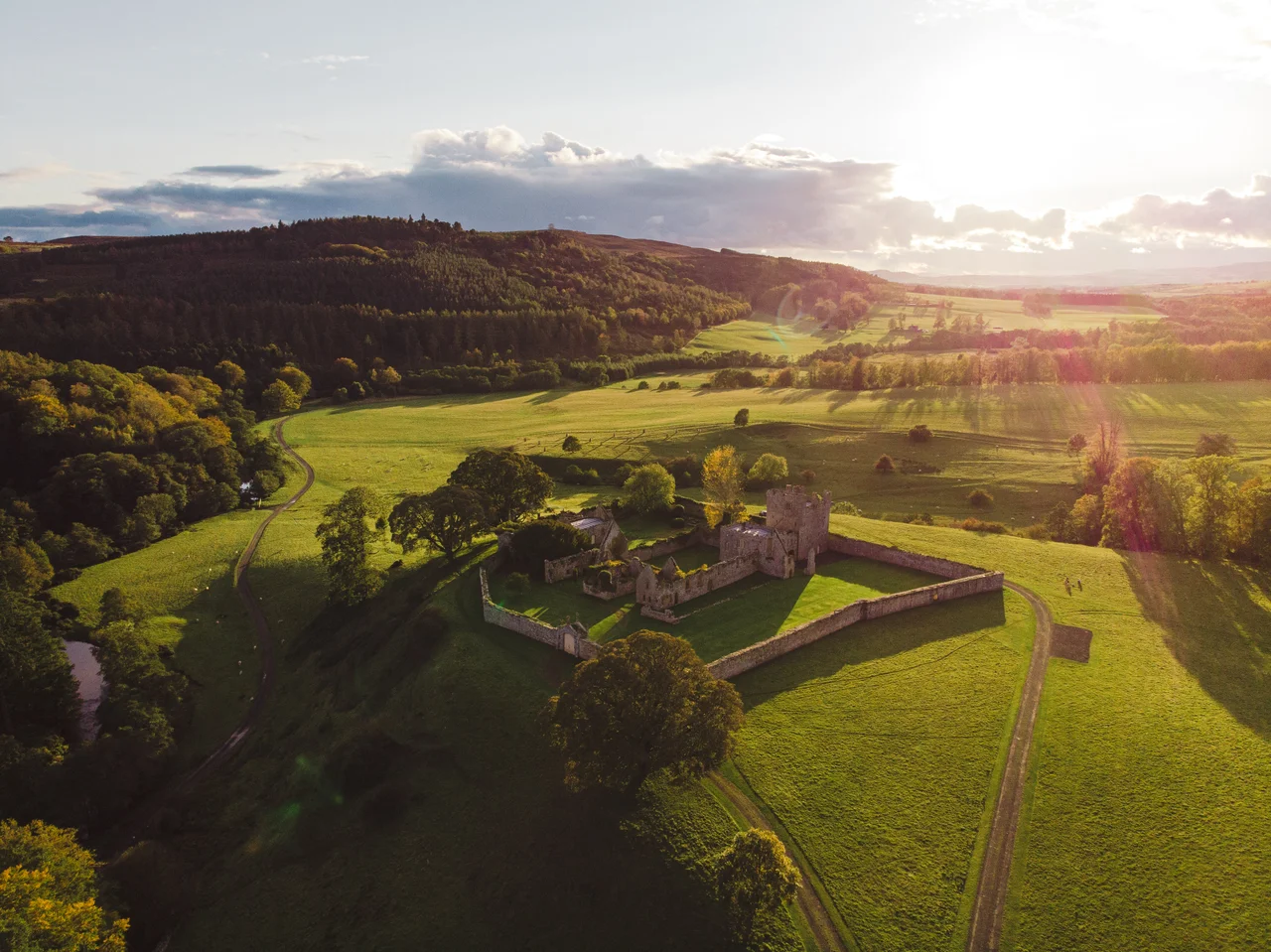

Hulne Priory
Stone friars carved in the eighteenth century watch over the ruins of Hulne Priory, a thirteenth-century friary founded by white-robed Carmelites in a corner of Northumberland that allegedly reminded them of Mount Carmel in Palestine. The site has the bones of a religious community: cloister, chapter house, church. It also has something most English friaries lack: a fortified pele tower, built in the fifteenth century because Scottish raiders made even prayer a dangerous occupation here, two miles from the border with violence.
Carmelites in Northumberland
The Carmelites trace their order to hermits who lived on Mount Carmel above Haifa in the early thirteenth century, and they took their identity from that arid Levantine hilltop even after the Crusader states collapsed and the order scattered across Europe. William II de Vesci, a Northumberland baron who had spent time in the Holy Land, brought a community of Carmelites home with him and gave them land two miles northwest of Alnwick. The story passed down says he chose this exact site because something in its shape - a wooded ridge above a river bend - reminded the friars of their Carmel. Whether they actually believed that, or whether de Vesci needed a story to dignify a practical land grant, no one can now say. The friary was founded in 1240.
A Tower for a Cloister
Most English friaries were built as if peace was a permanent condition. Hulne was not. A surrounding wall went up early, and by the fifteenth century a full pele tower had been added - the squat, thick-walled defensive house typical of Northumberland and the Scottish Borders. The pele speaks to a problem you do not associate with prayer: this border country saw centuries of reiver raids, English-Scottish wars, and the routine cattle theft that made daily life dangerous well into the sixteenth century. The friars at Hulne were not just contemplative. They were also potential targets, and they built accordingly. The tower still stands, four storeys of grey stone above the cloister ruins, the practical answer to a theological question.
Dissolution and Restoration
Henry VIII's Dissolution of the Monasteries in the 1530s emptied Hulne along with every other religious house in England. The Percy family - the great Northumberland dynasty whose seat at Alnwick Castle stood just two miles away - took possession of the land, and the priory became part of their hunting park. In the eighteenth century, the 1st Duke of Northumberland turned the medieval ruins into a romantic landscape feature. He had stone statues of friars carved and placed among the broken walls, lending the site a permanent population of contemplatives in carved stone. It was an act of picturesque taste with an undertone of nostalgia, as if the duke wanted to keep the monks at his gate even after Henry's commissioners had cleared them out three centuries earlier.
Hollywood Comes to Hulne
The priory's careful preservation as a landscape ornament also made it cinematic. HTV's Robin of Sherwood, the cult 1980s television series with Michael Praed as Robin, used Hulne as Kirklees Abbey - the supposed site of Robin Hood's death by treachery in old age. Six years later, the 1991 film Robin Hood: Prince of Thieves cast it as Maid Marian's home, with Kevin Costner riding in to rescue her. The friary today is open to walkers in Hulne Park but is not promoted as a tourist destination. It hosts the occasional wedding ceremony and outdoor performance - Much Ado About Nothing has been staged here - and otherwise sits quietly under the trees, watched over by its eighteenth-century stone friars and the older silence that preceded them.
From the Air
Hulne Priory sits two miles northwest of Alnwick within Hulne Park at 55.44N, 1.74W. From the air the ruins are subtle - a small clearing in the wooded estate with broken walls and a pele tower visible from low altitude. Use Alnwick Castle (2nm east) and the Aln river valley for navigation. Best viewed at 1,500-2,500 ft AGL in clear conditions. Nearest ICAO: EGNT (Newcastle, 28nm south), EGPH (Edinburgh, 78nm northwest). The Northumberland coast lies 5nm east.
Nearby Stories
- Ashington 1.8 km away
- Cheviot Hills 3.4 km away
- Battle of Nesbit Moor (1402) 12 km away
- Hadrian's Wall Path 18 km away
- Berwick-upon-Tweed Lifeboat Station 27 km away
- Saltburn Pier 68 km away
- German submarine U-2367 84 km away
- Alexander L. Kielland (Platform) 271 km away