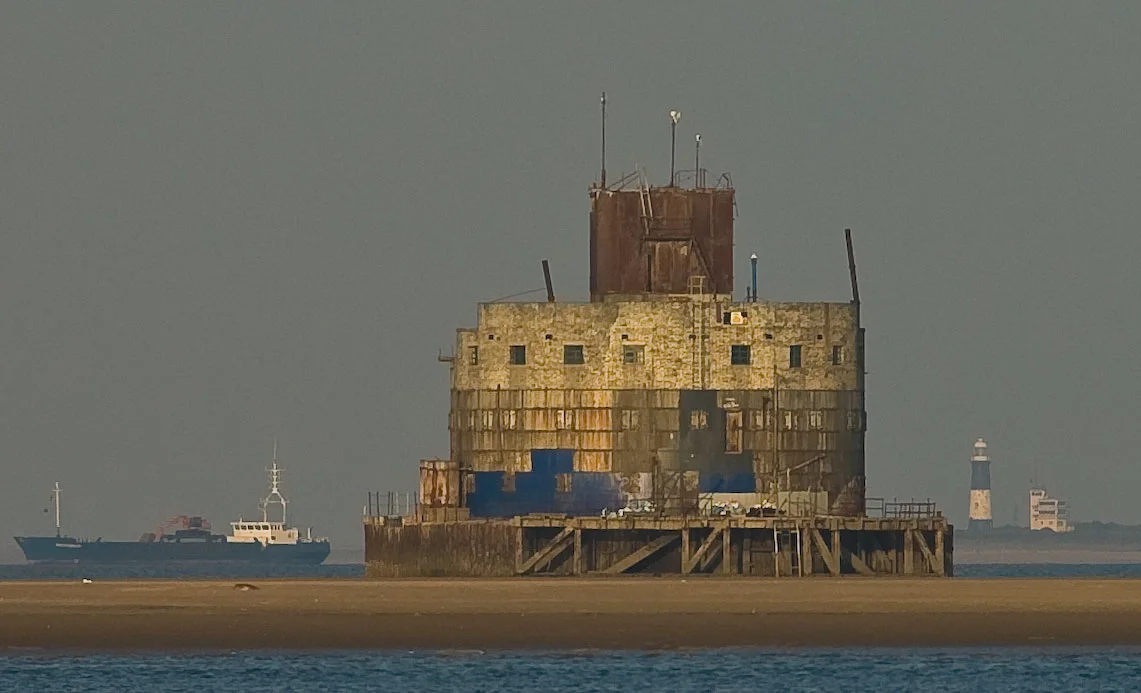

Humber Forts
They look, from a low pass over the Humber, like a pair of grey factory chimneys someone dropped into the sea. Bull Sand Fort and Haile Sand Fort stand eighteen metres above the water on sandbanks at the estuary's mouth - the British answer, in 1914, to the U-boat. The forts were planned to keep enemy submarines out of Hull and Grimsby. They took more than four years to build. By the time the last concrete cured in December 1919, the First World War had been over for a year. The forts had not fired a shot in anger. They would have to wait for the next war for that.
Built Against an Invisible Enemy
The U-boat was a new kind of war. In 1914 the Royal Navy had no good way to stop a submerged submarine threading the deep-water channel into the Humber - and the Humber led straight to Hull's docks, Grimsby's fish quays, and the rail lines feeding industrial Yorkshire. The Admiralty's answer was concrete. Two round towers, twenty-five metres across, would block the channel between them with a chain-and-net boom strung underwater. The southern fort, Haile Sand, sat at the low-water mark off the Lincolnshire coast. The northern one, Bull Sand, anchored to a sandbank eleven feet below low water - which is to say, the builders worked from a platform built on top of water for years, fighting tides and storms to lay foundations they could not see. Accommodation for two hundred soldiers eventually fitted inside each fort. Started in May 1915, finished in December 1919.
The War That Came Later
In the Second World War the forts finally got to do the job they were built for. Modernised and reactivated, they hung submerged steel netting across the estuary to deter U-boats heading for Hull's burning docks. The Luftwaffe noticed. Enemy aircraft attacked them regularly - two isolated drums of concrete in open water, impossible to miss yet hard to destroy. The gunners stayed at their posts as the bombs fell, ate their rations, played cards, waited for the next raid. By 1945 the threat had passed. By 1956 the military had given up on them entirely. The forts went on the surplus list and into a long, strange afterlife.
For Sale, One Sea Fort
In 1987 Bull Sand Fort was given Grade II listed status. In 1997 the Streetwise Charitable Trust bought it, hoping to convert the structure into a drug rehabilitation centre - the isolation, presumably, was the point. The plan failed. The trust no longer operates. In July 2022 Bull Sand Fort was put up for auction with a guide price of fifty thousand pounds. It sold for four hundred and ninety thousand. Haile Sand Fort, the smaller of the two, had been auctioned in October 2018 and sold for one hundred and seventeen thousand pounds to an unnamed purchaser. The new owners face the same problem the original builders faced: anything you want to do with these forts requires getting concrete, building materials, and water out to a structure in the middle of a tidal estuary, where everything has to be timed against the sea.
What Remains
From a small aircraft, the forts read as deliberate punctuation in an otherwise empty seascape. Bull Sand sits about four nautical miles offshore on a sandbank that disappears at high tide. Haile Sand sits closer to the Lincolnshire bank, between Cleethorpes and Humberston. Seabirds nest on the gun platforms. Rust streaks the concrete walls. At low water the sandbanks reveal themselves like the shoulders of submerged giants. The forts were built to stop an invasion that never came in 1919, and to fight a war that came twenty years late. They survived both, outlasted their charity-trust owners, and now belong to people who have bought a four-storey concrete drum at sea and will have to decide what to do with it.
From the Air
The Humber Forts sit at 53.53°N, 0.03°E in the mouth of the Humber Estuary. Bull Sand Fort is the northern, larger structure; Haile Sand Fort is the smaller, closer to the Lincolnshire shore. Recommended viewing altitude is 1,500-2,500 feet AGL for a clear sense of the channel between them. The nearest airports are Humberside (EGNJ) to the south-west and the disused RAF North Coates immediately south on the coast. Watch for restricted military airspace around the Donna Nook range, and for shipping in the deep-water channel. Best light is mid-morning with sun from the south-east illuminating the concrete drums against dark water.
Nearby Stories
- Westermost Rough Wind Farm 2.5 km away
- Silver Pit 5.4 km away
- Beverley Minster 7.4 km away
- Lincoln Cathedral 13 km away
- 2004 Ingoldmells Bus Crash 14 km away
- Humber Bridge 21 km away
- Holkham National Nature Reserve 33 km away
- SMS Blucher 333 km away