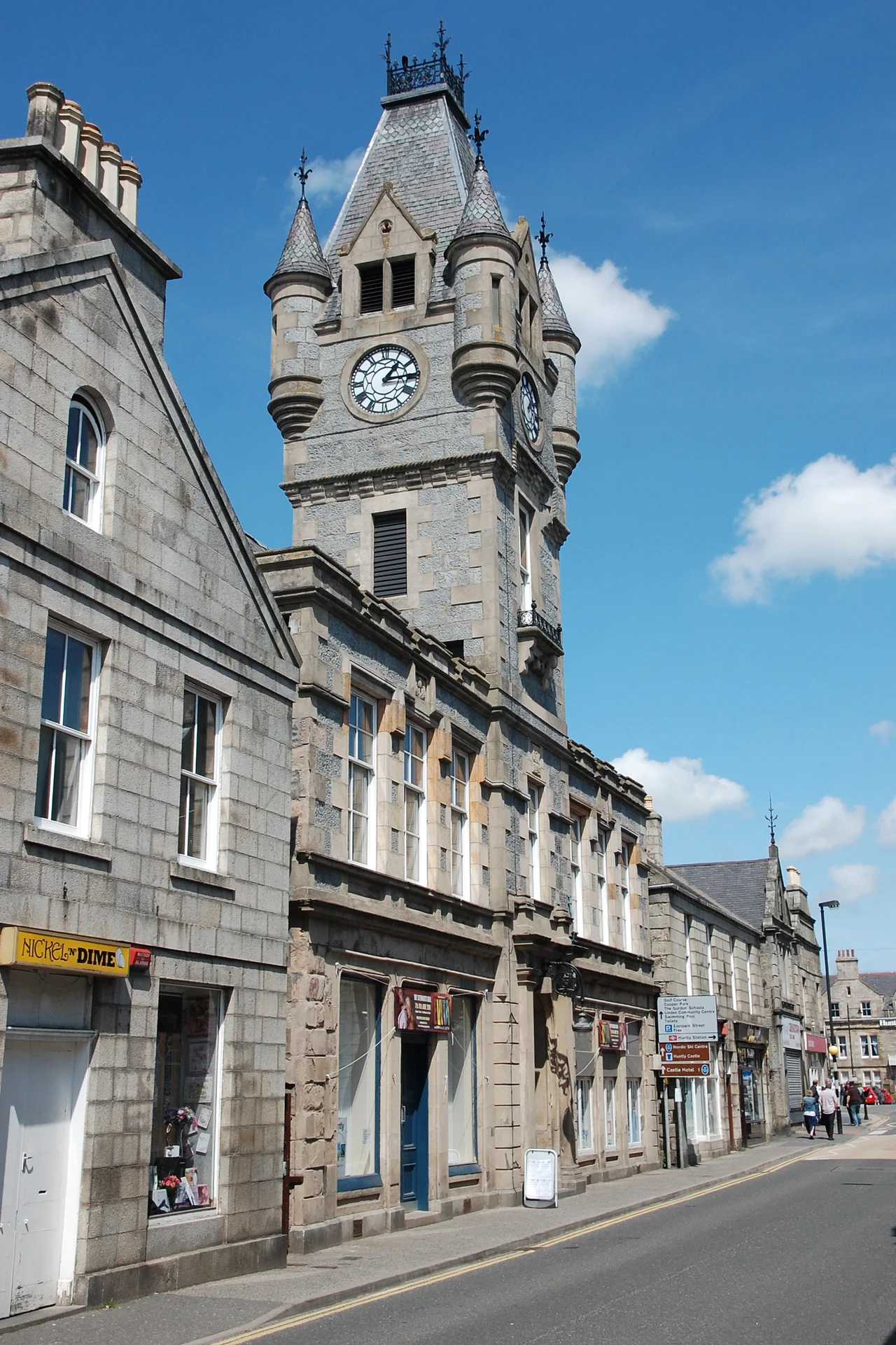
.jpg)
Huntly
For most of its history this place was called Strathbogie. Then in 1508 the Gordons received a royal charter that let them rename the town and its castle after Huntly, their ancestral seat down in Berwickshire. The new name stuck. The town at the confluence of the Bogie and the Deveron has been Huntly ever since, even as the Gordons themselves rose and fell - Cock o' the North, Catholic in a Reformation kingdom, twice sacked by their own monarchs, eventually outlasted by the regiment that bore their name. The Gordon Highlanders are gone; Huntly remains, a market town of around 4,650 people on the Aberdeen-to-Inverness line, host to four owls that flew through the Harry Potter films and a contemporary art organisation that has used the entire town as its venue since 1995.
Confluence and Vitrified Stone
Long before the Gordons or the burgh charter, people lived where the rivers met. Neolithic remains have been excavated on Battlehill on the outskirts of the town, alongside an Iron Age hillfort. A few miles west rises Tap o' Noth, a vitrified hillfort dating to Pictish times - one of those mysterious stone ramparts in which the rocks have been fused together by enormous heat, whether by accident, military destruction, or deliberate magical ceremony. Nobody knows. What is certain is that the high ground was important enough to fortify on a grand scale. The site at the confluence below controlled the routes from Moray into Strathdon and Deeside. Around 1180, Donnchadh II, the Gaelic-speaking 2nd Mormaer of Fife, raised the first motte-and-bailey castle here. The Picts had a thousand years here. The Gaels followed.
How the Gordons Got the Place
The Gordons were originally a Berwickshire family of Anglo-Norman origins. They acquired the lands at Strathbogie in 1352 - not by conquest or marriage but as a royal gift, made in retaliation for the previous owner's bad timing. David of Strathbogie, a descendant of the Earls of Fife, had defected from Robert I to Edward II's cause on the eve of the Battle of Bannockburn. Bannockburn went badly for Edward, and David lost his lands. The Gordons inherited them and proceeded to spend the next four hundred years becoming the dominant family of the north-east. Through warfare, dynastic marriage, and patient acquisition, the clan chief became known informally as Cock o' the North. The settlement at the foot of the castle grew with the family. In 1472 it became a burgh of barony. In 1508 the royal charter renamed it Huntly.
Bombarded Twice
The Gordons were Catholic, and the Scottish Reformation made that complicated. In 1562 the 4th Earl of Huntly rebelled against the Protestant settlement of Mary, Queen of Scots, and Huntly Castle was bombarded and sacked. The earl died of apoplexy after the Battle of Corrichie that followed; his embalmed body was paraded through Edinburgh for the trial. In 1594 the castle was bombarded and sacked again, this time on the orders of James VI, after the family's continued Catholic intrigues. The Gordons recovered each time, partly through politics, partly through the sheer size of their estates, partly through marriages back to the heart of Scottish power. The castle was rebuilt as a Renaissance palace, with friezes and heraldic carvings that survived even the seventeenth-century wars. The ruins you see today carry both the grandeur and the violence.
The Regiment Raised Here
Huntly is the historic home of the Gordon Highlanders regiment, raised in 1794 by the 4th Duke of Gordon and recruiting throughout the north-east of Scotland for the next two centuries. The Gordon Schools, a secondary school next to Huntly Castle, was endowed by the Duchess of Gordon in 1839 and still carries the family name into the present. The regiment fought across the world from Egypt to Belgium to the Western Front to North Africa, and many of its soldiers came from the farms and villages around this small town. When the regiment was amalgamated in 1994, Huntly lost a tradition that had defined its public identity for two hundred years. The Gordon Schools remain. The castle ruins remain. The bronze Gordon Highlander still watches the Inverurie town square from his memorial. The men they remember are part of every Aberdeenshire family with deep roots.
A Town That Became a Venue
Since 1995 Huntly has been home to Deveron Projects, an arts organisation that operates on a startling premise: the town itself is the venue. Artists from around the world come to live and work in Huntly for weeks or months at a time, making projects rooted in this specific place - its forestry, its geology, its botany, its food, its anthropology, its history and politics. Over a hundred artists have spent time here, including the Swiss artist Roman Signer and the English long-distance walker Hamish Fulton. Deveron's Walking Institute commissions artists to make walks across the surrounding country. In 2013 the organisation won Huntly the Creative Place Award. A town of 4,650 has, almost by accident, become one of the more internationally connected small communities in Scotland - and one of the few where you can buy your groceries on a street where George MacDonald, the Victorian fantasy writer who shaped C. S. Lewis and J. R. R. Tolkien, grew up.
From the Air
Huntly sits at 57.450N, 2.783W, at the confluence of the River Bogie and the River Deveron in north-west Aberdeenshire. From the air look for the rivers joining just north of the town, the ruins of Huntly Castle on the north edge of the settlement, the green expanse of the Gordon Schools grounds, and the line of the Aberdeen-to-Inverness railway passing through. Tap o' Noth, the great vitrified Pictish hillfort, sits about 7 nm to the south-west. Strathbogie - the historical name for the surrounding country - extends in every direction. Nearest airport: EGPD (Aberdeen Dyce), 31 nm to the east-south-east.
Nearby Stories
- Boyne Castle 2.7 km away
- Pitsligo Castle 4 km away
- Battle of Lumphanan 4.2 km away
- Battle of Pitgaveny 6.8 km away
- Aberlour Distillery 9.2 km away
- Abergeldie Castle 9.5 km away
- Old Slains Castle 12 km away
- Eyemouth Disaster 137 km away