
Hyde Park and Regent's Park bombings
At twenty minutes past ten on a warm Tuesday morning in July 1982, sixteen mounted soldiers of the Blues and Royals were trotting south down South Carriage Drive in Hyde Park, on their daily ride to the Changing of the Guard. They were close enough to Knightsbridge Barracks to hear the city waking up around them. A blue Morris Marina was parked along the route. Inside it, twenty-five pounds of gelignite were packed around thirty pounds of six-inch nails. Someone in the park, watching, pressed a button.
The Morning Ride
Three troopers - Roy Bright, Jeffrey Young, and Simon Tipper - died at the scene. Denis Daly, the standard-bearer, lived three days more before his injuries killed him as well. Seven of the cavalry horses died with them. The blast threw nails and shrapnel across the road and into the parked cars, the trees, the morning commuters. Twenty-two people were taken to hospital, eighteen of them soldiers, and the photographs from that morning - a guardsman in dress uniform lying in the road beside a dying horse - remain among the most painful images of the long conflict the British still call the Troubles. The detonation was almost certainly remote. Investigators concluded the bomber had been standing in the park, watching the cavalry come, choosing the precise moment.
Sefton
Among the seven horses killed was a roll call that the regiment still recites: Cedric, Epaulette, Falcon, Rochester, Waterford, Yeastvite, and Zara. The horse that survived was Sefton, a 19-year-old Irish-bred bay belonging to Trooper Michael Pedersen. Sefton took thirty-four wounds. A six-inch nail lodged in his jugular vein, missing the artery by a hair. The veterinary surgeons at the Royal Army Veterinary Corps barracks at Melton Mowbray worked through the night and through the months that followed. He recovered. Sefton lived another eleven years and was named Horse of the Year in 1982 - a national symbol of survival, photographed grazing peacefully at the Defence Animal Centre. His story carried something the country desperately needed that summer: a creature that had been at the center of the violence and somehow walked out alive.
Regent's Park
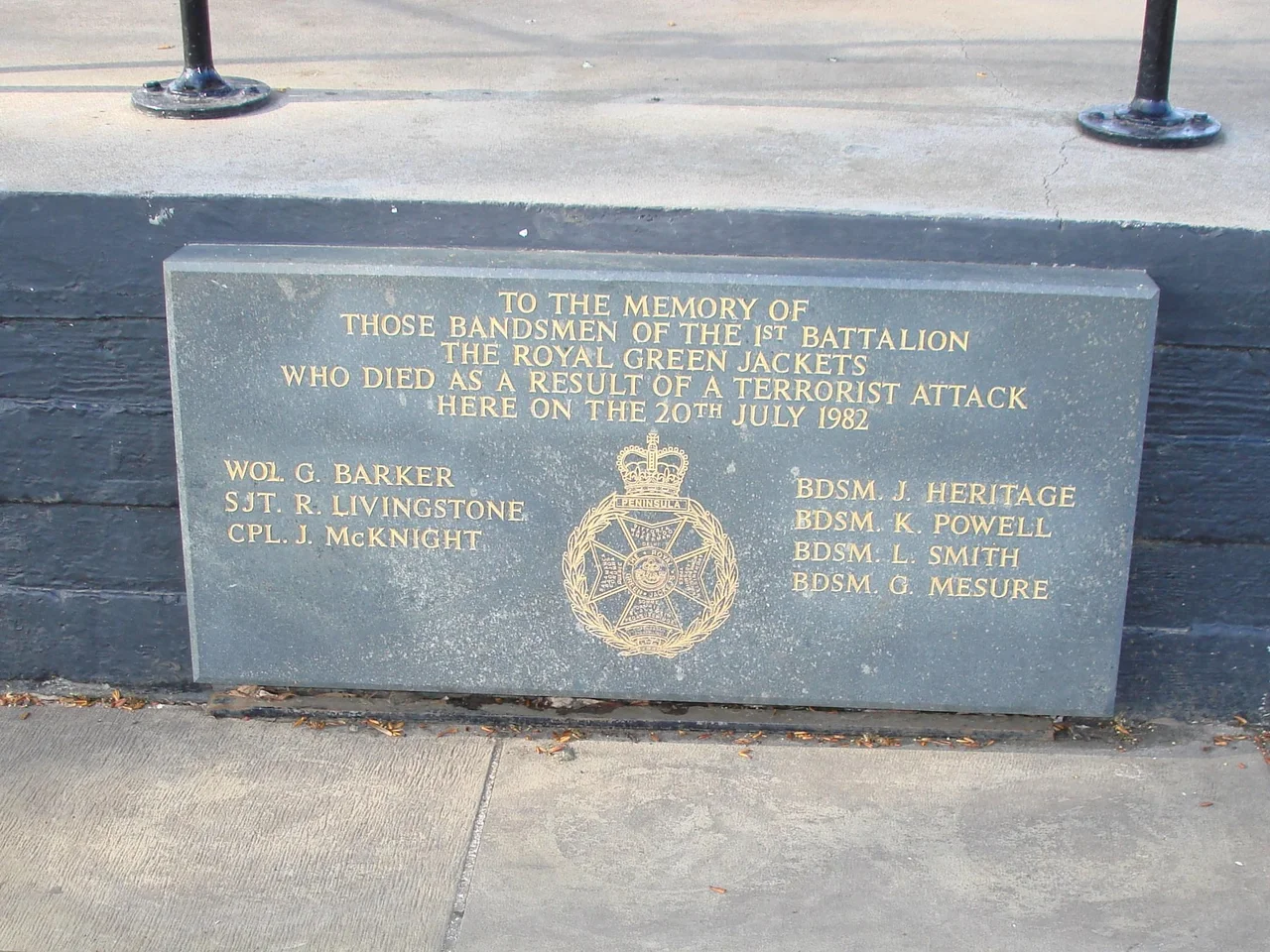
Two hours later, in Regent's Park, the Band of the 1st Battalion, Royal Green Jackets was halfway through a free lunchtime concert. Around a hundred and twenty people had gathered on the deck chairs to listen to selections from Oliver! at the cast-iron Victorian bandstand. The bomb had been hidden beneath the stand sometime earlier - waiting, on a timer, for the music. When it went off, the bandstand collapsed inward on the musicians. Seven of the thirty bandsmen died: John Heritage, John McKnight, George Mesure, Robert Livingstone, Keith Powell, Graham Barker, and Laurence Smith. The youngest was nineteen. Most of the audience, sitting back from the structure, survived with injuries. No one has ever been charged with the Regent's Park bombing. The bandstand was rebuilt to the same Victorian pattern - the kind of quiet act that says, we will not let you take this place from us.
The Long Tail
The grief did not stop in July 1982. Trooper Pedersen, who survived the Hyde Park blast on Sefton's back, lived for three decades with what his doctors finally named as post-traumatic stress. In September 2012, after his marriage ended, he killed his two children and then himself in a country lane in Hampshire. He was forty-eight. It is impossible to draw a neat line between a bomb and a tragedy thirty years later. But the people who knew him drew it. As for the men accused of building the Hyde Park device, the courts could never quite close the file. Danny McNamee was sentenced in 1987 and saw his conviction quashed in 1998. John Downey's trial collapsed in 2014 when it emerged that he had been sent a letter, in error, telling him he would not be prosecuted - one of 187 such on-the-run letters. In 2019 a civil court ruled he had been an active participant. The criminal case never reopened.
The Daily Salute
A simple stone memorial stands today at the edge of South Carriage Drive, on the spot where the cavalry rode that morning. It lists the four soldiers by name. Every weekday, when the Household Cavalry mount changes the guard, the troop reaches that stone and the order is given: eyes left. Swords drawn. Salute. The horses pass, the riders look across at the names, and the column moves on. In Regent's Park, a small bronze plaque near the rebuilt bandstand carries the seven bandsmen's names. The Pink Floyd song 'The Gunner's Dream' from 1983 contains a single bitter line about the day - a wish for a world where 'maniacs don't blow holes in bandsmen by remote control'. Both parks today look exactly as you would expect a London royal park to look in summer: dogs on the grass, children on the bandstand steps, deckchairs in the sun. The violence is gone. The names stay.
From the Air
The two memorial sites lie at the heart of central London at 51.526N, 0.157W. The Hyde Park bombing memorial sits along South Carriage Drive on the south side of the park, near Knightsbridge. The Regent's Park bandstand stands roughly two miles to the north-northeast, near the Inner Circle. Both are easily picked out from low approaches into London City Airport (EGLC) or coming into Heathrow (EGLL) from the east. London's TMA controls almost all overflight - sightseeing helicopter routes hug the Thames a half-mile south of Hyde Park.
Nearby Stories
- Stevenage 5.7 km away
- Malling Abbey 5.7 km away
- 1952 Farnborough Airshow Crash 7.7 km away
- Ingatestone Hall 8.2 km away
- Hellfire Caves 9.1 km away
- The Carrington Event: The Solar Storm That Could Happen Again 9.8 km away
- Bletchley Park 16 km away
- Castle Hedingham 23 km away