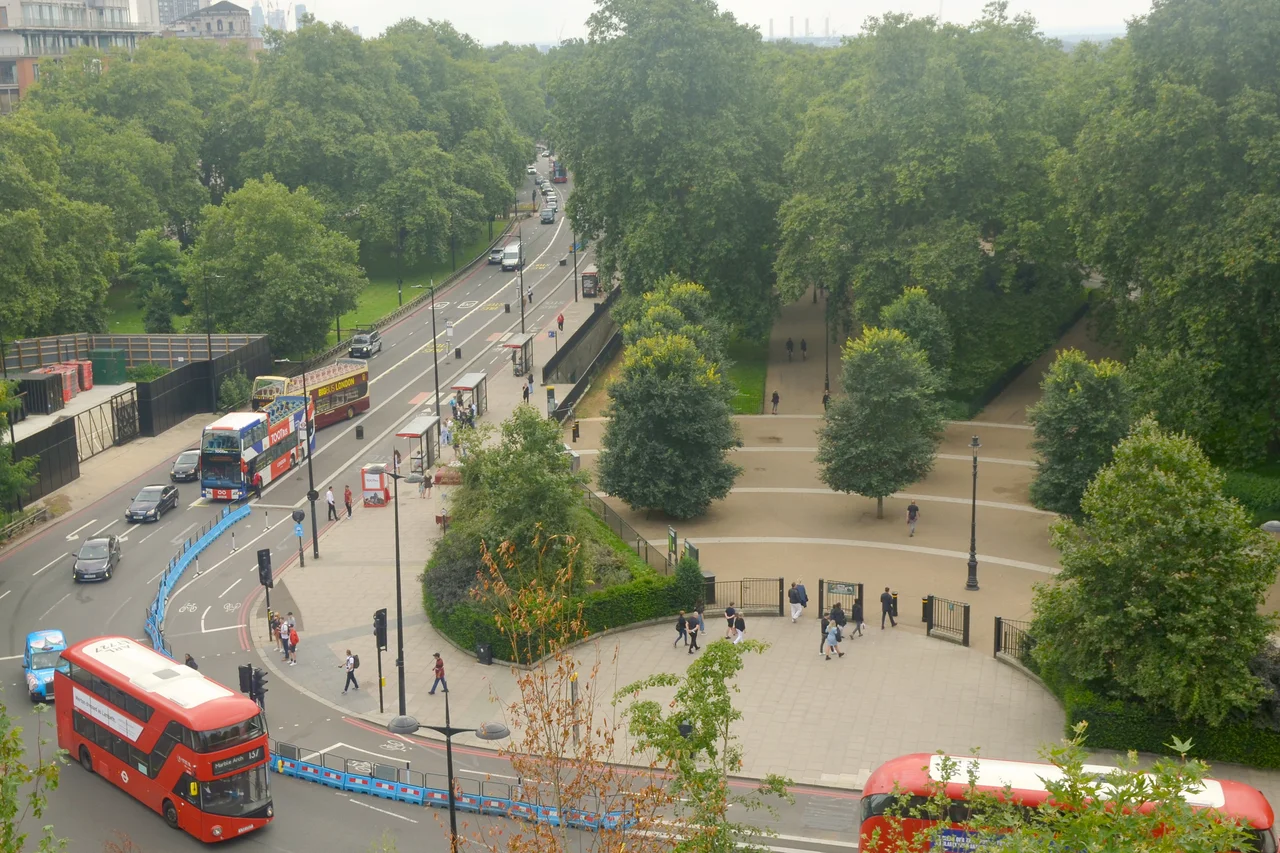

Hyde Park, London
Walk in from Marble Arch on a Sunday morning and the first thing you'll hear is shouting. A man on a stepladder in a tweed jacket is explaining the End Times. Beside him, a woman with a megaphone is denouncing the city council. Tourists film both. None of them seem to mind being filmed. This corner of the park, just inside the gate, has been London's open-air debating chamber since 1872 - the only place in the country where a citizen can stand on a box and say more or less anything to anyone who'll listen. It's the smallest, loudest postage stamp of a 350-acre park.
Henry's Hunting Ground
Hyde Park exists because Henry VIII wanted to chase deer without crossing London. In 1536, riding the dissolution of the monasteries, he took the manor of Hyde from Westminster Abbey and threw a fence around it. For exactly a hundred and one years it was a private royal hunting ground - oak and hazel and bramble, with deer drives and gamekeepers and the occasional execution. Charles I opened it to the public in 1637, and Londoners poured in for May Day parades. During the English Civil War in 1642 a string of earthworks was thrown up along its eastern edge, with a checkpoint at what is now Hyde Park Corner to vet anyone entering the city. In 1665, when the Great Plague was killing 7,000 Londoners a week, the army camped here. The park has always been London's overflow - the place the city went when it needed room.
Caroline's Lake
The Serpentine is not a river. It looks like one, snaking 700 metres east-to-west through the middle of the park, but it was dug. In 1730, Queen Caroline - wife of George II, and an enthusiastic landscape gardener - had the little River Westbourne dammed to create the broad ornamental water. Workers raised the dam on the eastern edge and let the lake fill. At the same time she split Hyde Park from Kensington Gardens, which had been a single estate, and the Serpentine became the boundary. The lake has hosted everything since. In 1814 Londoners watched a model re-enactment of the Battle of Trafalgar on its surface, complete with a tiny French fleet that sank as the band played 'God Save the King.' The Hyde Park Lido opened on its south bank in 1930 after the Sunlight League petitioned for somewhere proper to swim. Members of the Serpentine Swimming Club still go in on Christmas morning, when the lake is sometimes broken with ice.
The Crystal Palace
For five months in 1851, the south side of the park held one of the strangest buildings ever erected in Britain. Joseph Paxton, a gardener who designed greenhouses for the Duke of Devonshire, sketched the Crystal Palace on a piece of pink blotting paper during a railway board meeting. It was 1,851 feet long - a deliberate echo of the year - and made almost entirely of cast iron and 300,000 sheets of plate glass. Six million people walked through it during the Great Exhibition, more than a third of Britain's population at the time. When the exhibition closed, the public refused to let the building be demolished. Paxton raised the funds himself, dismantled it pane by pane, and rebuilt it on Sydenham Hill in south London, where it stood until it burned down in 1936. The footprint in Hyde Park is now lawn. If you stand near the rose garden and look toward Knightsbridge on a summer evening, you can almost see the ghost of it - a glass cathedral that filled this corner of the city for half a year.
Concerts and Concrete
On 29 June 1968, Blackhill Enterprises put on the first free rock concert in Hyde Park. Pink Floyd headlined, with Roy Harper and Jethro Tull. John Peel later called it 'the nicest concert I've ever been to.' A year later, Brian Jones drowned in his swimming pool two days before the Rolling Stones were due to play here; they went ahead anyway, and Mick Jagger read from Shelley's 'Adonais' before releasing thousands of white butterflies over the crowd. In September 1976, Queen drew somewhere between 150,000 and 200,000 people to a free Richard Branson-organised concert - the largest single-day crowd the park has ever held. Police told Freddie Mercury they would arrest him if he tried to play an encore. He did not. The park kept hosting them: Live 8 in 2005 brought Pink Floyd's classic line-up together for the last time. Today the annual BST Hyde Park festival fills the same lawns each July with sound systems the Victorians could never have imagined - and neighbours in Mayfair who would gladly tear them out.
Memorials in the Grass
If you walk the park slowly, the dead start to appear. The Cavalry Memorial stands near the Serpentine, bronze St George trampling a dragon. Just south of the water, the Diana, Princess of Wales Memorial Fountain - an oval ring of Cornish granite that opened in 2004 - runs cold and shallow enough for children to splash through. Britain's Holocaust Memorial sits in a quiet clearing east of the Serpentine, two boulders carved with words from the Book of Lamentations. The 7 July Memorial near Lover's Walk is 52 steel pillars, one for each person killed by suicide bombers in the 2005 London transport attacks - arranged in four clusters for the four bomb sites. And tucked away in a hedge at the north edge of the park is something unexpected: a pet cemetery, started in the 1880s, with several hundred small Victorian headstones for dogs and cats whose owners lived along Bayswater Road. The last burial there was in 1976. The park does not advertise it. You have to know where to look.
From the Air
Hyde Park lies in the centre of London at 51.509N, 0.164W - a clear green rectangle bounded by Bayswater Road to the north, Park Lane to the east, Knightsbridge to the south, and merging with Kensington Gardens to the west. The Serpentine cuts a distinctive S-curve through the middle. From the standard arrival routes into Heathrow (EGLL, 12 nautical miles west) the park is one of the first major landmarks visible after the Thames. London City (EGLC) lies six nautical miles east. Helicopter routes hug the Thames south of the park; fixed-wing overflight below 2,400 feet requires Heathrow or London City clearance.
Nearby Stories
- Stevenage 5.7 km away
- Malling Abbey 5.7 km away
- 1952 Farnborough Airshow Crash 7.7 km away
- Ingatestone Hall 8.2 km away
- Hellfire Caves 9.1 km away
- The Carrington Event: The Solar Storm That Could Happen Again 9.8 km away
- Bletchley Park 16 km away
- Castle Hedingham 23 km away