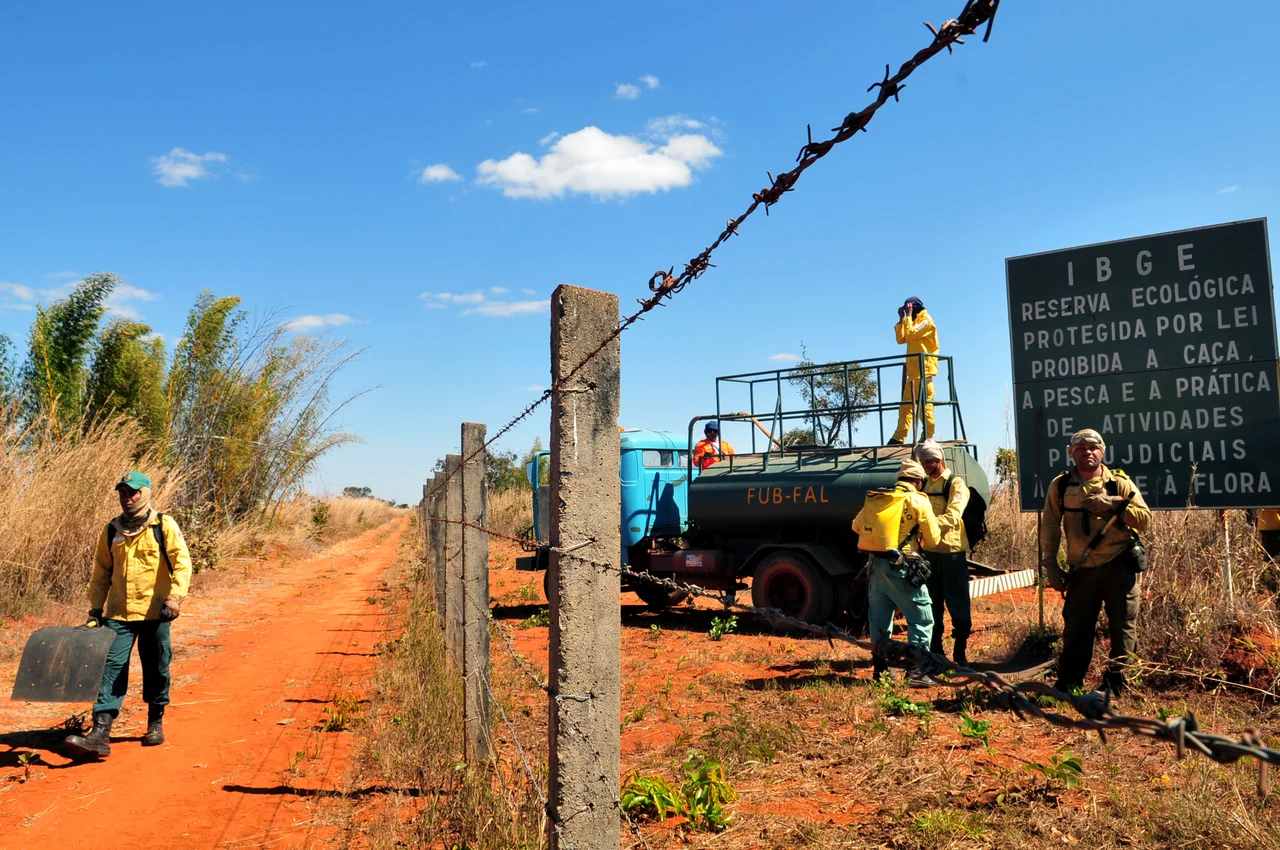

IBGE Ecological Reserve
The Cerrado is the richest savanna on Earth - and also one of the most rapidly vanishing. At the turn of the 2010s, it was being cleared at roughly 14,200 square kilometers a year, a pace that turns biomes into memory inside a generation. The IBGE Ecological Reserve sits on a gentle plateau 25 kilometers south of Brasília, a 1,300-hectare island of scientific refuge where researchers have been racing to document what exists before it disappears. More than a thousand scientific papers have drawn data from this one plot of land. 177 doctoral theses have been built on its observations. The cerrado doesn't perform for visitors here - visitors are mostly excluded - but for the biologists who do get access, this is one of the best-studied patches of savanna anywhere in the world.
An Accidental Laboratory
Until 1956, cattle herders and subsistence farmers worked this land. Then the Federal District, just beginning to build its new capital on the plateau to the north, requisitioned it. In 1961 the land was donated to the Brazilian Institute of Geography and Statistics - the IBGE, which gives the reserve its name. On 22 December 1975, the institute formally created the Reserva Ecológica do Roncador, named for the stream that drains its center. The acronym RECOR still sticks to researchers' tongues. By the late 1970s, scientific papers had begun to trickle out: insect ecology, tree growth rates, the surprising presence of heavy metals in the soil. A weather station went up in 1979-80. A plant nursery followed. What had been ranchland quietly turned into one of the most instrumented ecosystems in Brazil.
A Cerrado Near Brasília
The reserve sits on Precambrian metasedimentary rocks from the Brasiliano orogeny - stone laid down between 550 and 900 million years ago, before animals with shells had evolved - capped by a Tertiary-era crust of detrital laterite. The land tilts gently between 1,048 and 1,160 meters, drained toward the northwest by the Taquara, the Roncador, and their tributaries with beautiful small names: Escondido, Monjolo, Pitoco. Gallery forests thread along the streams, thick and damp, while the interfluves support the classic cerrado of twisted trees with corky bark and deep taproots - adaptations to fire and drought that took millennia to perfect.
The Rainy Season
From September or October through April or May, the rains come. Mean annual rainfall is 1,453 millimeters - enough for the cerrado's grasses to green up explosively and the streams to run full. The dry season that follows stretches May to September, and the average annual temperature hovers around 20°C, cool for a Brazilian latitude thanks to the altitude. The plateau's weather station has logged these patterns for more than four decades now, a continuity that is itself a kind of rarity. You can't do real ecology without deep time, and the reserve has been banking time since Jimmy Carter was in the White House.
A Plant List Longer Than Most Countries'
By 2004, researchers had catalogued 1,829 species of vascular plant inside the reserve - 1,503 native, 326 exotic. The phanerogamic flora here has been called the most diverse arboreal collection in Central Brazil. Eighteen species of liverworts have been pressed and identified. Native grasses like Tristachya leiostachya, Olyra ciliatifolia, and Olyra taquara grow alongside a handful of tiny micro-orchids, their flowers small enough to miss if you aren't looking for them. One hundred and one species of herpetofauna - frogs, lizards, snakes - have been recorded, and herpetologists suspect the real number is higher. The reserve is as much a database as a place.
Wolves, Anteaters, and the Tapaculo
More than 250 species of birds pass through the reserve over the course of a year. Two waves of migrants time their arrival to insect abundance - a winter cohort and a spring cohort, both feasting. The giant anteater shuffles across its grasslands, nose to the ground, hunting ant mounds with a tongue longer than your forearm. The maned wolf - Brazil's leggy, red-furred, almost fox-like canid - slips between copses at dusk. The pampas deer, now rare, still appears. A small bird called the Brasília tapaculo, endemic to the highlands around the capital, sings from the undergrowth, and a fish called the Brasília lyrefin lives in the reserve's streams. The bush dog, a stocky little pack hunter, prowls the gallery forests. It's a full cast of cerrado, kept intact because a federal agency had the foresight in 1975 to draw a line around it.
From the Air
Coordinates 15.95°S, 47.88°W. The reserve sits just south of Brasília at 1,048-1,160 meters elevation. Brasília International Airport (SBBR) is roughly 25 km north - flights approaching SBBR from the south pass over or near the reserve and the contiguous Gama-Cabeça de Veado protected area. Look for the distinct pattern of gallery forests along the Roncador and Taquara drainages against the open cerrado plateau. Access on the ground is restricted to researchers.
Nearby Stories
- Luziânia 9.9 km away
- Contagem Biological Reserve 13 km away
- Formosa, Goias 18 km away
- Corumbá de Goiás 31 km away
- Formosa 44 km away
- Anápolis 50 km away
- Unaí 64 km away
- Ceres, Goiás 122 km away