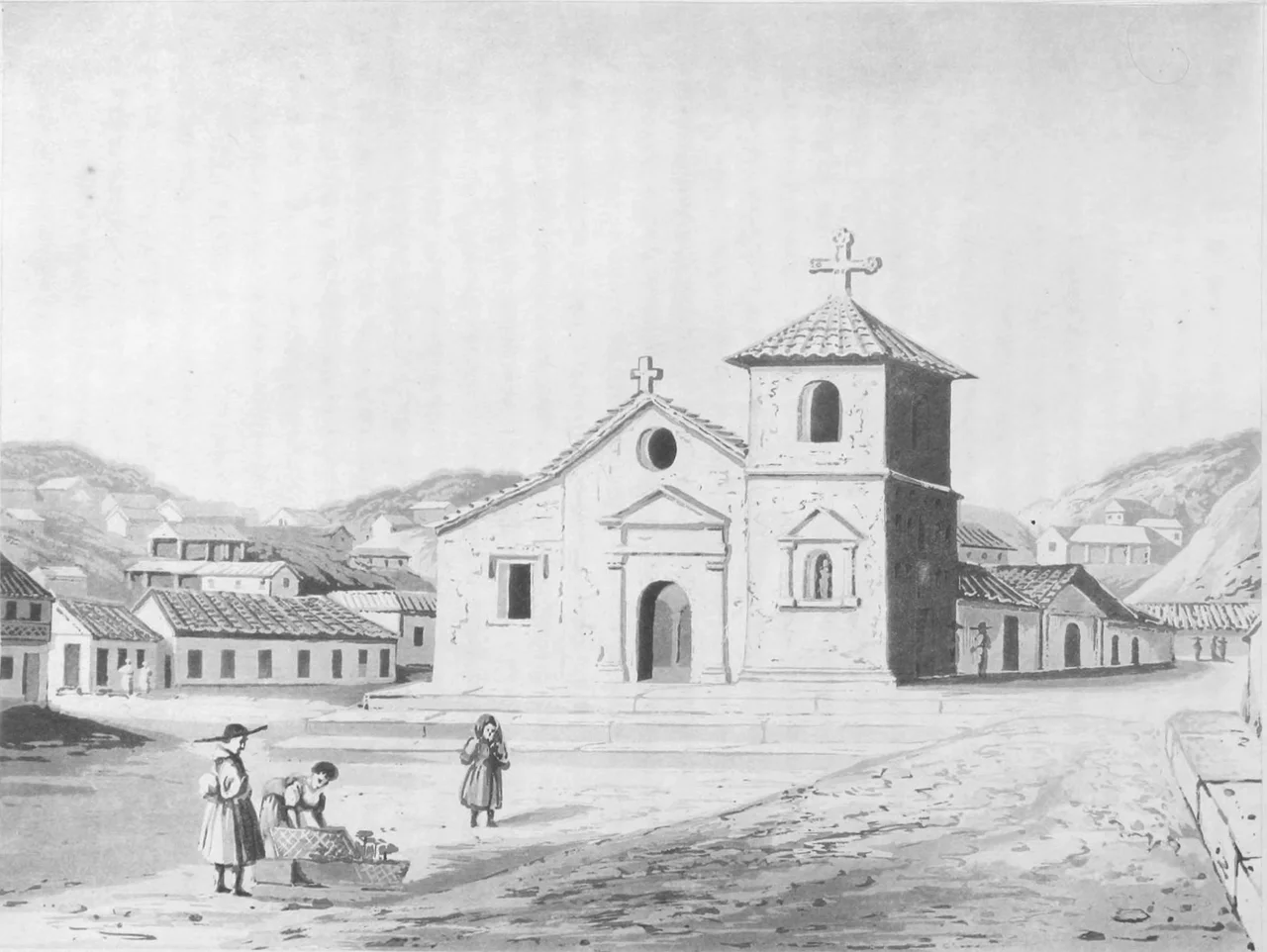

Iglesia de la Matriz
In 1578 the English privateer Francis Drake sailed into Valparaíso's bay, sacked the little port, and put its only chapel to the torch, carrying off a silver chalice for good measure. That chapel had stood barely twenty years. Its successor on the same ground is the Iglesia de la Matriz del Salvador, the Church of the Saviour, and it has been knocked down and raised again so many times that the building you see today is the fourth on the site. To climb the worn steps into the cool, adobe-walled nave is to enter the spot where Valparaíso's recorded history as a Christian town first took root, in the cobblestoned heart of Barrio Puerto.
A Chapel That Was Barely a Hut
The story begins in 1559, when Rodrigo González de Marmolejo, the Bishop of Santiago, founded the first temple in Valparaíso. Calling it a temple flatters it. The chronicles describe something closer to a hut, a rough shelter raised at the foot of Cerro Santo Domingo to serve a settlement of a few hundred souls clinging to the shore. As the port grew, so did the demands on its church. A procession of religious orders passed through over the centuries, the Augustinians arriving in 1627, the Franciscans in 1664, the Mercedarians in 1715, and later the priests of the Sacred Hearts in 1834 and the Jesuits in 1850, each leaving a trace in the parish's long memory.
Pirates, Privateers, and the Open Sea
Valparaíso faced the Pacific with almost no defenses, and that vulnerability shaped the church's early life. Drake's raid of 1578 was the most famous assault, but it was not the last. Through the seventeenth and eighteenth centuries the chapel endured repeated attacks from pirates and corsairs drawn to a wealthy, lightly guarded port at the edge of the Spanish empire. Treasures vanished, walls were scorched, and the small congregation rebuilt each time. For the sailors who prayed here before rounding Cape Horn, the church was both a comfort and a reminder of how exposed their town truly was, a single bell tower facing an ocean full of predators.
Rebuilt Stone by Stone
The sea was only half the threat. This is earthquake country, and the ground itself has repeatedly destroyed what the faithful built. A violent quake in November 1822 wrecked the church so thoroughly that it had to be raised again stone by stone, though the town had little money to spare. The ruins sat exposed for more than a decade. Reconstruction finally began in 1837 and finished in 1842 under the priest José Antonio Riobó, and that fourth church is the one still standing. In 1868, in a curious turn, the building briefly traded prayer for politics and served as a polling place during an election, its nave filled with voters instead of worshippers.
Three Ships in Stone
Step inside and the architecture rewards a slow look. The church follows a basilica plan, its space divided so that the interior reads almost like three vessels set side by side, an echo perhaps fitting for a town that lived by the sea. Eight columns frame the body of the nave, and overhead the ceiling carries painted scenes. Two sensibilities meet in the design: the restrained classicism of the tower, and the heavy, earthy creole style of the eighteenth century, expressed in thick adobe walls and a roof of fired clay tiles. In 1971 Chile recognized the church and its surrounding lanes as a national monument, protecting the oldest sacred ground in the city.
The Heart of the Old Port
The church does not stand apart from its neighborhood; it is the neighborhood. La Matriz sits at the center of Barrio Puerto, surrounded by cobblestone streets and the tightly packed houses of the old port district, many dating to the nineteenth century. This was always the parish of working Valparaíso, the sailors and dockhands and market vendors whose lives ran on the tide. The quarter has known hard decades, and the church has weathered them alongside the people who live in its shadow. To find La Matriz today you walk down from the grander hills into the dense lower town, where the steeple rises over a maze of lanes, still calling its corner of the Jewel of the Pacific to prayer after more than four and a half centuries.
From the Air
The Iglesia de la Matriz stands at 33.036°S, 71.632°W, at the foot of Cerro Santo Domingo in the sea-level core of Barrio Puerto. From the air it is best located by the curve of the working port just to its north and the wall of hills climbing immediately behind it; the church's single tower sits among the dense low rooftops of the old port quarter. Nearest is Viña del Mar Airport (SCVM), a Chilean Navy field roughly 16 km north with limited civilian traffic, and the small Rodelillo airstrip (SCRD) above the city to the southeast. Santiago's Comodoro Arturo Merino Benítez International (SCEL) is the regional hub, about 110 km east over the coastal range. A viewing altitude of 1,500 to 2,500 feet AGL gives the clearest view of the historic quarter; expect a morning marine layer that typically burns off before noon.
Nearby Stories
- Battle of Papudo 24 km away
- Casa de Isla Negra 28 km away
- Battle of Chacabuco 31 km away
- Battle of Maipú 38 km away
- Aconcagua 94 km away
- Constitución, Chile 237 km away
- Santa Olga 278 km away
- 1687 Peru Earthquake 1982 km away