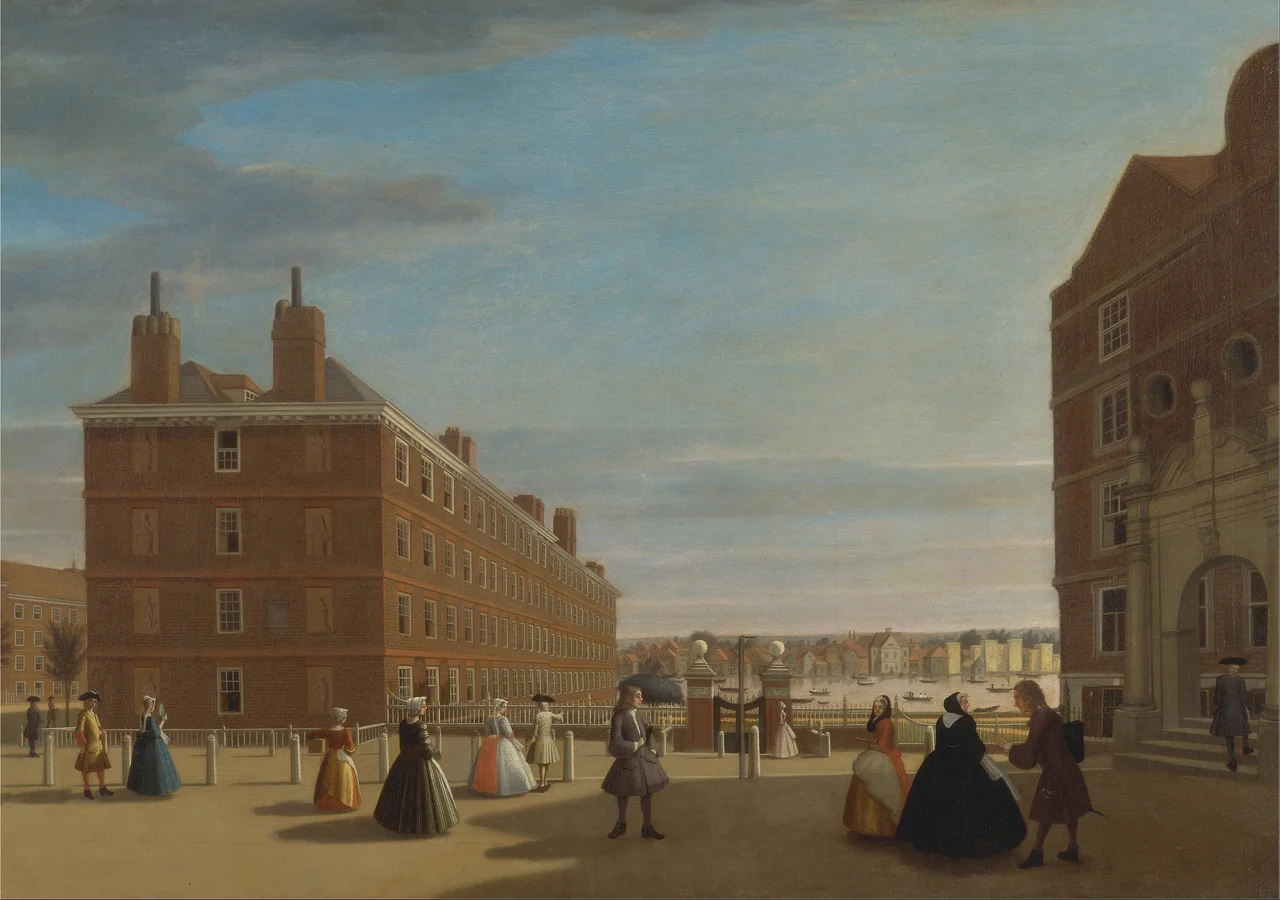

Inner Temple
Step off Fleet Street through the narrow archway beside number 17, and central London goes quiet. The traffic noise drops to a hum. The pavement turns to flagstones. Three minutes' walk from the Royal Courts of Justice you are suddenly in a courtyard of brick chambers, a Templar church with stone effigies of crusader knights on its floor, and a garden that Shakespeare claimed was where the Wars of the Roses began. The Inner Temple has been here since at least 1388. It runs its own roads, owns its own land, and answers to no one in the City of London except, technically, the Crown - for a peppercorn rent that James I set in 1608.
The Knights' Land
The name is the giveaway. The Knights Templar - the warrior monks of the Crusades - bought this stretch of riverbank in the twelfth century and built a complex of buildings around a round church modelled on the Holy Sepulchre in Jerusalem. The church was consecrated by the Patriarch of Jerusalem himself on 10 February 1185, and William the Marshal - the greatest knight of his age, regent of England under the boy King Henry III - was buried there in 1219. His marble effigy still lies in the round. When the Templars were suppressed in 1312, accused by the French king of heresy, the property passed to their rivals the Knights Hospitaller. The Hospitallers used it mostly as a source of rent. Their tenants, almost from the start, were lawyers - common-law men who wanted to be near the courts at Westminster but outside the City's jurisdiction. By 1388 the two groups of lawyers were known as the inner inn and the middle inn. The names stuck.
Sacked and Rebuilt
Wat Tyler's rebels burned the Temple in 1381 during the Peasants' Revolt - not out of any quarrel with lawyers (though that came later) but because the land belonged to the Prior of St John, a particular target of the rising. The chronicler John Stow wrote that after the rebels finished pulling down the houses and burning the Inn's records, they lay drunk in the rubble and 'were slain like swyne.' The lawyers used the chance to rebuild the Hall in the new fourteenth-century style. The Great Fire of London took the Inn again in 1666. Another fire in 1677 took most of what had been rebuilt. The Inn put itself back together each time, and grew. By 1640 it had admitted 1,700 students in forty years and was the second-largest of the Inns of Court behind Gray's Inn. There is something stubborn about the place. Burn it down, sack it, lose it to plague, and the barristers come back the next term with their wigs and their year books.
The Blitz
On the night of 10 May 1941, the worst night of the London Blitz, incendiary bombs gutted the Temple. Temple Church burned. The Hall was lost. The Library, which had grown to contain 26,000 law books and 36,000 historical volumes, went up - 45,000 books were destroyed, though the rarest manuscripts had been moved to safety. The cloisters, the chambers, much of what had survived since the Restoration: gone in a single night. The Inn applied to the War Damage Commission for £1.5 million. It got £1.4 million and found the rest itself. The architect Hubert Worthington designed the new Hall in a restrained classical style; Queen Elizabeth, then Princess, laid the foundation stone in 1952, and the new Hall opened in 1955. The Library followed in 1958. Temple Church was reconsecrated by the Archbishop of Canterbury in 1954. The crusader effigies on its floor had been chipped by falling masonry and the heat had cracked some of the stone, but the knights were still there.
Gandhi, Gilbert, Drake
The list of people who studied here is long and improbable. Mahatma Gandhi was called to the Bar at the Inner Temple in 1891. So was Jawaharlal Nehru. The economist John Maynard Keynes was admitted but never practised. So was the dramatist W. S. Gilbert, who much preferred writing operettas to arguing in court. Admiral Francis Drake was a member. So was the King of Bhutan. So is Lady Justice Butler-Sloss, who chaired the inquiry into the Cleveland child abuse cases. In 1922 the Inn called Ivy Williams - and in doing so made her the first woman ever called to the Bar in England and Wales, though she never practised either; she spent her career teaching law at Oxford. The Inn has educated four Chief Justices of Nigeria, a Prime Minister of Ceylon, a Chief Minister of West Bengal, and roughly half of the legal profession of the British Empire. It still admits about 250 students a year.
Garden, Pegasus, Rookery
The Inner Temple Garden was laid out around 1601 and remains one of the loveliest pieces of green space in central London - a sloping lawn running down toward the Thames Embankment, with herbaceous borders and a sundial from 1707 by Edward Strong the Elder. The iron gates of 1730 carry the Inn's pegasus and Gray's Inn's griffin, side by side, a heraldic record of an old friendship between the two societies. Edward Northey, an eighteenth-century barrister, imported a colony of crows from his estate in Epsom and established a rookery here that lasted generations. Shakespeare, in Henry VI Part 1, set the moment when the white rose and the red rose are plucked in this exact garden - a literary fiction, but the Inn keeps a rose garden in honour of it anyway. The garden opens to the public most weekday lunchtimes in spring and summer. Walk in from Tudor Street, find a bench, and you can sit ten minutes from the Royal Courts of Justice in something that feels closer to a country house than a capital city.
From the Air
The Inner Temple sits at 51.512N, 0.109W on the north bank of the Thames between Blackfriars and Temple stations. From the air it looks like a small enclave of red-brick chambers and a single green garden, just south of Fleet Street and a quarter-mile west of St Paul's Cathedral. Best identified by Temple Church's distinctive round nave - one of only a handful of round churches surviving in England. London City Airport (EGLC) lies five nautical miles east; Heathrow (EGLL) thirteen nautical miles west. The City of London helicopter route follows the Thames directly past the Embankment frontage.
Nearby Stories
- Stevenage 5.7 km away
- Malling Abbey 5.7 km away
- 1952 Farnborough Airshow Crash 7.7 km away
- Ingatestone Hall 8.2 km away
- Hellfire Caves 9.1 km away
- The Carrington Event: The Solar Storm That Could Happen Again 9.8 km away
- Bletchley Park 16 km away
- Castle Hedingham 23 km away