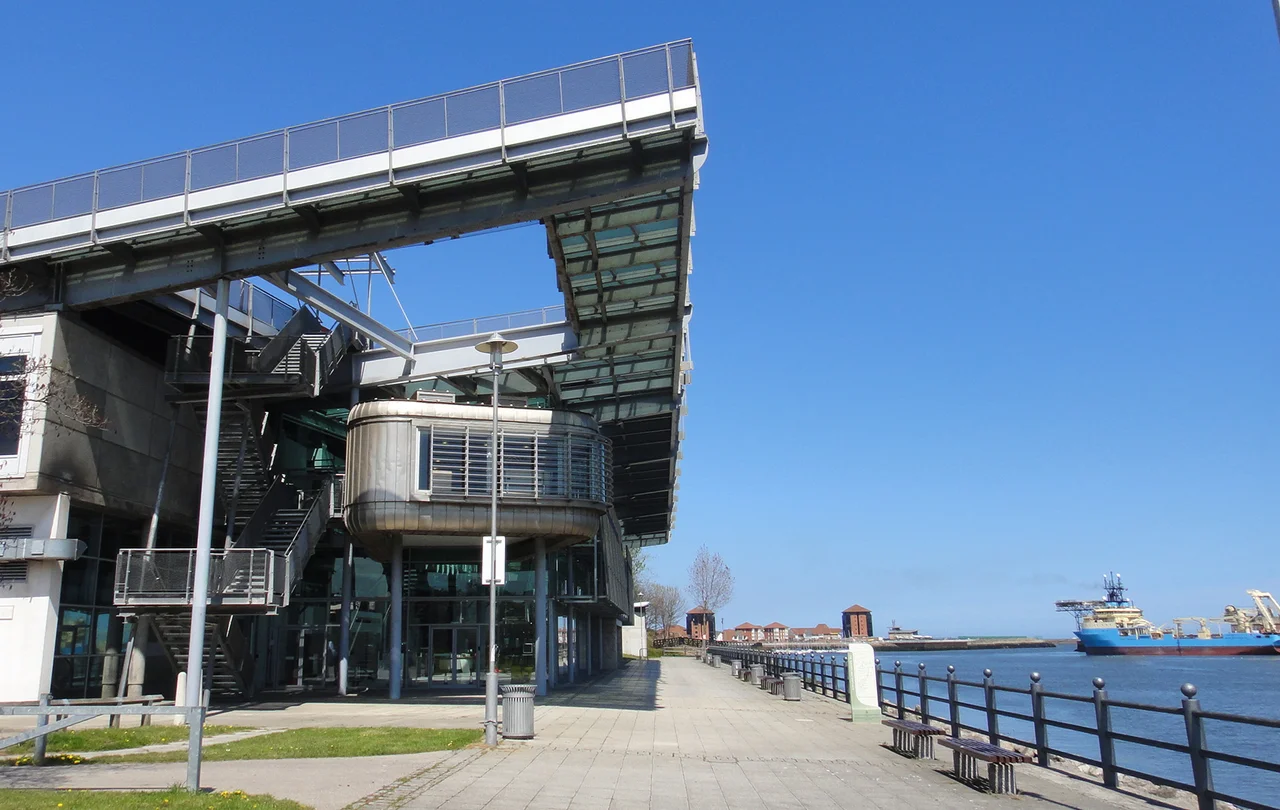

Institute for International Research in Glass
Glassmakers have been firing furnaces on the banks of the River Wear for over thirteen hundred years. The first ones were brought from Francia by Benedict Biscop in the 670s to glaze the windows of the new abbey at Monkwearmouth - the first stone monastery in northern England, and one of the first English buildings to have glass at all. The Institute for International Research in Glass, founded thirteen centuries later in 1998, sits about a hundred metres from where those Anglo-Saxon glassworkers built their workshop. Continuity in Sunderland is sometimes literal.
From Wikipedia to Wear
The Institute was born from a number on a piece of academic paperwork. In the 1996 Research Assessment Exercise - the audit by which British universities are ranked and funded - glass research at the University of Sunderland received a special mention and an international rating. That number unlocked grant money. The university created two full professorships in glass, the first of their kind in the United Kingdom, and appointed Dan Klein and the Slovak glass artist Zora Palová. Planning began that year. The Institute formally launched in June 1998 to complement the new National Glass Centre, which Prince Charles opened in October. The Institute became the first research centre of the University of Sunderland's Art and Design faculty.
A Czech Curator at the Helm
Sylva Petrova arrived from Prague to direct the new Institute. She had spent her career as curator of twentieth-century glass at Prague's Museum of Decorative Arts, where she helped build one of Europe's most important collections of Czech studio glass. Czech glass and English glass are two distinct schools, both rooted in centuries of regional skill. Bringing Petrova to Sunderland linked them. She led the Institute from 1998 to 2012, expanding its international footprint, mounting exhibitions in the Czech Republic, Slovakia, Japan, Croatia, and Singapore. When she retired, Dr Kevin Petrie took over. The Institute's biannual research conference, Parallels and Connections, treats glass and ceramics as sister disciplines that have too long been kept in separate rooms.
Residencies, Fellowships, and Strangers
The Institute works the way a good research lab works - it brings strangers into the building and watches what they make together. Visiting professors have included the Finnish glass designer Oiva Toikka, the Swedish artist Bertil Vallien, and the Czech engraver Jiri Harcuba. Fulbright Specialists Tim Tate and Michael Janis came from the United States in 2012. The Crafts Council placed artists-in-residence here through the Next Move programme. The Artists Access to Art Colleges scheme has rotated through dozens of makers working in glass casting, lampworking, kiln-formed sculpture, and slumped vessel work. Each residency leaves behind a piece of practice the next residency builds on.
Wheel and Water, Kith and Kin
The Institute's exhibitions read like a tour of contemporary glass thought. Wheel and Water Grind an Edge, mounted at the National Glass Centre in 2005, took its title from a working glass studio's two essential elements and asked what they meant when extended into sculpture. The 2012-13 exhibition Kith and Kin paired new glass with new ceramics, arguing that the materials had more to say to each other than the curatorial divisions of the art world usually allowed. None of this looks much like Benedict Biscop's Francian glassworkers grinding crown glass for a Northumbrian abbey. But the basic transaction is the same: sand, fire, skill, light. Sunderland still does this. The Institute makes sure it still asks why.
From the Air
The Institute for International Research in Glass occupies the National Glass Centre at 54.913 N, 1.385 W, on the north bank of the River Wear immediately west of the Wearmouth Bridge. The building's distinctive low glass-roofed profile is visible from the air. Cruise at 2,500-4,000 feet to take in the Wear corridor, including the Stadium of Light just upriver and St Peter's Church (the surviving Anglo-Saxon abbey site) almost adjacent. Newcastle International (EGNT) lies 17 nautical miles north-north-west; Durham Tees Valley (EGNV) 22 nautical miles south. Best visibility in westerly weather - easterly winds bring the North Sea haar that grounds the entire coast.
Nearby Stories
- Seaton Carew 2.7 km away
- HMS Unity (N66) 6 km away
- George Stephenson's Birthplace 6.1 km away
- Raby Castle 9 km away
- Cragside 15 km away
- Whitby Abbey 21 km away
- German submarine U-2367 46 km away
- Alexander L. Kielland (Platform) 277 km away