
InterContinental Athenee Palace Bucharest
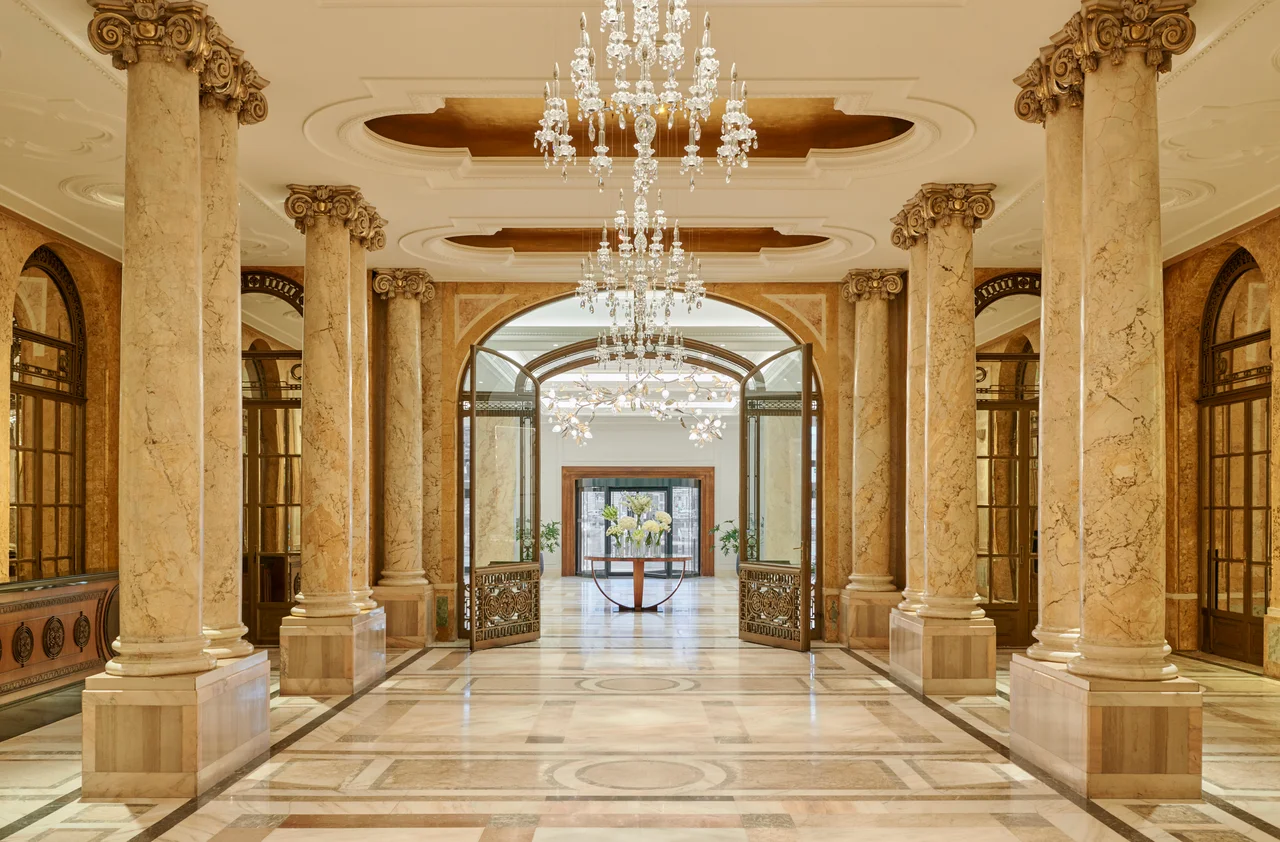
Heavy ornate furnishings, marble and gold pillars, great glittering chandeliers, and the deep settees placed well back in the recesses of the lounge as if inviting conspiracy: that is how A. L. Easterman of the London Daily Express described the lobby of the Athenee Palace in 1938. He was on assignment in Bucharest in the years when Romania was the chess board where every European intelligence service was making moves. The Athenee Palace was the room they all met in. C. L. Sulzberger of the New York Times settled in to wait for war and noted that the staff would happily change a guest's money on the black market. Countess R. G. Waldeck wrote that the hotel was the heart of Bucharest, topographically, artistically, intellectually, politically, and, if you like, morally. Spies sat at the same tables. Diplomats slipped envelopes across them. The piano played on.
First Reinforced Concrete in Bucharest
The hotel was designed by the French architect Theophile Bradeau and built between 1912 and 1914 on the corner of Calea Victoriei and Strada Episcopiei, on the site of an old 19th-century inn called Han Gherasi. Han is Romanian for inn, a relic of the city's earlier Ottoman-influenced commercial vocabulary. The Athenee Palace was the first building in Bucharest to use reinforced concrete construction, a technical novelty that allowed the architect's Art Nouveau facade to support large open public rooms below and rentable accommodation above. It opened just months before the assassination at Sarajevo plunged Europe into the war that would test every neutral capital, Bucharest among them. The hotel sits on what is now Revolution Square, but was not originally a square at all. The space across from the hotel was occupied by the Splendid Hotel and other buildings until American bombing on 24 August 1944 cleared the area.
The Art Deco Remake
Between 1935 and 1937 the architect Duiliu Marcu completely modernized the interior and reworked the exterior in Art Deco style. Marcu was one of interwar Romania's leading architects, responsible for many of the institutional buildings that gave 1930s Bucharest its distinctive blend of French rationalism and Romanian particularism. The new Athenee Palace was crisp and geometric on the outside, plush and theatrical inside. By the late 1930s, with Romania becoming a critical neutral hinge between Nazi Germany, Britain, France, and the Soviet Union, the hotel had filled with foreign correspondents, military attaches, oil-company representatives, and a constantly shifting cast of European nobility on the run from one revolution or another. Countess Waldeck, a German-born American journalist whose 1942 book Athene Palace remains the classic account of those years, captured the atmosphere as one of polite hysteria, where every cocktail might be the last before the war finally arrived.
What the Walls Heard
The bartenders spoke five languages. The waiters knew which guests should not be seated at adjacent tables. The maids reported to multiple paymasters. Romanian intelligence, German intelligence, British intelligence, Soviet intelligence, all maintained networks of informants among the staff. Microphones were installed in many rooms. The Romanian writer and journalist Olivia Manning, who lived in Bucharest with her husband Reggie Smith of the British Council in 1940 and 1941, used the Athenee Palace as the central setting of her Balkan Trilogy novels, later filmed as the 1987 BBC miniseries Fortunes of War with Kenneth Branagh and Emma Thompson. The miniseries was shot in Yugoslavia rather than Bucharest, which by 1987 still bore the scars of Nicolae Ceausescu's reshaping of the city center. But the Athenee Palace itself survived everything: the war, the Soviet occupation, the imposition of communism, the demolition that destroyed so much of historic Bucharest. The hotel kept serving cocktails.
Communism and a New Wing
After 1948 the hotel passed into state ownership. The interiors were remodeled in 1983, and a new wing was added in 1965. Through the long Ceausescu years, the Athenee Palace remained Bucharest's pre-eminent hotel for foreign visitors, which meant it remained a primary collection point for the Securitate, the Romanian secret police. Conversations were monitored. Rooms were watched. The bar scene had less of the cosmopolitan spy fizz of the 1930s, and more of the dour surveillance of the police state, but the building's basic function as the place where outsiders met insiders did not change. After the December 1989 revolution that overthrew Ceausescu, the hotel was renovated extensively and reopened in October 1997 as the Athenee Palace Hilton Bucharest, managed by Hilton International.
What You See From the Windows
The hotel today operates under the InterContinental brand. In 2021, the rooms in the 1965 new wing were fully renovated. From the upper floors you look out across Revolution Square, where in December 1989 Ceausescu addressed his last crowd before being shouted down and forced to flee by helicopter from the roof of the Central Committee building, which still stands across the square. To the right of that building stands the Romanian Athenaeum, the gloriously domed concert hall completed in 1888 that gave the hotel its name. Beyond the Athenaeum runs Calea Victoriei, the Champs-Elysees of Bucharest, lined with the palaces and townhouses of the old Romanian aristocracy and the streetlamps of a city that has lived through more than its share of history. Sit in the lobby tonight. Order a drink. Listen to who is sitting at the next table. The Athenee Palace is still doing what it has always done.
From the Air
Located at 44.441 degrees north, 26.096 degrees east, on the corner of Calea Victoriei and Strada Episcopiei, facing Revolution Square in central Bucharest, Romania. Henri Coanda International Airport (LROP) is 16 kilometers north of the city; Aurel Vlaicu (LRBS) is 8 kilometers north. The hotel sits in the historic core of the city, 600 meters from the Cismigiu Gardens. From the air Bucharest spreads as a roughly oval city on the flat Wallachian Plain, with the Carpathian foothills 100 kilometers north and the Danube 60 kilometers south. The hotel itself is too small to identify from cruising altitude but the central boulevards converging on Revolution Square form a recognizable star pattern.
Nearby Stories
- National Transport Museum, Bulgaria 34 km away
- Slanic Mine 68 km away
- Sinaia 79 km away
- Great Basilica, Pliska 87 km away
- Sinaia Monastery 108 km away
- Holy Forty Martyrs Church, Veliko Tarnovo 115 km away
- Shumen Fortress 126 km away
- Danube Delta 227 km away