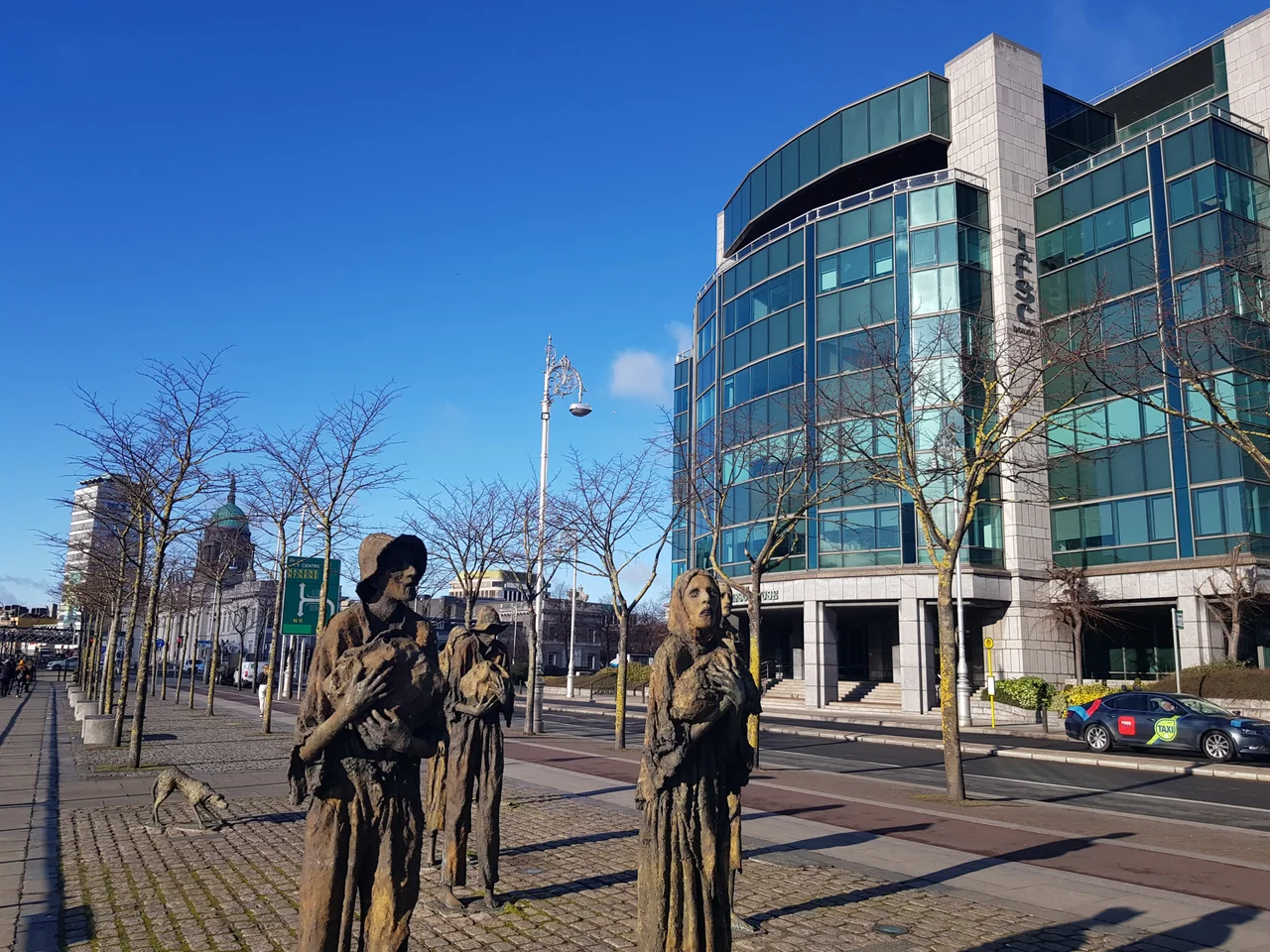

International Financial Services Centre, Dublin
In 1987, Charles Haughey returned to power in Ireland with a manifesto pledge that almost nobody outside Dublin's small financial set understood: he was going to build an international financial services centre on eleven hectares of empty, weed-grown dockland on the north bank of the Liffey, and tax it at a special rate of ten percent. The Department of Finance objected. The EU wavered, then nodded. The first three offices went up - The International Centre, IFSC House, La Touche House, all faced in distinctive green panelling. Today that experiment occupies thirty-eight hectares of the Dublin Docklands, hosts the European headquarters of the world's largest banks, custodies more than three trillion euros, and produces about seven percent of Irish GDP.
Idea Before Architecture
Two Irishmen are usually credited with first articulating the idea: the financier Dermot Desmond and the Labour politician Ruairi Quinn. They were not in power and could not implement it. But Fianna Fail leader Charles Haughey, returning to government in 1987 with input from AIB chief executive Michael Buckley, ran on it and got it done. The 1987 Finance Act Section 30 created the special zone with EU approval to apply a ten percent corporate tax rate for designated financial services activities, while the rest of Ireland was still taxed at much higher rates. To operate inside the IFSC and access that rate, a company had to be approved by a body called the Certification Advisory Committee - representatives of the IDA, the Department of Finance, the Department of Enterprise, and the Central Bank of Ireland - and that gatekeeping kept the early growth disciplined.
From Custom House Quay to Spencer Dock
The original site was the reclaimed North Wall and George's Dock area - state-owned land that had been the working port of Dublin and was, by the mid-1980s, derelict and embarrassing. Construction began with the three green-panelled office blocks; then came a long sequence of expansions. IFSC II added 4.8 hectares east of Commons Street between 1997 and 2007, run by the Dublin Docklands Development Authority. By 2018 the contiguous area was 37.8 hectares. Around 2015 the financial zone effectively merged with the neighbouring Grand Canal Dock and the Dublin Docklands, drawing in the European headquarters of Google, Facebook, Amazon, and later Salesforce - the term "International Services Centre" began appearing to describe the wider precinct. The big four global custodians - State Street, BNY Mellon, Citibank, Northern Trust - all built major offices here, alongside JPMorgan Chase, Goldman Sachs and Bank of America.
Aircraft Leasing on the Liffey
Few visitors to Dublin realise that the aircraft leasing capital of the world looks out over the Liffey. AerCap, Avolon, GECAS, SMBC Aviation Capital - the largest aircraft lessors on the planet have major offices in the IFSC. As of 2019, the sector held 141 billion euros in Irish-domiciled aircraft assets and was estimated to contribute more than 500 million euros annually to the Irish economy in salaries and fees, with average salaries around 165,000 euros. Most of the wide-body jets you have flown on were probably owned, at some point in their lives, by an Irish-registered leasing company that booked the deal from a glass tower a few minutes' walk from the Custom House. Irelandia, the Tony Ryan family vehicle that helped seed Ryanair, Tiger Airways and VivaColombia, also lives here. Whatever else aviation owes Ireland, it owes a remarkable amount of its capital structure to one square mile of redeveloped Dublin docks.
Double Irish, Section 110, Tax Storms
The IFSC has been controversial almost from the beginning. The 1997 Taxes Consolidation Act created the Irish Section 110 Special Purpose Vehicle, which PwC has called "the heart of the Irish structured finance regime" and which made Ireland the fourth largest shadow banking centre in the world. Legal innovations developed here - the Double Irish, the Single Malt, the Capital Allowances for Intangible Assets tool - became central to the global tax structuring of US multinationals; Bloomberg in 2013 identified PwC Ireland as the "great architect" of the Double Irish arrangement, said to shield more than a hundred billion US dollars annually from taxation. In 2016 the country discovered that US distressed-debt funds, popularly called vulture funds, were using Section 110 SPVs to pay essentially no Irish tax on their Irish investments; estimated losses to the Irish exchequer ran to billions. In 2018 it emerged that Russian banks, some under EU and US sanctions, had also routed more than a hundred billion euros through the same vehicles. The Irish government has tightened the loopholes, repeatedly. The structures, repeatedly, evolve.
Crashes and Comebacks
Dublin's ranking on the Global Financial Centres Index tells the story in shorthand. The IFSC reached its high point at ninth globally in March 2009 - just before the Irish financial crisis caught up with it. By September of the same year it had dropped to twenty-third, and a formal investigation began. After tighter regulation and the exit of several institutions, the city tumbled to seventy-third in 2014. Then came the patient climb back: thirty-first in 2016, and a continued recovery since. The original 1987 special-zone status is gone - the entire country moved to a 12.5 percent corporate tax rate from 2003 onwards, and the IFSC ceased to exist as a separate legal entity from 1 January 2006 - but the buildings, the talent, the law firms (Matheson, A&L Goodbody, McCann Fitzgerald, William Fry) and the accounting firms (PwC, KPMG, Deloitte, EY) remain, employing more than 35,000 people across the Irish financial services sector. The view from the upper floors at dusk, looking west up the Liffey toward the old city, is one of the unexpectedly beautiful sights in Europe. The wealth being moved around behind that view is staggering.
From the Air
The IFSC sits at approximately 53.3494 degrees N, 6.2472 degrees W, on the north bank of the River Liffey in central Dublin, just east of the Custom House. From altitude the precinct is identifiable as the cluster of mid-rise modern office towers immediately south of the IFSC tram stop and along North Wall Quay and Custom House Quay. Dublin Airport (EIDW) is roughly 9 km north; Weston (EIWT) sits west. The Liffey itself makes the most useful navigational feature, running east-west through the centre of the city.
Nearby Stories
- Wicklow Mountains 12 km away
- Mornington 14 km away
- German submarine U-1051 16 km away
- Abbey of Kells 18 km away
- Irish Military Intelligence Service 20 km away
- HMS Manners (K568) 37 km away
- Templemore 42 km away
- Irish Sea Bridge 43 km away