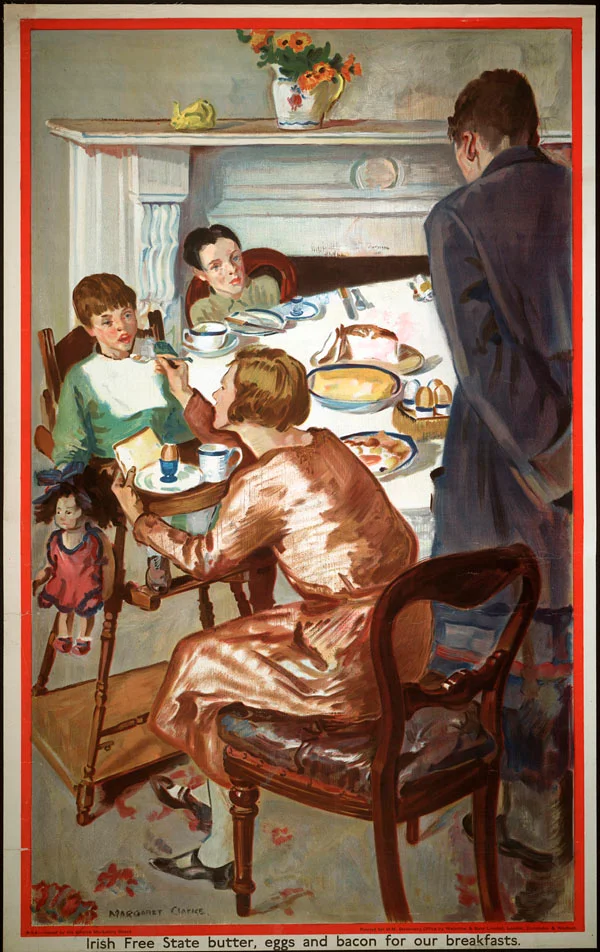

Irish Free State
Michael Collins called the Anglo-Irish Treaty of 1921 "the freedom to achieve freedom." Eamon de Valera called it a betrayal worth fighting a civil war over. They were both right. The Irish Free State that came into existence on 6 December 1922 - a dominion of the British Empire comprising twenty-six of Ireland's thirty-two counties, with the king still nominally on the throne and parliamentarians required to swear fidelity to him - was a fragile compromise that immediately fractured. The brothers and former comrades who had fought side by side in the War of Independence now turned their guns on each other, and the new state was born into a civil war it would win at a cost it would never quite finish counting.
The Oath That Split a Country
Members of the new Dail were required to take an Oath of Allegiance to the Free State constitution and to declare fidelity to King George V. The wording was carefully drafted, largely by Michael Collins himself, partly drawn from a draft suggested by de Valera before the negotiations, partly lifted from the oath of the Irish Republican Brotherhood (of which Collins was the secret head). It promised fidelity to the king "in Ireland" - not to the king of the United Kingdom - and only in his role under the Treaty settlement. The wording was indirect on purpose. Republicans saw it anyway as a direct oath to the Crown, and on that question the country fought. Collins was dead by August 1922, killed in an ambush in County Cork. Arthur Griffith died of a brain haemorrhage ten days earlier. The day after the Free State was officially founded, anti-Treaty IRA gunmen killed Sean Hales, an elected member of the Dail. The next day, in retaliation, four imprisoned anti-Treaty leaders - Liam Mellows, Rory O'Connor, Joe McKelvey and Dick Barrett - were executed by the Free State without trial. The civil war ended in May 1923 with the anti-Treaty side dumping arms, but it left a wound that would shape Irish politics for generations.
Dominion Status, Tested
On paper the Free State was a constitutional monarchy. A governor-general represented the king, the Oireachtas (parliament) consisted of king plus Dail plus Seanad, and the Treaty allowed Britain to keep three strategic Treaty Ports on the Irish coast. In practice the W. T. Cosgrave government, led by Cumann na nGaedheal between 1922 and 1932, spent its energy pushing at every limit dominion status imposed. It accepted credentials from foreign ambassadors - something no other dominion had done. It registered the Anglo-Irish Treaty with the League of Nations as an international document, over British objections. It joined the League itself on 10 September 1923. It sent its first Olympic team to Paris in 1924. In 1931 the Statute of Westminster - the imperial conference's grand acknowledgement that the dominions were no longer subordinate - took most of what remained of British legal authority over Ireland and quietly dissolved it. Cosgrave's ministers had built, over ten years and against bitter opposition, a functioning state and an internationally recognised independent nation. Their reward, in the 1932 general election, was to lose power to the man who had refused to take the oath. When Eamon de Valera read the Cosgrave files he told his son Vivion: "They were magnificent, son."
De Valera Dismantles the Crown
De Valera entered office in February 1932 and began removing, piece by piece, the elements of the Treaty he had spent a civil war opposing. He abolished the Oath of Allegiance in 1933 - the policy was so obvious that Cosgrave had planned to do it himself had he won. He abolished the right of appeal to the Judicial Committee of the Privy Council. He abolished university representation in the Dail. He abolished the Seanad outright. He fought an economic war with Britain over annuity payments that ran from 1932 to 1938. Then in December 1936, taking advantage of the abdication of King Edward VIII, he attempted to abolish the Crown and the office of governor-general entirely with the Constitution (Amendment No. 27) Act. He was advised by senior law officers that the Crown and governor-general existed in too many other instruments to be killed by one bill, and a hasty Executive Powers (Consequential Provisions) Act followed in 1937, backdated to December 1936 to cover the gap. The legal mess was untidy. The direction was unmistakable.
Bunreacht na hEireann
In 1937 de Valera presented an entirely new constitution to the Dail. Bunreacht na hEireann - the Constitution of Ireland - was put to a plebiscite on 1 July 1937, the same day as a general election, and a relatively narrow majority approved it. It came into force on 29 December 1937, and on that date the Irish Free State ceased to exist. The state was simply called Ireland, or Eire in Irish. A new office of President of Ireland replaced the governor-general. Articles 2 and 3 claimed jurisdiction over the whole island while accepting that legislation would not actually apply in Northern Ireland - language that would not be reworded until the Good Friday Agreement in 1998. Article 44 acknowledged the "special position" of the Catholic Church (a section removed by referendum in 1973). The constitution's vocational Seanad, drawing on Pope Pius XI's 1931 encyclical Quadragesimo anno, was an explicit nod to Catholic corporatism. The new Ireland was distinctly Irish, distinctly Catholic, and at last constitutionally its own.
Freedom to Achieve Freedom
Look back at the fifteen years between 6 December 1922 and 29 December 1937 and the through line is incremental. The Free State was, structurally, a compromise; what its leaders did with that compromise was extract every degree of latitude available. Collins's phrase about "freedom to achieve freedom" turned out to describe not the Treaty itself but the entire era. The Free State's design and production of its own Great Seal in 1931 - a portrait of King George V on one side, the Irish state harp and the words Saorstat Eireann on the other - is the era in miniature. The seal sits today in the Irish National Museum at Collins Barracks in Dublin, the building named for the man who started the state and was killed defending it. By 1949, twelve years after the Free State had dissolved into Ireland, the country formally became the Republic of Ireland and left the Commonwealth altogether. The wound from the civil war never quite closed - it shaped Fianna Fail and Fine Gael and the entire shape of Irish politics for the rest of the century - but the freedom Collins promised had, by patient increments, been achieved.
From the Air
The Irish Free State's institutions were centred on Dublin, with the Dail meeting in Leinster House at approximately 53.3478 degrees N, 6.2597 degrees W. From the air, the heart of the Free State is identifiable as the Georgian core of Dublin south of the Liffey, with Leinster House and the National Museum visible in the block between Kildare Street and Merrion Square. Dublin Airport (EIDW) lies about 10 km north. Best viewed in clear conditions when the Liffey is identifiable as the silver line separating north and south Dublin.
Nearby Stories
- Wicklow Mountains 12 km away
- Mornington 14 km away
- German submarine U-1051 16 km away
- Abbey of Kells 18 km away
- Irish Military Intelligence Service 20 km away
- HMS Manners (K568) 37 km away
- Templemore 42 km away
- Irish Sea Bridge 43 km away