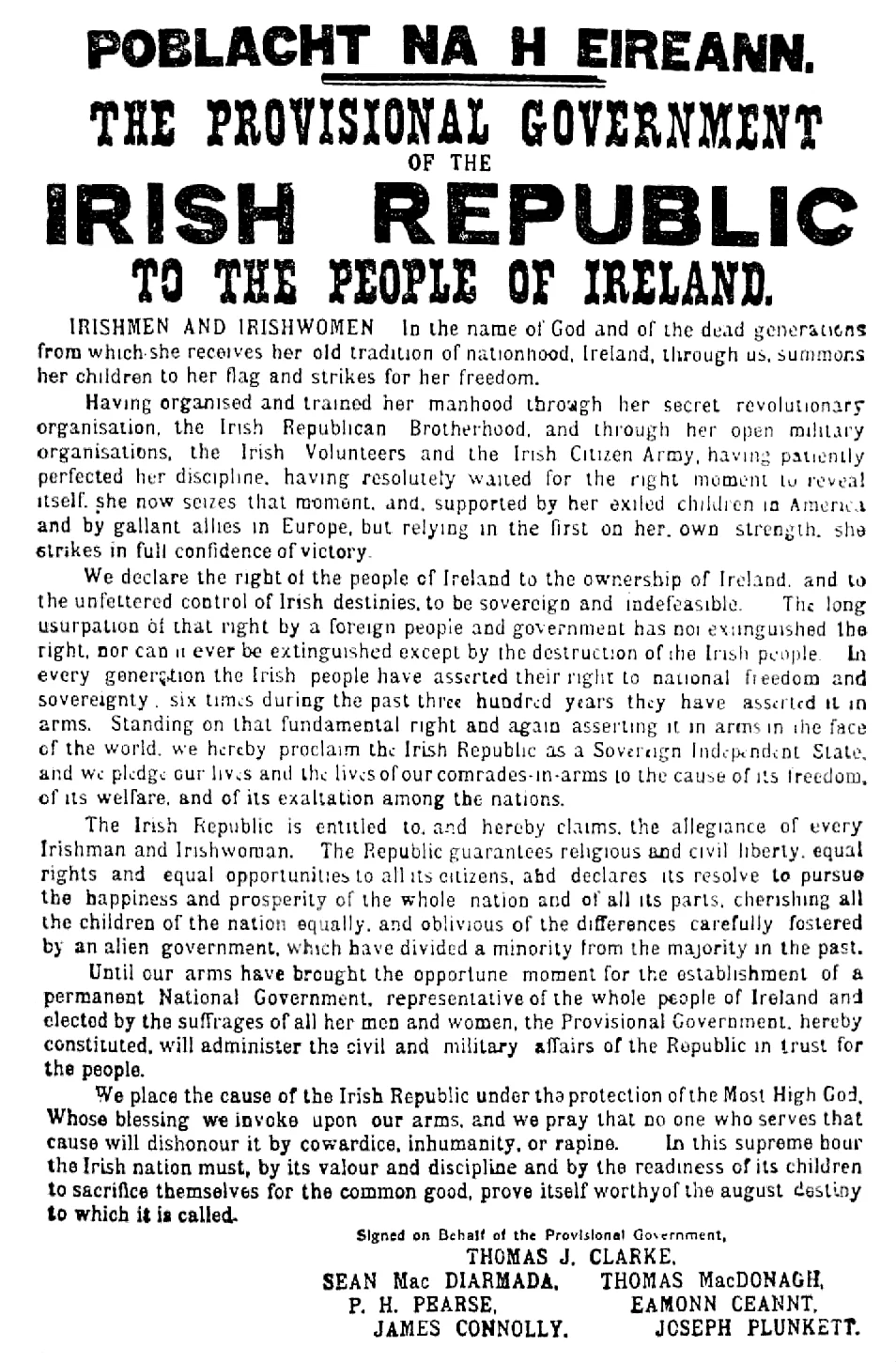

Irish Republic
On 21 January 1919, twenty-seven Irish members of parliament who had been elected to Westminster the previous month refused to take their seats in London. Instead, they gathered in the Mansion House on Dawson Street in Dublin and called themselves Dail Eireann, the parliament of Ireland. Thirty-five of their colleagues were noted in the rolls as fe ghlas ag Gallaibh - imprisoned by the foreign enemy. Another four were ar dibirt ag Gallaibh - deported by the foreign enemy. The twenty-seven who could attend read out a Declaration of Independence and retroactively dated the Irish Republic back to the Easter Proclamation of 1916. The same day, in Tipperary, two members of the Royal Irish Constabulary escorting a cart of gelignite were killed at Soloheadbeg by the 3rd Tipperary Brigade. Nobody had ordered the ambush, but the war it started would not stop for two and a half years.
Two Words for Republic
The new state had two Irish names, both meaning roughly the same thing. Poblacht na hEireann was the word the writers of the 1916 Easter Proclamation had coined for "republic." Saorstat Eireann - literally "free state" - was the word used in the 1919 Declaration of Independence and most other documents of the period. When de Valera met David Lloyd George in London in July 1921, Lloyd George - a native Welsh speaker and amateur linguist - was interested in the literal meaning of Saorstat. De Valera explained: it meant Free State. Lloyd George asked, "What is your Irish word for Republic?" The pause stretched. Lloyd George then remarked, with the cool condescension of an experienced negotiator, "Must we not admit that the Celts never were Republicans and have no native word for such an idea?" De Valera's colleague Lord Longford later disputed the account. But the exchange caught something real: a new state inventing its own vocabulary in real time, with two competing Irish words for what English-speakers were calling, almost casually, a republic.
A Parallel Country
What the revolutionary Dail did between January 1919 and December 1922 was build a functioning government inside the shell of British administration. There was a Ministry - initially four ministers (Finance, Home Affairs, Foreign Affairs, Defence), later expanded to nine - that met as often as secrecy and safety allowed. There was a judicial system, the Dail Courts, which began life as arbitration panels (British law allowed arbitration if both parties consented) and gradually came to supersede the British Assize courts in many parts of the country. Farmers liked them because they were fast and dealt harshly with cattle rustling. There was the Irish Republican Police, drawn from the IRA, who enforced the Dail Courts' decisions. There was an army - the Irish Volunteers, renamed the Irish Republican Army to reflect their new role - that fought British forces in the field while pretending, when convenient, to be answerable to the Ministry in Dublin. There were embassies: Sean T. O'Kelly opened one in Paris in April 1919, Patrick McCartan opened another in Washington. None of it had been formally recognised by any major government. All of it worked, intermittently, brilliantly, for almost three years.
The President Who Was Not a Head of State
The Irish Republic's executive structure was deliberately ambiguous, in part because its founders disagreed about the form of the state. The leader was originally called Priomh Aire - literally prime minister, but rendered in the English-language constitution as "President of the Ministry." During de Valera's American tour the title "President of Dail Eireann" came into use. On 26 August 1921, in preparation for treaty negotiations with the British, de Valera had the Dail appoint him to the new post of "President of the Republic" - explicitly a head of state title, designed to assert that any negotiations would be between two sovereign states. The British view, of course, was that there was nothing to negotiate with except elected members of the British parliament who happened to want independence. The two sides spent the autumn of 1921 using carefully ambiguous language so that each could go home and tell its own constituents what it wanted to believe. The Anglo-Irish Treaty signed on 6 December 1921 was passed, accordingly, through three different processes: the Dail, the United Kingdom parliament, and the House of Commons of Southern Ireland - a body that legally existed and had almost the same membership as the Dail, the better to allow each side its preferred constitutional fiction.
Dissolution and Division
The Dail approved the Anglo-Irish Treaty on 7 January 1922 by sixty-four votes to fifty-seven. The republicans who opposed it mostly walked out, arguing that the Dail had no right to dissolve the republic they had sworn to defend. The Provisional Government took office under Michael Collins. The Republic, somehow, kept existing in parallel - its Ministry under Arthur Griffith continued meeting; its president continued holding office; the two administrations slowly merged through the spring and summer of 1922. Then both Griffith and Collins died in August, and W. T. Cosgrave inherited both leaderships at once: a Crown-appointed prime minister who was simultaneously president of a self-declared republic. On 6 December 1922 the Constitution of the Irish Free State came into force, and on that date the Irish Republic ceased to exist as a legal entity. The civil war over whether it should have done so was already underway. It would not officially end until 24 May 1923, when IRA chief of staff Frank Aiken issued his order to dump arms and de Valera addressed his defeated "Legion of the Rearguard."
The Republic That Would Not Die
The legal story ended in December 1922. The political story did not. Hardline republicans refused for decades to recognise the Free State, then the 1937 constitution, then the 1949 Republic of Ireland Act, on the theory that the Irish Republic declared in 1919 had never been lawfully dissolved. In 1938 a group calling itself the Executive Council of the Second Dail formally delegated its self-declared authority to the IRA Army Council, a delegation that would be cited as legal underpinning for IRA campaigns through the rest of the century. The Provisional IRA split from the original IRA in December 1969 and continued to claim, on this basis, to be the army of an undissolved Irish Republic. Republican Sinn Fein and Continuity IRA still make versions of the claim today. Most Irish people regard the lineage as romantic at best and pretextual at worst. But the symbol endures, because the original Republic - improvised, courageous, never formally recognised by a single great power - did something real. It taught Ireland how to govern itself before anyone in London admitted Ireland could.
From the Air
The institutions of the Irish Republic centred on Dublin, with the first Dail meeting at the Mansion House on Dawson Street at approximately 53.3409 degrees N, 6.2588 degrees W, in the heart of Georgian Dublin south of the Liffey. The site is a short walk from Grafton Street and St Stephen's Green. Dublin Airport (EIDW) lies about 10 km north. From altitude, the relevant Dublin precinct is identifiable as the area between Trinity College, Leinster House, and the Green. Best viewed in clear conditions when the Liffey makes a useful east-west reference line through the centre of the city.
Nearby Stories
- Wicklow Mountains 12 km away
- Mornington 14 km away
- German submarine U-1051 16 km away
- Abbey of Kells 18 km away
- Irish Military Intelligence Service 20 km away
- HMS Manners (K568) 37 km away
- Templemore 42 km away
- Irish Sea Bridge 43 km away