
Isle Maree
There is an old saying in the Highlands. If someone is behaving strangely - irrational, melancholy, lost to themselves - locals would say they must be "wanting a dip in Loch Maree." The dip in question was not casual swimming. It was a treatment that had to be administered correctly: the sufferer was towed three times sunwise around a small wooded island in the middle of the loch, dipped each time, then drunk three sips from a holy well. Isle Maree is barely two hundred metres across. It holds the ruins of a chapel, a graveyard with eighth-century cross-slabs, an oak tree studded with coins, and the memory of a kind of medicine that ran on belief.
The Hermit Who Named the Loch
Sometime in the late seventh century, an Irish monk named Maol Rubha left Bangor Abbey in what is now Northern Ireland and made his way north. In 673 he founded a Celtic Church monastery at Applecross on the west coast of Scotland. From there, oral tradition holds, he travelled inland to Loch Maree - which at the time was called Loch Ewe, hence the name of the village of Kinlochewe at its eastern end - and built a hermitage on the small island. He died in 722. The two incised cross-slabs that still stand in the graveyard are dated to roughly that period. So thoroughly did he embed himself in local memory that the loch was renamed in his honour: Loch Maree, the loch of Maol Rubha.
The God of the Bulls
By the 17th century, what was happening on Isle Maree had drifted far from anything the original monk would have recognised. The Presbytery of Dingwall, in 1656, recorded with alarm that pilgrims were sacrificing bulls on the island for the feast of the saint - a practice that local scholars believe represented an older pre-Christian cult of a god called Mourie, accidentally fused with the half-remembered figure of Maol Rubha. The cliff opposite the island on the loch's north shore is called in Gaelic Creag nan Tarbh - the Cliff of the Bull. It is one of the clearest pieces of evidence we have in Britain for a pagan practice surviving into the early modern period under a thin Christian veneer.
The Madness Cure
Through the 18th century - within living memory for some of the people in this story - Isle Maree was a working asylum of a kind. People suffering from what we would now call psychiatric illness were brought here by relatives, sometimes from great distances. The treatment was specific: three sunwise circuits around the island in a small boat, with the sufferer dipped into the loch on each pass, followed by three sips from the holy well. Some sources record the patients being tied into the boat. We know now that this was not a kind treatment. But it was a treatment - a structured response to suffering, in an era when nothing else was on offer. The island today demands a small piece of empathy from visitors: nothing must be taken away. Not a pebble. The tradition says that anything carried off carries the madness with it.
The Coin Tree
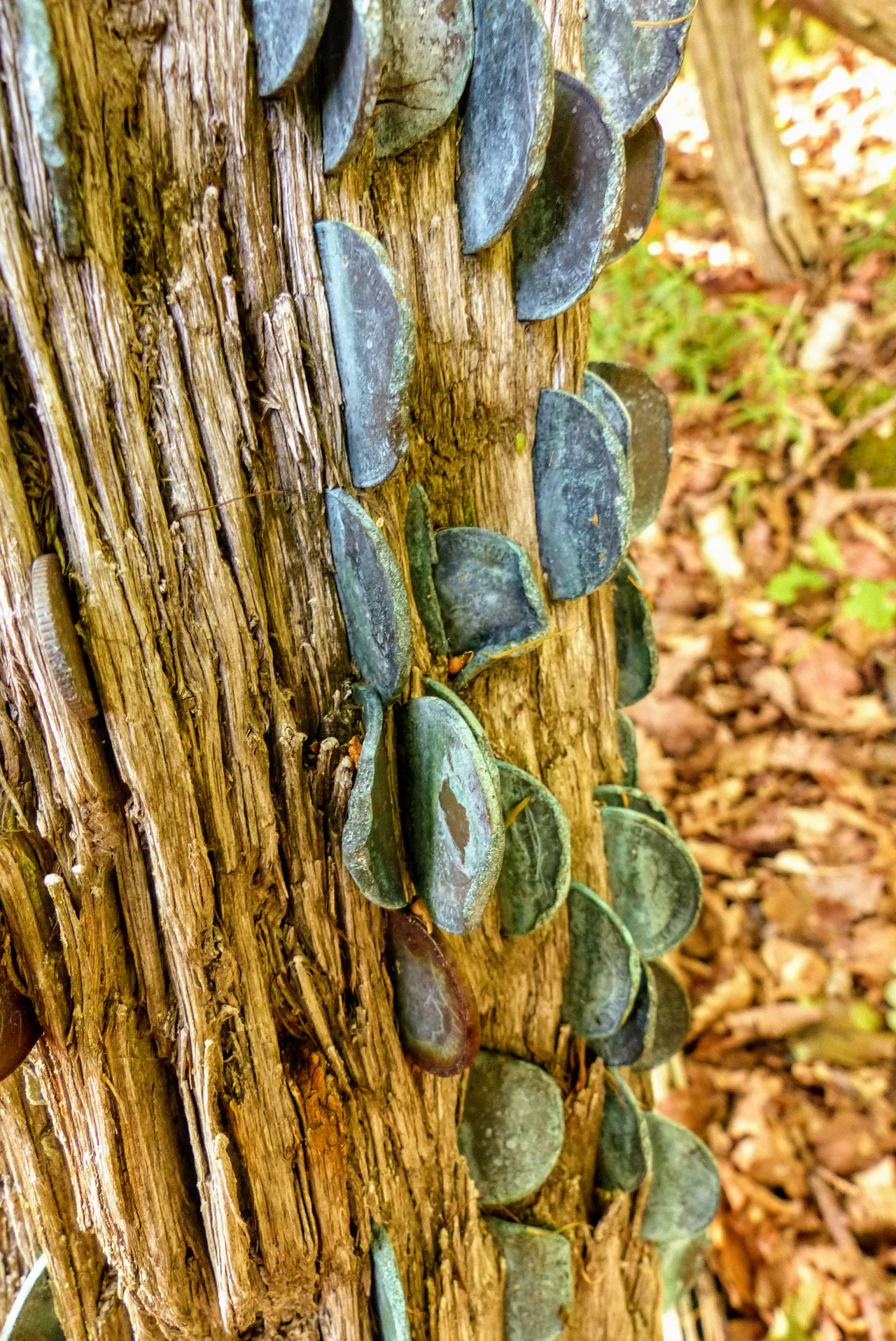
Queen Victoria visited in 1877 and wrote about a great oak tree on the island, festooned with hammered-in coins as offerings to the spirit of the place. Each coin was a wish, a thanksgiving, or a plea on behalf of someone unwell. After the publication of her diaries, the tree became a tourist attraction. More visitors came. More coins were hammered in. By the early twentieth century the original tree had died - copper poisoning from the thousands of metal disks driven into its bark. Other trees on the island took up the role. They too are studded with green-tinged coppers and shillings now, slowly dying the same way. It is one of the strangest things a forester can show you: a tree being killed by kindness, by belief, by the steady accumulation of small acts of hope.
What You See
From the air, Isle Maree is one of dozens of islands in Loch Maree, but it stands out because it is uncharacteristically wooded - dense with ancient oak and holly, in a landscape otherwise dominated by sparse Scots pine. The chapel ruins are difficult to spot from any altitude; the graveyard wall is more visible. The cliff of Creag nan Tarbh sits across the channel on the north shore. The loch itself, threading 13 miles between Beinn Eighe and the Letterewe Forest, is one of the most beautiful in Scotland. Most visitors never set foot on the island - boat access is restricted out of respect for the burial ground - and that, too, is part of why it has remained the kind of place a story can still cling to.
From the Air
Isle Maree sits at 57.69 N, 5.47 W in Loch Maree, Wester Ross. Inverness Airport (ICAO EGPE) is about 95 km east; Stornoway (EGPO) about 100 km west across the Minch. Recommended viewing altitude 2,500-4,000 ft AGL - low enough to read the wooded island against the bare slopes around it. Slioch rises sharply to the north-east, Beinn Eighe to the south; both are useful navigational anchors. Watch for strong westerlies and rapidly forming low cloud.
Nearby Stories
- Summer Isles 2.5 km away
- Raasay 9.6 km away
- Lochalsh 15 km away
- Staffin 19 km away
- Affric-Beauly hydro-electric power scheme 19 km away
- Alladale Wilderness Reserve 22 km away
- Bayble Island 24 km away
- Loch Shin 25 km away