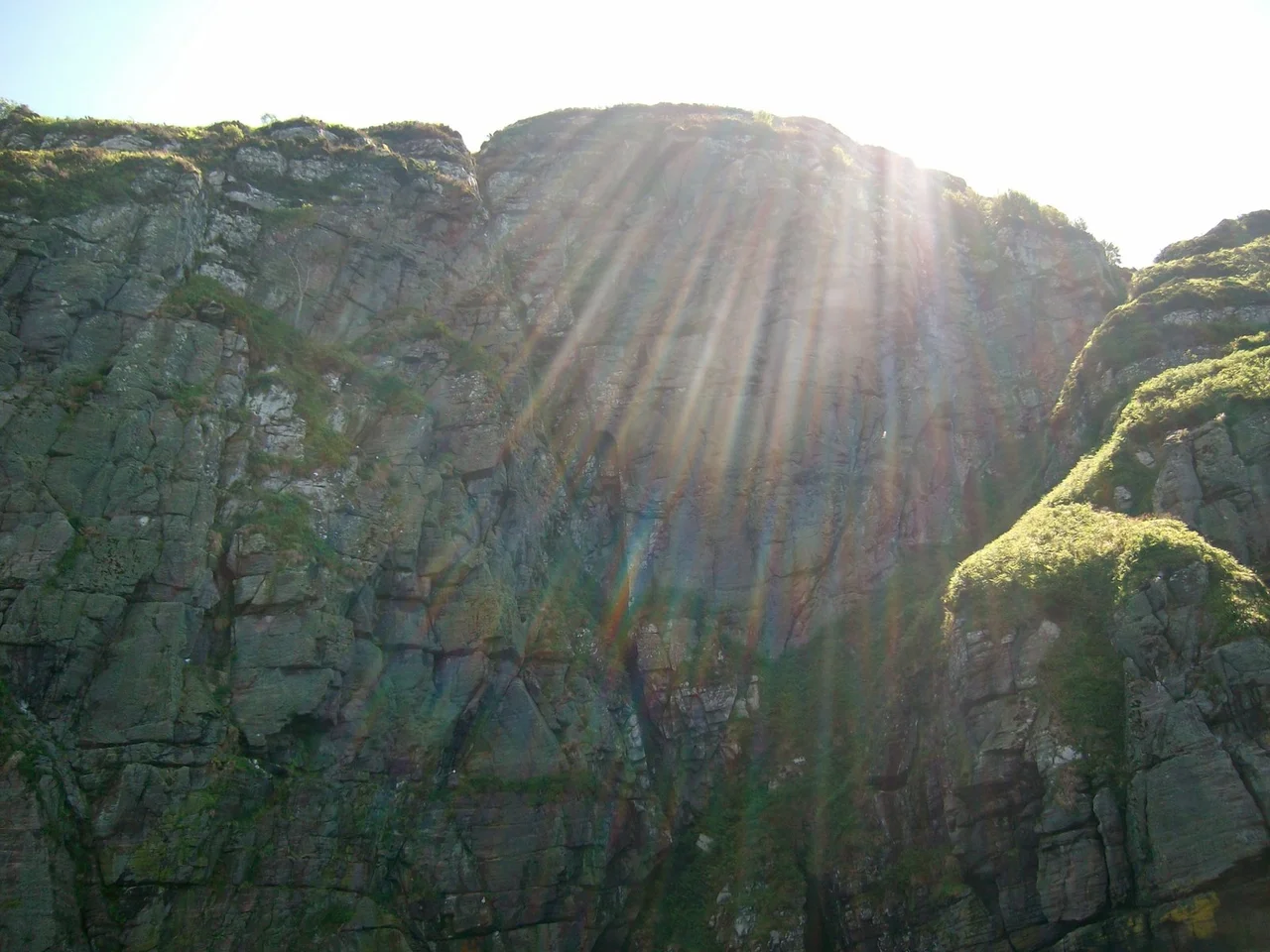

Isle Martin
The wheat arrived from somewhere south by sailing ship and was unloaded onto a wharf on an uninhabited Highland island. Between 1939 and 1948, a flour mill on Isle Martin ground that wheat into flour, packed it into sacks labelled 'Isle Martin Flour Mills,' and sent it back to the mainland on the same ships. Most of the workers came over each morning from Ullapool, did a day's shift, and went home at dusk. A few lived in cottages built for them. After the war the mill closed, the buildings were dismantled, and the island fell quiet again. It was not the first time Isle Martin had been industrious and then abandoned, and it will not be the last time a generation chooses what to make of it.
Not Saint Martin
Despite the name, Isle Martin has no connection to St Martin of Tours. The old Gaelic name, recorded in the sixteenth century, is *Ellan Mertack* - the *martrick* being an old word for the pine marten that once moved through the island's woods. A monastery is reputed to have been established here around 300-400 AD, putting it among the very earliest Christian sites in the west of Scotland. The physical evidence is sparse and indirect but suggestive: a stone bearing a Latin triple cross that may date from anywhere between 400 and 700 AD, almost certainly tied to the Celtic church. Higher on the island lie the ruins of a post-Reformation chapel or meeting house and a vanished street of houses with an old school, the wreckage of a community that once had enough children to need a teacher and a building.
Herring Before Ullapool
For most of its history Isle Martin lived off the sea and the thin soil. It was an important centre for the fishing trade, with a curing station running here before Ullapool was even founded as a planned village on the mainland in 1788. The island was lotted into crofts in 1831 - the standard Highland reform of land tenure - and crofting continued until the 1960s. Most of the ground was used for cattle and sheep grazing; only a small patch at the southern end near the main settlement was workable as arable. Then came the war and the flour mill, built on the foundations of the old herring station. Workers were ferried daily across the narrow channel from Ardmair, with bakeries across the north of Scotland selling bread made from Isle Martin flour. The mill closed in 1948, its buildings dismantled, and the population drained back to the mainland - the long, familiar trajectory of a Highland island in the twentieth century.
The Conservationists
In the 1960s Monica Goldsmith bought Isle Martin and took it out of crofting tenure. She wanted it managed for nature: she installed water and power, removed the sheep in 1969, and in 1980 gave the island to the Royal Society for the Protection of Birds on the condition that it stay a conservation site. From 1980 to 1985 the writer Andro Linklater lived in the Mill House, finishing his acclaimed biography of Compton Mackenzie - an island holding a man trying to write about another island man. The RSPB's Bernard Planterose moved his family there in the 1980s and launched an ambitious broad-leaved woodland regeneration project, fencing out the rabbits and replanting native species, while monitoring the breeding and visiting bird populations. But by the mid-1990s the RSPB had concluded that Isle Martin was too difficult for them to manage from a distance. In May 1999, with the active encouragement of Mrs Goldsmith's daughter Oriole, they gifted the island instead to a new community trust proposed by the people of Loch Broom and Coigach: the Isle Martin Trust.
Community Hands
The trust improved the jetty at Ardmair Bay and now operates a seasonal ferry across the half-mile of water that separates the island from the mainland. A new pontoon went in in 2007. Some of the houses have been refurbished, and one is available to rent for those who want a few nights on an uninhabited Hebridean-style island with nothing but the wind, the gulls and the ruins of a flour mill for company. Guided walks and small events run through the season. The island sits at the head of Loch Broom, looking up Annat Bay to Ben Mor Coigach and out across the sound to the rest of the Summer Isles. A monastery, then a fishing station, then a mill, then a bird reserve, now a community asset - Isle Martin has belonged to a series of small groups of people who each took what they needed from it and then handed it on.
From the Air
Isle Martin sits at 57.945N, 5.225W in Loch Broom, the closest of the Summer Isles to Ullapool and visible from the A835 along Ardmair Bay. From cruising altitude the island is a distinct small landmass off the western mouth of Loch Broom, with Ben Mor Coigach rising behind on the mainland. Nearest airport is Inverness (EGPE), about 60 nautical miles east-southeast. Approach to Ullapool is via A835; ferry services run seasonally from Ardmair.
Nearby Stories
- Assynt 4.5 km away
- Castle Leod 6.7 km away
- Carbisdale Castle 9.6 km away
- Loch Torridon 12 km away
- HMS Nelson (28) 12 km away
- Cape Wrath Trail 14 km away
- Loch Naver 16 km away
- Tiumpan Head Lighthouse 31 km away