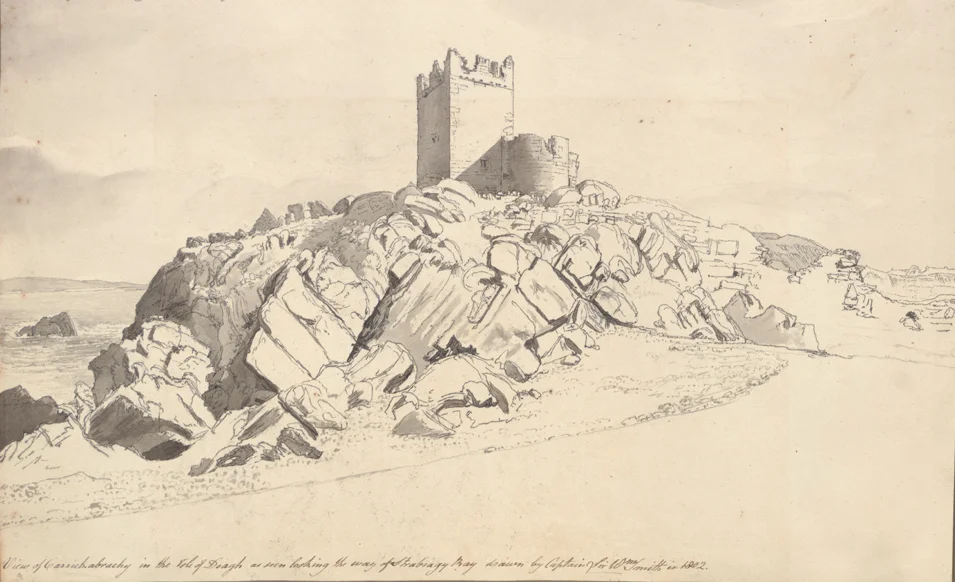

Isle of Doagh
On 22 April 1847, in calm weather, a fishing boat from the Isle of Doagh capsized in Trawbreaga Bay. The wave that turned it over came out of nowhere, the locals said. The eight men aboard had been doing what their families had done for centuries: working fish from a coastline that had always been dangerous and was now becoming unbearable. Seven of them drowned. Their names were carefully recorded by a journalist of the time: Donald Doherty, owner of the boat, who left a wife and six children; Patrick Doherty, who left a wife and three; James McLoughlin, a wife and four; Patrick Roe Doherty, a wife and one; William Doherty, unmarried; Hugh McCool, unmarried; John McLoughlin, the only son of a widow. The eighth man swam ashore. The Famine had only just begun.
Five Thousand Years of Markings
The Isle of Doagh has one of the largest concentrations of prehistoric rock art in Ireland. The markings, cup-and-ring carvings pecked into outcrops of stone, are roughly four to five thousand years old. No one knows what they meant. Theories include astronomical alignments, territorial markers, ritual sites, abstract art for its own sake. The carvings predate the great pyramids of Egypt by centuries. They were made by people whose names and language are entirely lost, on a small peninsula that was then an actual island, separated from the mainland by a tidal channel that has since silted up. You can stand among the markings today and watch the Atlantic roll past the same shore those Neolithic carvers worked under. The continuity is unsettling. The forgetting is total.
The Friars Rock and the Annals
The Isle of Doagh was a stronghold of the Lords of Carraig Bhrachai, the McFalls, from the ninth to the thirteenth century. The Annals of the Four Masters record their lords by their deaths over four hundred years. The first reference is to 834, when Niall Caille led an army into Leinster and his officer Fearghas, son of Badhbhchadh, lord of Carraig Bhrachai, was killed by Munstermen. The McFalls held the island through the Viking period. The ruined castle at the north-western tip, Carrickabraghy, dates only to around 1600, built by the O'Dohertys who had succeeded the McFalls and who would themselves be broken in Cahir Roe O'Doherty's 1608 rebellion. The castle was abandoned by 1665. Three and a half centuries of weather have not finished it off.
The Famine on Doagh
The Famine devastated the Isle of Doagh. In May 1848, the Weekly Vindicator reported that police and bailiffs entered the island and evicted between twenty and thirty families, after the tenants had been confronted with a doubling of their rents. Some had been paying double rents on land where the crop had failed for three consecutive years. In June 1848, the Belfast Vindicator reported that in Feggart, on the Isle of Doagh, 53 people had died of hunger. The paper printed the names: James McLoughlin, his wife and three children; Owen McLoughlin and his six children; Widow Diver and her two sons; Patrick Doherty and his wife; Widow Doherty and her two children; Patrick James Doherty, his wife, and three children; Widow McCoal and five children; Charles McLoughlin, his wife, and three children; Neal Doherty, his wife, and four children. The list goes on. Each name was a household. Each household had a door. Doors on Doagh were not opening to bring food in. They were opening to bring bodies out.
Wrecks and Stills
The waters around Doagh are hazardous. On 24 November 1841, the schooner James Cook struck rocks near Glashedy Island; the master and nine crew drowned. In March 1878, the barque Danube, sailing from Liverpool to New York, ran aground in a severe storm. Two coastguards from Malin Head rowed out to her; one was drowned by a wave. The crew of twelve were eventually hauled ashore by line. In September 1847, a brig heading for Greenock ran aground here too. Through the nineteenth and twentieth centuries the island was also a centre of illicit poitin distillation. In April 1898 the Royal Irish Constabulary raided multiple homes. In October 1927 the Civic Guards spotted smoke rising from the beach and gave chase to two distillers rowing a boat that contained a still. They captured the boat and the still. In March 1926 they found stills concealed in the sand hills, with barrels of wash mixed with turnips for reasons not fully explained.
The Famine Village
In the townland of Lagacurry, a collection of traditional Irish houses has been gathered into the Doagh Famine Village, a folk museum that walked visitors through life on the island from the 1840s to the present. The museum included thatched cottages, working interiors, and guided tours. In May 2025, it was badly damaged by fire. The reconstruction continues. The Doagh Famine Village existed not just to record the past but to insist that it be remembered correctly: that the famine was not a natural disaster but a political event, that the people who died in Feggart and Carrickabraghy and Lagacurry had names, that the island they died on still exists and still bears the marks of what happened. The rock art will outlast all of this. The names should too.
From the Air
Located at 55.30N, 7.34W, on the north coast of Inishowen between Pollan Bay and Trawbreaga Bay, County Donegal. Nearest airports are Donegal (EIDL) 33 nm south-southwest and City of Derry (EGAE) 22 nm south-east. From cruising altitude, the Isle of Doagh appears as a sand-dune-fringed bulge of land joined to the mainland by what used to be a tidal channel. Carrickabraghy Castle's ruin marks its north-western point, with Glashedy Island a small grass-topped rock a mile offshore. The site is exposed to Atlantic weather; clearest viewing in spring or late summer afternoons.
Nearby Stories
- Foyle Bridge 5.4 km away
- River Bann 6.7 km away
- Cathedral of St Eunan and St Columba 7.7 km away
- Portrush Lifeboat Station 8.6 km away
- Rosguill 11 km away
- German submarine U-155 (1941) 28 km away
- Bruichladdich Distillery 32 km away
- German submarine U-1005 45 km away