
Istana Darul Hana: The Palace That Survived a Rebellion
On the night of December 8, 1962, shots crackled across Bandar Seri Begawan. Rebels from the North Kalimantan National Army attacked police stations, the power grid, and the hilltop palace where Sultan Omar Ali Saifuddien III slept with his family. Roughly three hundred armed men descended on the capital in darkness, intent on capturing the sultan and forcing him to proclaim an independent state. They failed. Inside Istana Darul Hana, the sultan held fast with his family, a handful of state dignitaries, and just six police officers. By morning the revolt was crumbling, and the Palace of the Happy Country -- as its Arabic name translates -- had earned a place in the story of Brunei's survival.
A Hilltop Seat of Power
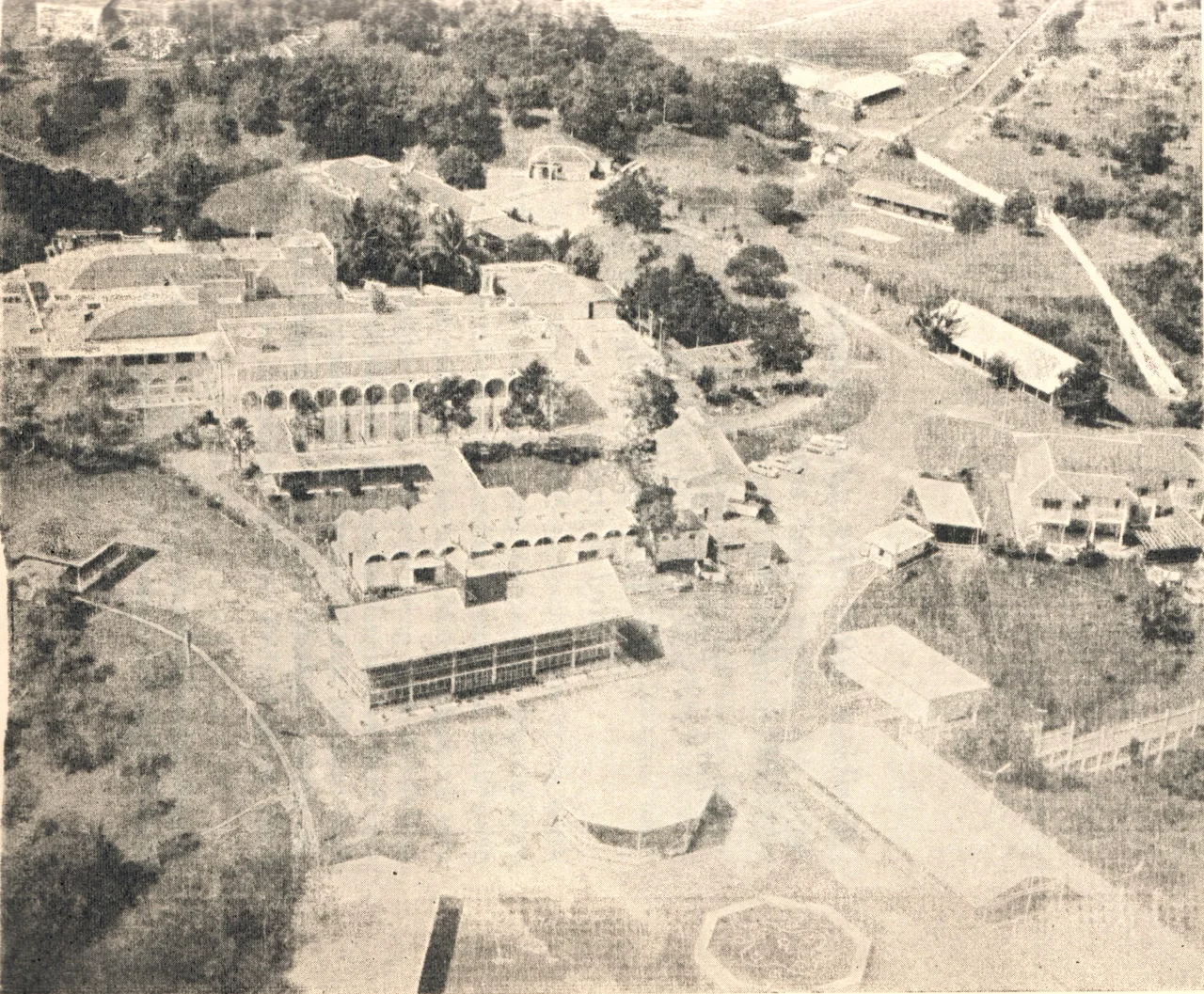
Istana Darul Hana sits on elevated ground at Kilometre 3 of Jalan Tutong in Kampong Tumasek, overlooking the low-lying capital of Brunei-Muara District. Completed in 1951, the palace became the official residence and office of Sultan Omar Ali Saifuddien III on May 10 of that year. Its name draws on two Arabic words -- "Darul Hana" meaning "Happy Country" -- with no religious connotation, a simple aspiration carved into the identity of a nation still finding its modern shape. From this hilltop the sultan governed a protectorate in transition, reviving ancient royal customs and ceremonies that had lapsed under colonial influence. Honours were awarded in formal ceremonies from 1954 onward, and the palace's surau hosted the early private education of the young Crown Prince Hassanal Bolkiah before he left for schooling in Malaysia.
Births, Weddings, and the Weight of Ceremony
Istana Darul Hana was not merely an administrative seat; it was where the royal family lived and grew. Prince Sufri Bolkiah was born there on July 31, 1952, and Prince Jefri Bolkiah followed on November 6, 1954. Sultan Omar Ali used the palace to revive the elaborate royal processions that had defined Brunei's sultanate for centuries. In 1967, the wedding of Princess Nor'ain and Pengiran Anak Mohammad Yusof brought one of the grandest of these processions through the palace grounds. That same year, on October 4, 1967, the palace witnessed its most consequential ceremony: the abdication of Sultan Omar Ali Saifuddien III. The following day, he passed the throne to his son, and Crown Prince Hassanal Bolkiah became the twenty-ninth Sultan of Brunei. After the abdication, the palace continued to mark royal milestones -- Princess Rashidah was born there in 1969, Princess Muta-Wakkilah in 1971, and Prince Al-Muhtadee Billah, the current crown prince, on February 17, 1974.
The Night the Rebels Came
The 1962 Brunei revolt was an armed insurrection by the Brunei People's Party and its militia, the North Kalimantan National Army, who opposed the proposed Federation of Malaysia. Their plan was direct: seize the sultan at his palace and force him to proclaim independence. Attacks struck across the protectorate simultaneously -- police stations in Seria, Tutong, Limbang, and Bangar fell to the insurgents, and European hostages were taken. But the assault on Istana Darul Hana was repelled. Signals from Brunei to British Far East Headquarters reported rebel attacks on the sultan's palace, the Chief Minister's house, and the power station, with another rebel force approaching the capital by water. British Gurkha reinforcements arrived swiftly and the revolt collapsed within days. The sultan, unharmed, had refused to leave his hilltop residence through the crisis.
From Residence to Relic
Sultan Omar Ali Saifuddien III continued to live at Istana Darul Hana until 1987, long after his abdication. By then, his son had already moved the seat of power to Istana Nurul Iman, the vast new palace on the banks of the Brunei River completed in 1984. The hilltop residence that had anchored Brunei's monarchy through its most turbulent decades -- a revolt, an abdication, the birth of a new sultanate -- fell quiet. Today the palace still stands in Kampong Tumasek, its surau, gates, and police housing visible from the surrounding neighborhood, a monument to the decades when Brunei's fate was decided not in a billion-dollar palace but in a modest hilltop compound defended by six officers and a sultan who would not leave.
From the Air
Coordinates: 4.8797N, 114.9287E. The palace sits on a hill at Kilometre 3 of Jalan Tutong in Kampong Tumasek, visible as an elevated compound west of central Bandar Seri Begawan. Best viewed at 1,500-2,000 ft AGL. Nearby airport: Brunei International Airport (WBSB), approximately 8 km to the northeast. The Brunei River and Omar Ali Saifuddien Mosque provide visual reference points from the air.
Nearby Stories
- From Residency to Memory 28 km away
- Twenty Years on the Seattle Run 30 km away
- The Abode of Peace on Borrowed Coastline 31 km away
- USS Salute: The Minesweeper That Found the Last Mine 33 km away
- The Ants of Borneo 50 km away
- Sabah State Railway 55 km away
- Starcevich Monument 74 km away
- Luconia Shoals 209 km away