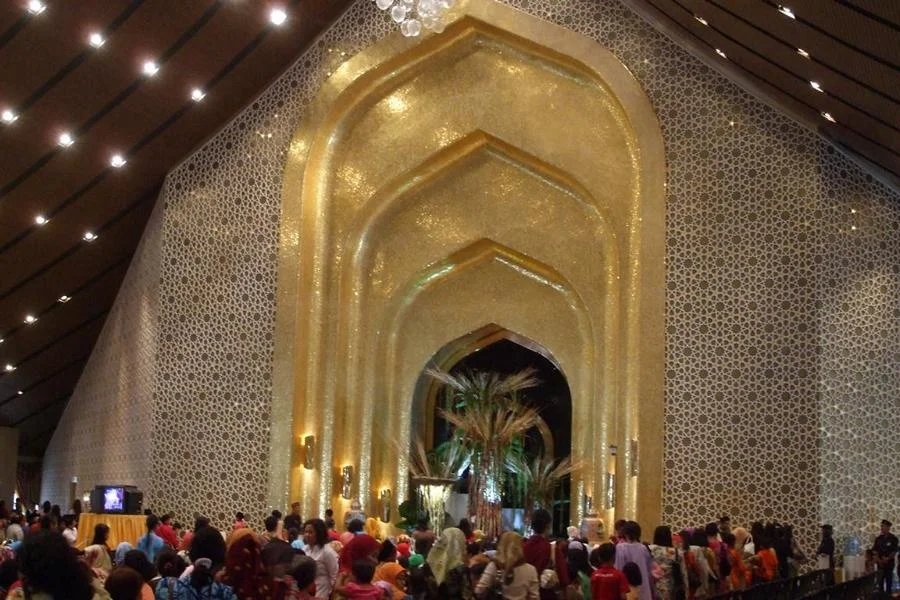

Istana Nurul Iman: The Palace of Light and Excess
Two hundred and fifty-seven bathrooms. That is not a misprint. Istana Nurul Iman, the official residence of the Sultan of Brunei, contains 1,788 rooms spread across 200,000 square meters of floor space, and among them are 257 bathrooms -- more than most hotels, more than many apartment complexes, all under one roof and all belonging to a single family. The Guinness World Records recognizes it as the largest residential palace ever built. Buckingham Palace, the Forbidden City, Versailles -- all of them smaller by the standard that matters, which is the sheer volume of enclosed, climate-controlled, gold-domed living space. The palace sits on the leafy banks of the Brunei River, a few kilometers southwest of Bandar Seri Begawan, and it cost approximately US$1.4 billion to build in 1984. Its name means "Palace of the Light of Faith." Its scale suggests something closer to the Palace of Unlimited Budget.
A Pianist's Blueprint
The architect behind this staggering edifice was Leandro V. Locsin, a Filipino from Silay in Negros Occidental who had studied pre-law, then music, before finally turning to architecture. Locsin was a talented pianist and a grandson of the first governor of his province -- an unconventional path to designing the world's largest home. By the time Sultan Hassanal Bolkiah commissioned him, Locsin had already designed the Philippine Pavilion at the 1970 World Expo in Osaka and the Church of the Holy Sacrifice in Manila, known for its pioneering thin-shell concrete dome. For Brunei, Locsin drew on Islamic and Malay architectural traditions, translating them into golden domes and sweeping vaulted roofs that echo mosque design at residential scale. The interior was handled by Dale Keller Interior Designers, while construction fell to a multinational effort: Ayala Abbott and Butters from the United Kingdom and Hagen International from Denmark, with ten thousand workers drawn from seventeen countries.
A Palace by the Numbers
The statistics resist comprehension. Beyond the 1,788 rooms and 257 bathrooms, Istana Nurul Iman houses a banquet hall that can expand to seat 5,000 guests, a mosque accommodating 1,500 worshippers, a 110-car garage, five swimming pools, and air-conditioned stables for the sultan's 200 polo ponies. The total floor area -- 2,152,782 square feet -- exceeds that of any other residence on Earth. Completed in 1984, the year Brunei gained full independence from Britain, the palace became both the sultan's home and the seat of government. Its position on the banks of the Brunei River places it within sight of the capital but set apart from it, screened by tropical vegetation on its sprawl of riverside hills. The palace replaced Istana Darul Hana, the modest hilltop compound where Hassanal Bolkiah's father had governed for three decades.
Three Days of Open Doors
For most of the year, Istana Nurul Iman is closed to the public. Its gates open only during Eid al-Fitr, the festival marking the end of Ramadan, when approximately 110,000 visitors pass through over three days. The sultan and his family receive guests personally. Visitors are given gifts of food, and young children receive green packets containing money -- a tradition of royal generosity that transforms the world's most exclusive address into something briefly, remarkably communal. During the ten days of the Ramadan period, the palace also opens to Muslims for Tadarus and Tarawih prayer gatherings. These annual openings offer the only public glimpse of an interior that few outsiders have ever described in detail, a space where Locsin's architectural vision meets the accumulated wealth of one of the world's last absolute monarchies.
Oil, Independence, and the Weight of Gold
Istana Nurul Iman is inseparable from the story of Brunei's oil wealth. The sultanate's offshore petroleum reserves, first discovered in 1929, generated the revenue that made a $1.4 billion palace conceivable. The timing of its completion in 1984 -- the same year Brunei achieved full independence -- was no coincidence. The palace was a declaration: a small nation of a few hundred thousand people, wedged between the Malaysian states of Sarawak and Sabah on the northern coast of Borneo, could build the largest home on the planet. Whether that declaration reads as triumph or excess depends on the observer. What is beyond dispute is the building's physical reality -- the golden domes rising above the Brunei River, the vaulted roofs designed by a pianist-turned-architect, the stables cooled by the same air conditioning that chills the banquet hall. It is a palace that refuses to be subtle, and Brunei has never apologized for it.
From the Air
Coordinates: 4.8720N, 114.9208E. The palace complex is visible as a massive compound with golden domes on the south bank of the Brunei River, southwest of Bandar Seri Begawan's city center. Best viewed at 2,000-3,000 ft AGL approaching from the northeast along the Brunei River. The golden domes are distinctive from the air. Nearby airport: Brunei International Airport (WBSB), approximately 10 km to the northeast. The Omar Ali Saifuddien Mosque in the city center and Kampong Ayer (the water village) provide visual landmarks for orientation.
Nearby Stories
- From Residency to Memory 28 km away
- Twenty Years on the Seattle Run 30 km away
- The Abode of Peace on Borrowed Coastline 31 km away
- USS Salute: The Minesweeper That Found the Last Mine 33 km away
- The Ants of Borneo 50 km away
- Sabah State Railway 55 km away
- Starcevich Monument 74 km away
- Luconia Shoals 209 km away