
Mount Ithome
When the Messenian people had nothing left — no city, no army, no recognized right to exist — they climbed to Ithome. The flat-topped peak rising to about 800 meters above the southwestern Peloponnese was not merely a defensible hill. It was the sanctuary of Zeus Ithomatas, the mountain the god himself was said to inhabit. To hold Ithome was to hold something more than ground. It was to insist, against every Spartan pressure, that the Messenians were still a people.
The Mountain That Would Not Fall
Geography shaped Ithome's destiny. The northernmost of twin peaks in Messenia, the mountain forms a natural fortress whose slopes drop sharply on three sides. Below the summit, the western flank opens into a bowl — sheltered, spring-fed, defensible — that became the site of the ancient town of Ithome and, later, the great city of Messene. The flat summit itself was probably inhabited in the Bronze Age. A temple to Zeus Ithomatas stood there in antiquity, and the annual festival of the Ithomaea originally featured a musical contest in the god's honor. The mountain was, in every era, a place of power.
Spartans besieged Ithome twice and failed to take it by storm both times. During the Messenian Wars of the seventh and sixth centuries BC, helots and free Messenians retreated here to mount resistance. They were forced down eventually — but never broken by direct assault. Then in 464 BC, when a severe earthquake devastated Sparta, the people the Spartans had enslaved as helots rose again. They held the summit of Ithome for years while the Spartan army, aided briefly by Athenian allies, camped in the valley below. The insurgents finally accepted an Athenian-mediated truce: safe passage out of the Peloponnese, to be settled at Naupactus on the Gulf of Corinth. They left the mountain. The mountain waited.
Names Across the Centuries
A place this charged with memory accumulates names. Ithome's etymology remains uncertain — it shares the name with a town in Thessaly, though scholars believe the Thessalian version was originally called simply Thome. The mountain also carried, for centuries, a completely different name: Vurkano, or Vourkano, with a dozen recorded variants including Voulkanos, Vulcano, Voucano, and Boulcano. The Archaeological Museum of Messenia dates this name to the tenth century, suggesting Byzantine usage. Among the earliest written records is a 1364 document, the Domains and Fiefs of the Principality of Achaia, compiled for Marie of Bourbon, which records that the Grand Seneschal of Naples, Niccolo Acciajuoli, held a fief called Lo Castello de Bulcano — the castle of the mountain, standing over the ruins of the ancient city.
Below the mountain, the spring-fed village that grew within the ancient walls earned its own evocative name. Mavromati — from the Greek for 'black eye' — refers to the spring itself, a circle of dark water emerging from the rock like an eye looking up at the sky. Springs were holy in ancient Greece. This one made the city possible, and it still flows.
A Monastery Where the God Once Stood
On the summit where Zeus Ithomatas was worshipped, a Christian monastery eventually rose from the same stones. The monastery of Panagia Voulkanou, or Moni Voulkanou, existed here no later than the reign of the Byzantine emperor Andronikos II Palaiologos (1282–1328), and the ancient temple's masonry went straight into its walls. By the seventeenth century the summit monastery had been closed to regular monastic life — a single caretaker remained, and the building was called the Old Monastery. A new monastery was established on the lower eastern slope of the adjacent peak of Eva, where it housed a library of ancient manuscripts and served as a staging point during the Greek War of Independence in the 1820s.
The progression is not unusual: sanctuary displaces sanctuary, and the new religion borrows the high ground the old one held. What is unusual is how clearly the logic of the place persists. Zeus needed a mountain. The Christian monks needed the same mountain. The Messenians in revolt needed it. Even today, standing on the flat summit, you understand why every tradition that passed through here made the same choice.
Epaminondas and the Walls That Remember
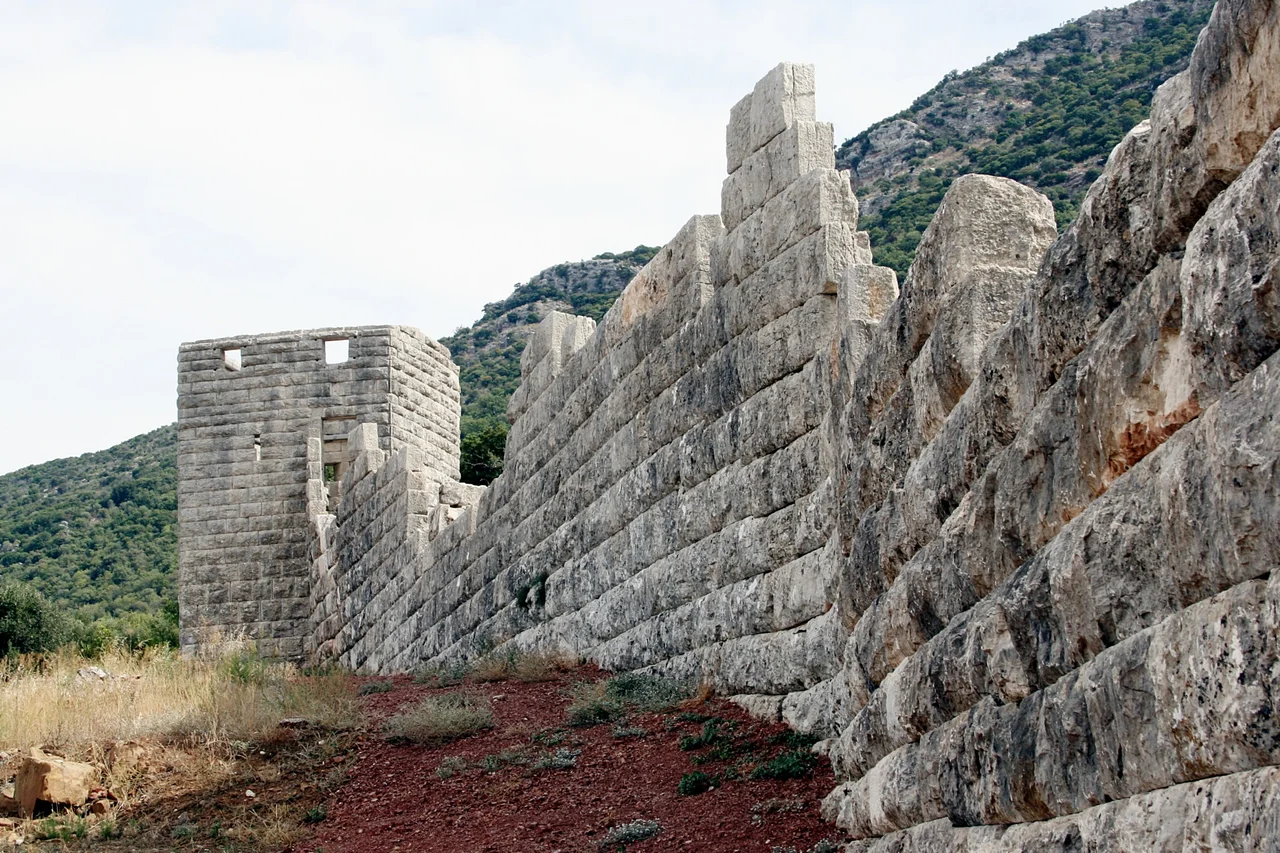
In 369 BC, the Theban general Epaminondas liberated Messenia and chose the bowl below Ithome's summit as the site of the new capital city. The massive circuit walls of Messene — roughly nine kilometers of ashlar masonry — incorporated the mountain itself as the eastern defense. A zig-zagging ancient road climbed from the city to the summit, protected on its upper stretch by the walls. These fortifications are often attributed entirely to Epaminondas, but the evidence suggests he restored and extended earlier defenses. The mountain had been defended before; now it was given a city worthy of what it had protected.
Within the lower circuit, excavations have uncovered evidence of settlement reaching back to the Stone Age. About 300 meters up the slope from the ancient city center sits the modern village of Mavromati, at 419 meters elevation — the mountain looms another 681 meters above it. The village grew within the ancient walls, around the klepsydra, the spring catchment that fed ancient channels down through the city. The channels are still visible, carved into stone. The spring still flows. Ithome still watches over everything below.
What Endures
Ithome was never just a geographic feature. It was a symbol that a people carried with them through centuries of subjugation, exile, and return. The Messenian exiles who spent generations in Sicily and North Africa — some for nearly three hundred years — preserved their dialect and their identity, waiting for the day Epaminondas would call them home. The mountain they remembered was Ithome. The god who witnessed their resistance was Zeus Ithomatas. When they returned, they built a city around the mountain's base and a temple to the god on its summit.
Today the ruins of Messene sprawl below, one of the best-preserved archaeological sites in Greece. Above them, the mountain stands unchanged. The Ithomaea festival is long over; the musical contests are silent. But hikers still climb the ancient road to the summit, past stones that have been sanctuary and fortress and monastery and ruin, and look out over the same Messenian plain the helots once looked out from, waiting.
From the Air
Mount Ithome sits at approximately 37.186°N, 21.925°E, rising to about 800 meters above the Messenian plain in the southwestern Peloponnese. Approaching from the south at 5,000–8,000 feet, the flat-topped summit is unmistakable — it stands distinctly above the surrounding terrain, with the ruins of the ancient city of Messene visible in the bowl on its western flank. The village of Mavromati sits visibly partway up the slope. The nearest airport is Kalamata International (LGKL), approximately 25 km to the southeast. Winds can funnel through the mountain passes; exercise caution at low altitudes. The Taygetus range is visible to the east. In clear weather the Messenian Gulf is visible to the south.
Nearby Stories
- Agios Sostis 1.5 km away
- Karyes 13 km away
- Koroni 13 km away
- Dimitrios (Shipwreck) 16 km away
- Pyramid of Hellinikon 22 km away
- Agios Andreas, Katakolo 28 km away
- 2023 Messenia Migrant Boat Disaster 34 km away
- El-Kouf National Park 464 km away