
Jamanxim National Park
Loggers call them by their Portuguese names - mogno, ipê-roxo, cumaru, cedro - and in most of the Amazon those trees mean money. In the Jamanxim National Park, which covers 859,797 hectares of rainforest along the Tapajós basin in central Pará, those same trees are protected by law. The park was created on the same day in February 2006 as the much larger Jamanxim National Forest that adjoins it, but the two reserves are legally worlds apart. The national forest permits some sustainable resource use. The national park is an IUCN Category II reserve: strict protection, no logging, no mining, no cattle. In a region where economic use is the rule, the park is a deliberate exception - a place where the big trees are allowed to grow old.
A Flat Basin and Two Plateaus
The park sits across the municipalities of Altamira, Itaituba, and Trairão in the state of Pará, with the Trairão National Forest bordering it to the north. Geographically, most of the park lies within the Jamanxim-Xingu depression - a broad, relatively flat basin whose elevations range from around 100 to 200 meters. The Southern Pará plateau rises slightly higher along the eastern margin. In the west, two small extensions of the Tapajós Plateau introduce gentle hills. The drainage flows into the Tapajós basin through the Jamanxim, Tocantins, and Aruri rivers, with small portions of the Ratão and Iriri watersheds also represented. Average annual rainfall is 2,228 millimeters, concentrated in the December-through-April wet season. Temperatures average 28 degrees Celsius year-round, rarely straying far from that mark.
Three Kinds of Forest
Biologists who have surveyed the park distinguish three forest types. Open rainforest dominated by vines and palms covers the drier uplands. Dense submontane rainforest with an emergent canopy grows on the plateau edges, where taller trees break through the general canopy in isolated crowns. Dense alluvial rainforest with a more uniform canopy follows the floodplains of the larger rivers. Each forest type supports its own assemblage of species, and the transitions between them are where biodiversity tends to concentrate. In the aggregate, the park preserves one of the better samples of central Amazon forest on the Tapajós side of the river system.
Big Trees, Big Targets
The tree list reads like an inventory of what the timber industry most wants. Hymenaea courbaril - jatoba, the Brazilian cherry wood - makes premium flooring. Cedrela odorata, Spanish cedar, is prized for cigar boxes and boats. Manilkara huberi is the massaranduba tree whose extraordinarily dense wood is exported globally. Dipteryx odorata produces tonka beans. Dinizia excelsa is one of the tallest trees of the Amazon, a giant that can exceed 80 meters. Handroanthus impetiginosus, the purple ipê, produces one of the hardest commercial woods on Earth. Copaifera reticulata yields a resinous oil long used medicinally. Outside the park's boundaries, all of these species have been cut heavily. Inside the park, they still stand. Non-timber species also include the Brazil nut - Bertholletia excelsa - whose cathedral-sized trees produce the nuts harvested across the region.
Jaguar Country
The two headline mammals of the park tell you a great deal about the ecosystem. The jaguar, Panthera onca, remains the apex predator across the neotropics, and healthy jaguar populations require huge ranges of intact forest - the kind of forest found inside Jamanxim National Park but increasingly rare outside it. Giant otters, Pteronura brasiliensis, patrol the blackwater rivers in noisy family groups, fishing and chasing caimans. A giant otter family needs miles of undisturbed river to thrive; their presence here indicates that the water system remains functional and well-oxygenated. Both species are internationally listed, and both have vanished from much of their historical range. Jamanxim keeps them.
The Politics of a Line
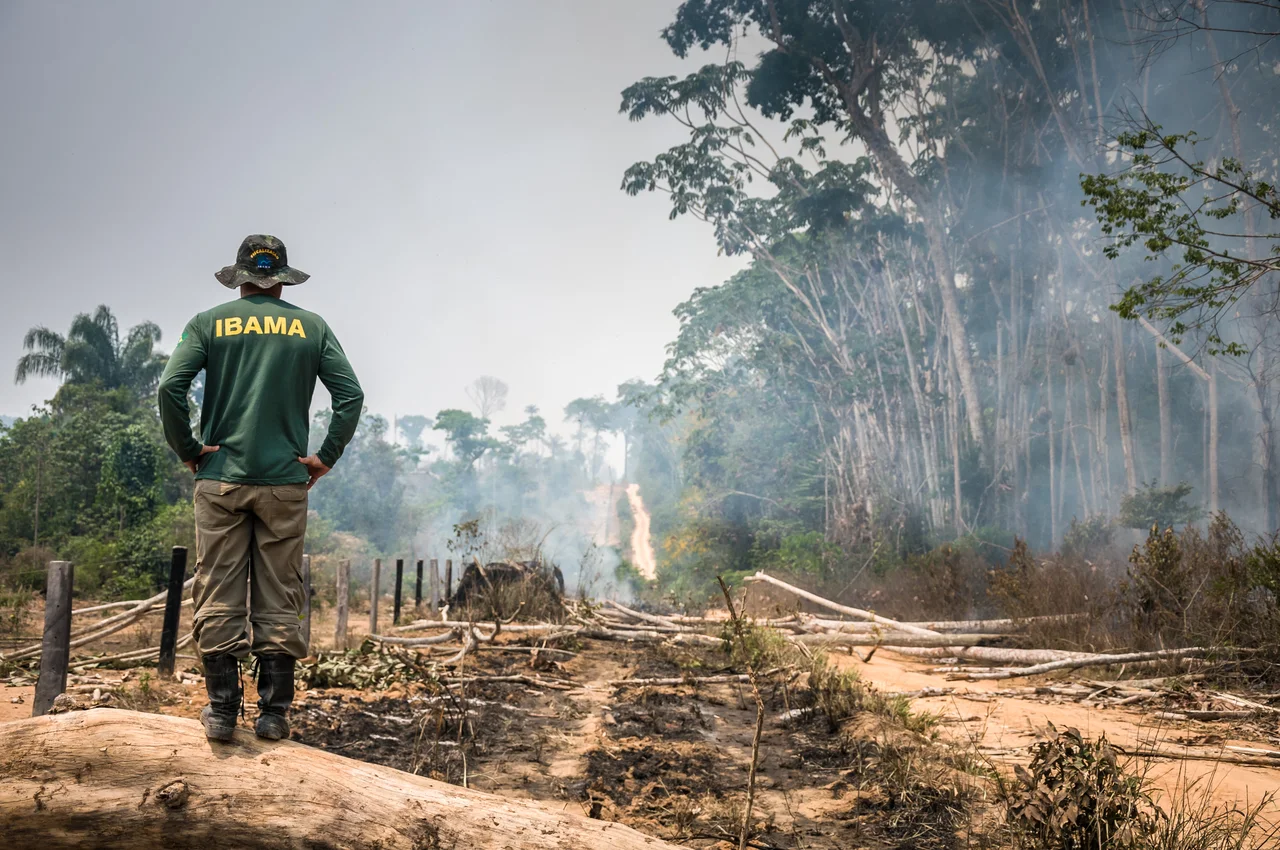
The park was created by decree on 13 February 2006, administered by the Chico Mendes Institute for Biodiversity Conservation, and supported by the Amazon Region Protected Areas Program - the international conservation initiative that has partly funded Brazil's largest Amazon reserves. Unlike the adjacent Jamanxim National Forest, which has been nearly continuously contested by settlers and logging interests, the national park has maintained stricter legal standing. But the pressures around it are intense. The BR-163 highway runs just east. Illegal logging and encroachment touch the park's edges. That a full Category II national park exists in this region at all is in some respects a minor miracle of Brazilian environmental politics. Flying over it, the canopy reads as unbroken - an 8,600 square kilometer patch of deep green, valuable because it is still here and valuable because in fifty years, it may be one of the few places where you can still see what Amazon forest used to look like.
From the Air
Located at 5.74°S, 55.87°W in central Pará, Brazil, in the Tapajós basin. Best viewed from 8,000-12,000 feet AGL during dry season (May-September). The park sits north of the Jamanxim National Forest and west of the BR-163 highway corridor. Nearest significant airports are Itaituba (SBIH), approximately 150 km northwest, and Altamira (SBHT), roughly 400 km northeast. The Jamanxim River threads through the park.
Nearby Stories
- Altamira National Forest 8.9 km away
- Sawre Muybu Indigenous Territory 73 km away
- Tapajos Environmental Protection Area 79 km away
- Tapajós–Xingu moist forests 87 km away
- Jatobá Hydroelectric Power Plant 94 km away
- Tapajos Hydroelectric Complex 113 km away
- Crepori National Forest 153 km away
- Tapajós National Forest 215 km away