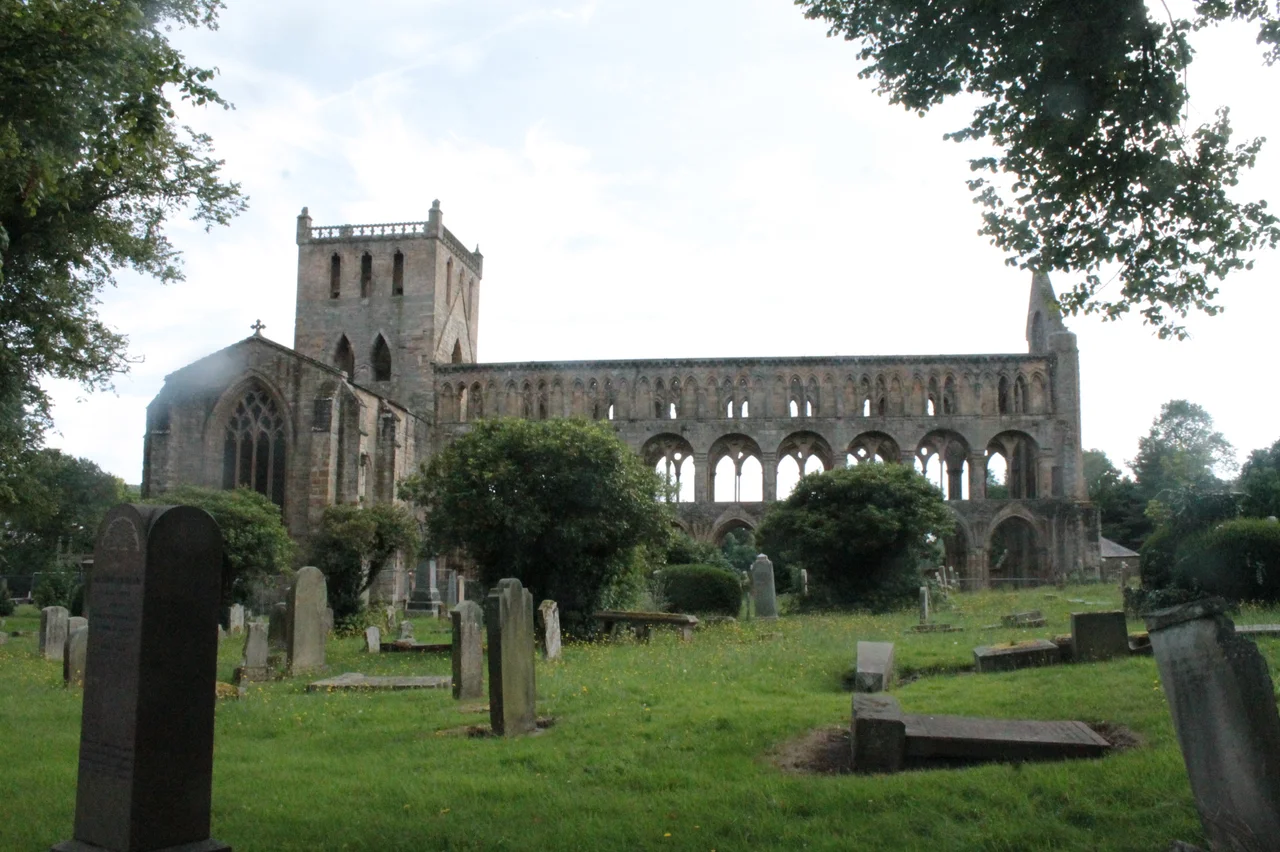

Jedburgh Abbey
Count the times Jedburgh Abbey has been burned, sacked, slighted, or set ablaze, and the number passes a dozen. 1297. 1346. 1410. 1416. 1464. 1523. 1544. And still the great church stands on its bluff above the Jed Water, the red sandstone of its nave glowing at sunset like coals that refuse to go out. The English Earl of Surrey, who burned the place to its rafters in 1523, sent a startled report home: the horses in the English camp had stampeded into the burning town, and Lord Dacre's men swore they had seen the Devil walking among them. Sometimes the abbey seems to confirm the suspicion. It will not die.
Prince David's Foundation
In 1118, before he was a king, David was a prince with French sensibilities and a vision for civilising the Scottish Borders. He brought Augustinian canons from Beauvais to a settlement called Geddwrda and gave them land beside the river. By 1139 a man named Daniel was being called Prior of Geddwrda. By the time David died in 1153, the priory had been raised to a full abbey dedicated to the Virgin Mary. The Norman nave that followed is what survives today: round arches stacked on massive cylindrical piers, a clerestory cut with the pointed lancets of early English Gothic, the two styles meeting in the same elevation as if the masons could not decide which century to live in. Two stones in the structure carry Roman inscriptions, reused from some forgotten altar, a small detail that speaks of even older builders working this same ground.
Royal Weddings, Royal Wounds
On 14 October 1285, Alexander III of Scotland married Yolande de Dreux at the high altar. He had lost his first wife and three children; she was the daughter of a French count, twenty-two years old, and the kingdom's last hope for an heir. Five months later Alexander rode off a cliff in the dark near Kinghorn, and Scotland's succession crisis cracked open the door for Edward I of England. From 1296 onward the abbey lived between hammer blows. The Abbot of Jedburgh was made to swear fealty to Edward at Berwick. After William Wallace's victory at Stirling Bridge in 1297, English troops sacked the abbey in retribution. After Neville's Cross in 1346 they did it again. Robert the Bruce continued patronising the canons through it all. David II saw the north transept finished in 1370. The masons rebuilt; the soldiers came back.
The Final Burning
The Earl of Warwick had the abbey in 1464 during the Wars of the Roses. The Earl of Surrey returned in 1523 with William Bulmer, Thomas Tempest, and a force that found Jedburgh better defended than expected: six towers and more houses than Berwick-upon-Tweed, according to Surrey's own dispatch. They burned it anyway. The Earl of Hertford finished what was left in 1544 during the war the Scots remember as the Rough Wooing - Henry VIII's attempt to force the infant Mary Queen of Scots into marriage with his son Edward. When the Reformation arrived in 1560, the surviving canons were quietly allowed to stay on. The nave became the parish kirk, hemmed inside a much larger shell. Worship continued there until 1871, when the building was finally judged unsafe.
What the State Inherited
The Marquis of Lothian began restoration work and then, in 1917, handed the church over to the state. Today Historic Environment Scotland maintains the abbey as a scheduled monument. The nave is roofless but the elevations rise nearly to their full height. Stone effigies and grave covers excavated from the floor sit in the visitor centre alongside the Jedburgh Comb, an eighth-century Northumbrian carving found here. Five known burials lie within the precincts, including Hugh de Roxburgh and John Capellanus, both medieval Bishops of Glasgow. The Border Abbeys Way links Jedburgh to its three sister ruins at Kelso, Dryburgh, and Melrose, four houses founded by the same king, broken by the same wars, surviving for the same reason: the stone was good and the masons knew their work.
From the Air
Jedburgh Abbey sits at 55.476°N, 2.554°W on the south bank of the Jed Water in the Scottish Borders, ten miles north of the English frontier at Carter Bar. The roofless red sandstone shell is the most prominent structure for miles - look for the tall lancet windows of the north transept and the truncated central tower. Best viewed at 2,000-3,000 feet AGL. Nearest major airport is Newcastle International (EGNT) about 45 nm southeast; Edinburgh (EGPH) is roughly 40 nm northwest. The A68 runs directly through town, providing a clear north-south reference from the air.
Nearby Stories
- Berwick-upon-Tweed Lifeboat Station 8 km away
- Kielder Water 8.8 km away
- Wallington Hall 11 km away
- Battle of Homildon Hill 12 km away
- Penicuik 12 km away
- Lockerbie 15 km away
- Oliver Castle 18 km away
- Yester Castle 19 km away