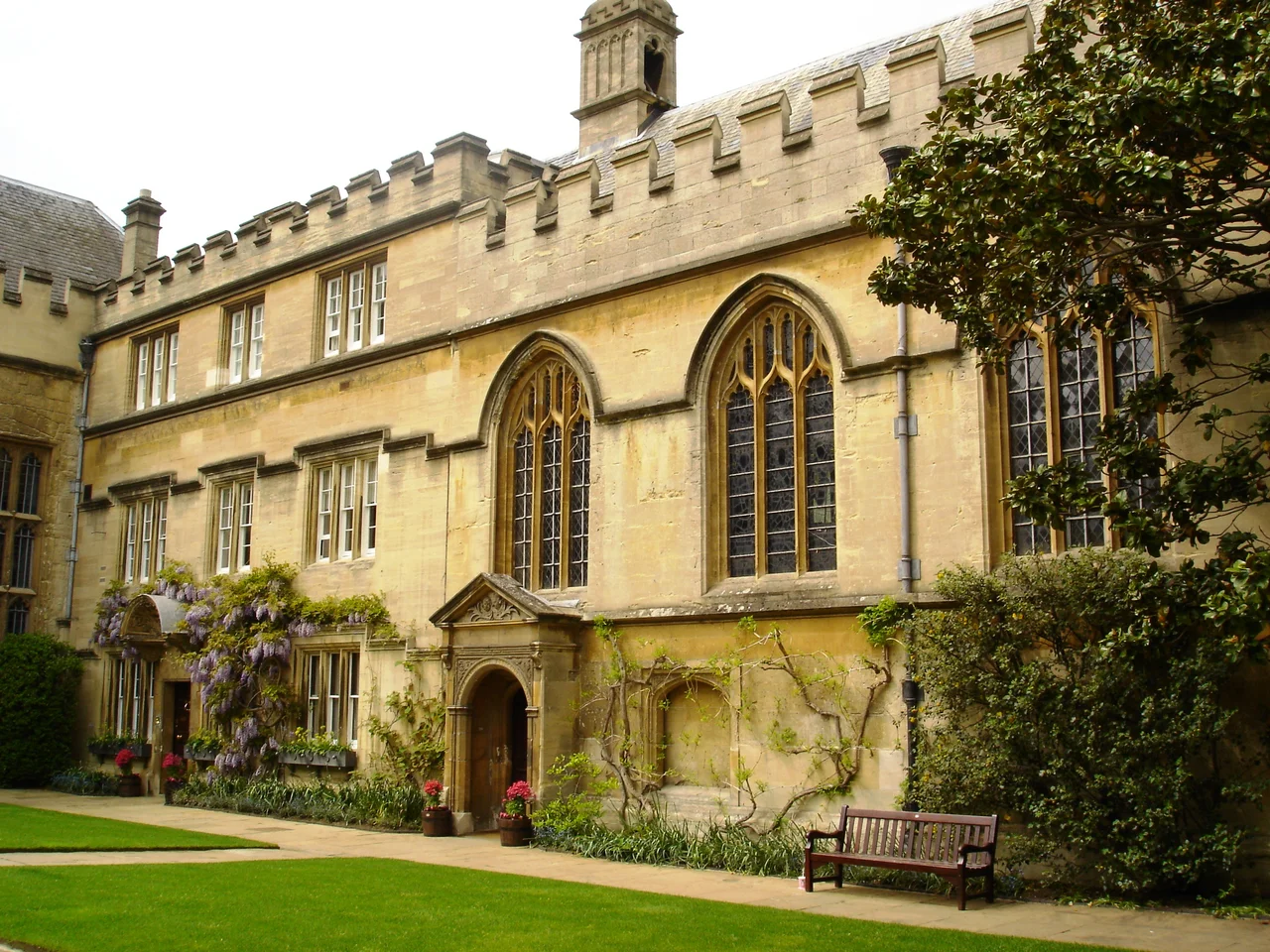

Jesus College, Oxford
Hugh Price, a Welsh churchman from Brecon, wanted to spend his money educating young men from Wales. He petitioned Queen Elizabeth I for permission to found a college at Oxford 'that he might bestow his estate of the maintenance of certain scholars of Wales to be trained up in good letters.' Elizabeth signed the royal charter on 27 June 1571, naming Jesus College the first new Oxford foundation since her Catholic sister Mary's reign. Then Price died in 1574 and it turned out that his promised legacy of £60 a year was actually a lump sum of £600. The college survived anyway, scraping along on the strength of Welsh ambition for the next four centuries.
The Welsh Pinnacle
The 1571 charter never restricted entry to Welshmen, but in practice Jesus became 'the pinnacle of the academic ambition of the young men of Wales.' For nearly 350 years the principal was almost always Welsh or of Welsh descent. The exception, Francis Howell, served briefly under the Commonwealth from 1657 to 1660 and was promptly replaced after the Restoration. Welsh benefactors kept adding scholarships and fellowships with strings attached - the recipients had to come from a specific town, or be related to the donor, or be candidates for the Welsh clergy. Eubule Thelwall of Ruthin spent £5,000 of his own money on the hall and chapel after he became principal in 1621, earning the title of second founder. Edmund Meyricke endowed scholarships for students from north Wales in 1713. Even today the Jesus Professor of Celtic, established in 1877, remains the only chair in Celtic Studies at any English university.
Lawrence's Thesis
T. E. Lawrence arrived to read history. Before he became Lawrence of Arabia - before the Arab Revolt of 1916 to 1918, before Seven Pillars of Wisdom, before he became one of the most famous Englishmen of the twentieth century - he was an undergraduate at Jesus who walked across northern Syria in the summer of 1909 photographing Crusader castles. The thesis he wrote on those castles is still in the Fellows' Library, where it sits alongside the Greek Bible signed by Philipp Melanchthon and 17th-century volumes by Robert Boyle and Isaac Newton. The library, completed in 1679, has been called 'one of the most charming of Oxford libraries, and one of the least frequented.' It holds 11,000 antiquarian books in cases with strapwork ornament dating to about 1628. Lawrence's fascination with the Middle East began on the fieldwork for that undergraduate thesis. Everything that followed came from there.
Three Prime Ministers and a Punch Bowl
Harold Wilson arrived at Jesus in 1934 as a grammar-school boy from Yorkshire and took a first in Philosophy, Politics, and Economics. He became Prime Minister of the United Kingdom twice, from 1964 to 1970 and again from 1974 to 1976. Norman Washington Manley, who had come up earlier as a Rhodes Scholar from Jamaica, became Premier of Jamaica from 1955 to 1962 and is one of the architects of his country's independence. Kevin Rudd, later Prime Minister of Australia, completed his DPhil at Jesus. Pixley ka Isaka Seme - a founder and president of the African National Congress - was a student here. So was the South African ANC tradition, in a quiet way, partly born at Oxford. The college's silver collection includes a 200-ounce silver-gilt punch bowl presented in 1732 by Sir Watkin Williams-Wynn. It holds ten imperial gallons. The story is that anyone who can wrap their arms around it - the bowl measures five feet across - and then drain its contents of strong punch may keep it. No one has ever managed both.
Four Quadrangles Over 450 Years
The first quadrangle was started in 1571 and finished in stages through the 1620s. The chapel was dedicated in 1621 and given an east window in 1636 that Giles Worsley calls Gothic Revival rather than Gothic Survival - by then classical architecture had become the only respectable style, and using Gothic was already a deliberate choice. The principal's lodgings on the north range have a beautiful shell-hood over the doorway, carved around 1620. The second quadrangle was begun in 1640, interrupted by the Civil War, restarted in 1676, and completed just after 1712 - it has Dutch gables with ogee sides and semi-circular pediments. The third quadrangle followed a fire in 1904 that destroyed the college stables; the new range was built between 1906 and 1908 facing Ship Street. The fourth quadrangle, the Cheng Yu-tung Building, was completed in 2021 to mark the college's 450th anniversary. Cheng Yu-tung was a Hong Kong jewelry billionaire whose family funded the project. The college that began for Welsh clergy now stretches from Turl Street to Cornmarket and reaches around the world for its donors.
Daffodils and the Red Book
Every March 1, the chapel is decked with daffodils and the choir sings Evensong entirely in Welsh - most of them are not native Welsh speakers, but they have learned the service phonetically for Saint David's Day. The Red Book of Hergest, a vast Welsh-language manuscript compiled between about 1382 and 1410, was given to the college and is one of the four main sources for the Mabinogion - the medieval Welsh tales of Arthur, of giants, of magical hunts and otherworldly courts. The opening of one Mabinogion tale begins: 'Gereint vab Erbin. Arthur a deuodes dala llys yg Caerllion ar Wysc' - 'Geraint son of Erbin. Arthur was accustomed to hold his court at Caerleon upon Usk.' The medieval manuscripts are now physically housed at the Bodleian Library across the street, where conditions are better, but they belong to Jesus. The college that Hugh Price imagined in 1571 has held that book for centuries. About 15 percent of undergraduates still come from Wales today - more than three times the Welsh proportion of the UK population.
From the Air
Located at 51.7534N, 1.2569W in central Oxford, on a block bounded by Turl Street, Ship Street, Cornmarket Street, and Market Street. The main entrance is on Turl Street, immediately west of Exeter College. Best viewed from low altitude (1,500-3,000 feet AGL). Nearest airports: London Oxford Airport (EGTK, 6 nm north-northwest) and RAF Benson (EGUB, 12 nm south). London Heathrow (EGLL) lies 38 nm southeast. From the air, Jesus is one of a tight cluster of college quadrangles in the heart of the old city, between the round dome of the Radcliffe Camera and the spire of the University Church of St Mary the Virgin.
Nearby Stories
- St George's Chapel, Windsor Castle 7 km away
- RAF Honeybourne 7.8 km away
- Sulgrave Manor 8.9 km away
- Cotswolds 9 km away
- Chesham 9.4 km away
- Avebury 11 km away
- Donnington Castle 12 km away
- Ampthill Park 14 km away