
John Dudley, 1st Duke of Northumberland
John Dudley spent the morning of 22 August 1553 in St Peter ad Vincula, the small chapel inside the walls of the Tower of London. He took the Catholic communion - the same Catholic communion he had spent the last decade of his career enforcing English Protestants to reject. He confessed to the priest. Then he climbed to the scaffold on Tower Hill in front of a crowd of ten thousand people, said the plagues upon this realm and upon us now is that we have erred from the faith these sixteen years, knelt at the block, and lost his head. He was forty-nine years old. Two months earlier he had been the most powerful man in England, the de facto regent of a sickly fifteen-year-old king, and the architect of a scheme to put his own daughter-in-law - the seventeen-year-old Lady Jane Grey - on the English throne. The scheme had lasted nine days. By the time the axe fell almost no one in England, Protestant or Catholic, was sorry to see him go.
A Childhood Shadowed by an Execution
Dudley was born in 1504. His father, Edmund Dudley, was one of the financial enforcers of Henry VII, the man who collected the harsh fines that paid for Henry's reign. When Henry VII died in 1509 the new king, Henry VIII, needed scapegoats for his father's unpopular policies, and Edmund Dudley was one of them. He was arrested almost immediately, tried for high treason on largely manufactured charges, and beheaded in 1510 when John Dudley was six years old. The boy became the ward of Sir Edward Guildford at the age of seven, was restored in name and blood by the same king who had killed his father, grew up in the Guildford household, and eventually married Sir Edward's daughter Jane. They had thirteen children. The shadow of his father's execution stayed with him to the end - he wrote to his colleague William Cecil in 1552 about my poor father's fate who, after his master was gone, suffered death for doing his master's commandments. He apparently saw his own life as following a similar curve. He turned out to be right.
Sailor, Soldier, Statesman
Dudley made his early career as a soldier and an exceptionally skilled administrator. He served in France as a young man, was knighted at Roye in 1523 during the invasion of France, sat in Parliament as MP for Kent in 1534, became Vice-Admiral in 1537 and Lord High Admiral in 1543. He commanded the fleet at the Battle of the Solent in 1545, the engagement in which the Mary Rose famously sank with five hundred men aboard, and reorganised the navy into the Council for Marine Causes - a body that for the first time co-ordinated the various tasks of running the English fleet and made English naval administration the most efficient in Europe. He directed naval and land forces in the burning of Edinburgh in 1544. He was made Earl of Warwick in 1547 when Henry VIII died and Edward VI's regency council was set up. At the Battle of Pinkie Cleugh in September 1547 - the last set-piece battle ever fought between separate English and Scottish armies - he led the vanguard.
The Coup Against Somerset
From 1547 to 1549 England was governed by Edward VI's uncle Edward Seymour, Duke of Somerset, who held the title of Lord Protector. Somerset's policies - light taxation of the rich, sympathy for the rural poor, hostility to enclosure of common land - made him popular with commoners and unpopular with the rest of the nobility. When Kett's Rebellion broke out in Norfolk in the summer of 1549, demanding an end to enclosures, Somerset hesitated. Dudley did not. He marched to Norwich with mercenaries, stormed the city, and broke the rebel army outside it in a slaughter that killed over two thousand peasants. Then he turned back to London. In October 1549 he and his fellow councillors confronted Somerset, who was barricaded with the young king at Windsor Castle, and forced him from office. By February 1550 Dudley was Lord President of the Council and effective regent. He raised himself to the Dukedom of Northumberland in October 1551. Somerset was executed on largely fabricated charges three months later, and Dudley apparently never quite forgave himself - a French eyewitness reported that he confessed at the scaffold that nothing had pressed so injuriously upon his conscience as the fraudulent scheme against Somerset.
The Nine Days Queen
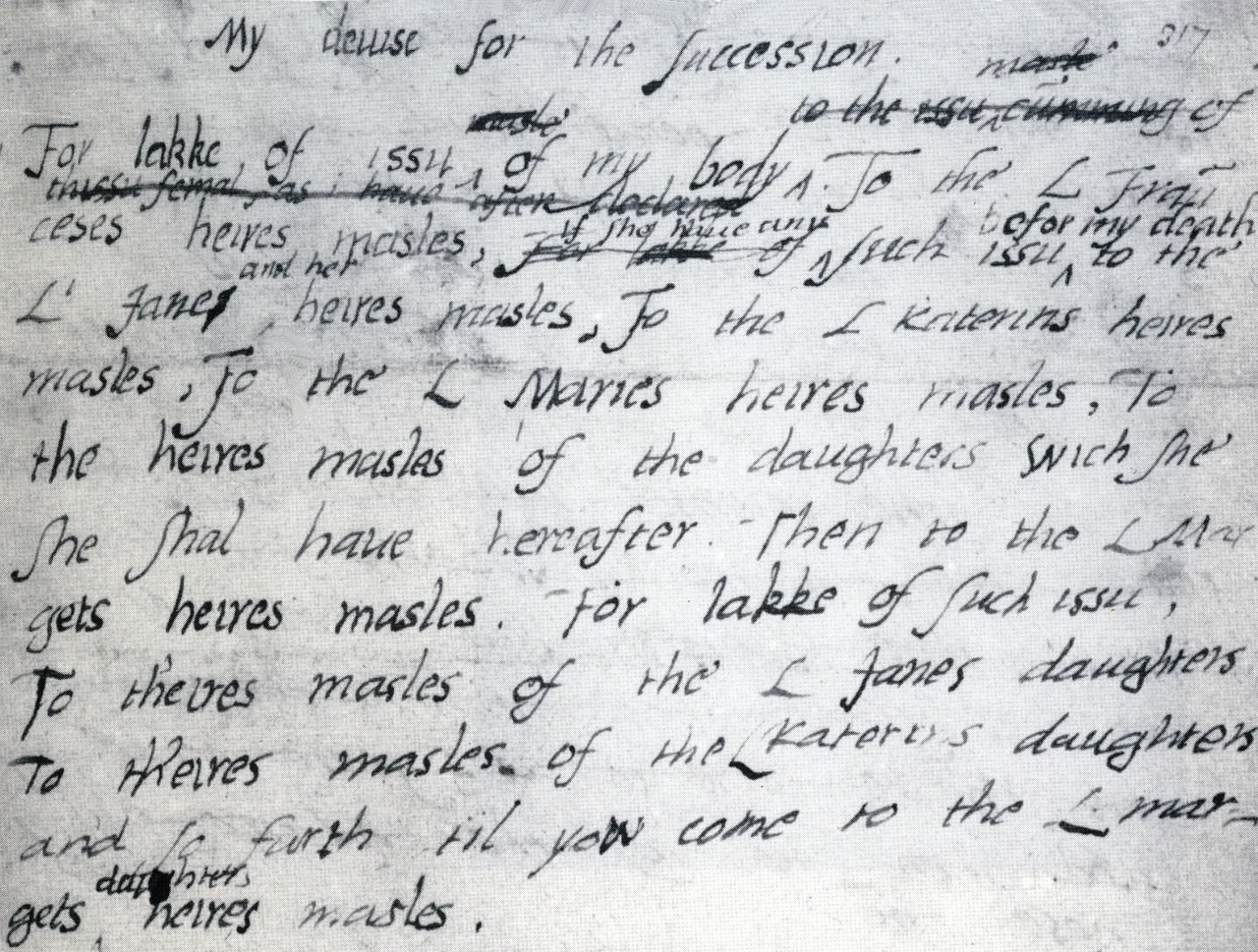
Edward VI fell ill early in 1553. He was fifteen, fervently Protestant, and horrified at the prospect of his Catholic half-sister Mary inheriting the crown and undoing the Reformation. He wrote a document headed My Devise for the Succession in which he excluded both his half-sisters and named, as his successor, his Protestant cousin Lady Jane Grey - who, by no coincidence, had married Dudley's son Guildford on 21 May 1553. How much of this was Edward's idea and how much was Dudley's remains genuinely disputed by historians. The king signed it; one hundred and two notables signed it; the lawyers were intimidated into accepting it. Edward died on 6 July 1553. Jane was proclaimed queen on 10 July. She did not want the crown. Mary Tudor, who had moved to her estates in East Anglia, raised an army. By 19 July the Privy Council in London had switched sides and proclaimed Mary. Jane reigned for nine days. Dudley, who had been marching towards Cambridge with fifteen hundred soldiers, threw up his cap in the marketplace there and laughed until tears ran down his cheeks for grief. He had lost.
The Scaffold and the Verdict of History
Mary's troops arrested him on 21 July. He rode through London to the Tower on 25 July, guards struggling to protect him from a hostile crowd that called him the great devil Dudley. He was tried on 18 August in Westminster Hall by a panel made up largely of his former colleagues, who had no interest in admitting their own role in the conspiracy. He was condemned. His execution was scheduled for 21 August, then postponed by a day so that he could publicly return to the Catholic faith. His recantation enraged Protestants, who had taken him for one of their own, and delighted Mary. Lady Jane Grey, still in the Tower, watched him pass below her window. She was executed herself the following February at the age of seventeen, when her father became implicated in a separate rebellion. Dudley's reputation curdled almost immediately - Protestant writers needed a villain to balance Somerset's role as the good Duke, and Dudley fit. Only since the 1970s have historians begun to rehabilitate him: not as a hero, but as one of the most able governors of any European state in the sixteenth century, a Tudor crown servant who took the necessary but unpopular steps to hold a minority regime together. The Tower of London still holds his prison cell. St Peter ad Vincula still holds his bones.
From the Air
John Dudley was executed at Tower Hill, on the north-west boundary of the Tower of London, at 51.51 degrees N, 0.08 degrees W. His remains lie inside the Tower at the chapel of St Peter ad Vincula, alongside many of the Tudor period's other high-status casualties including Anne Boleyn, Catherine Howard, and his daughter-in-law Lady Jane Grey. The Tower of London is one of the most recognisable structures on the Thames - a square white Norman keep surrounded by concentric walls, immediately east of Tower Bridge. Nearest airports: EGLC (London City) about 4 nautical miles east, EGLL (Heathrow) about 13 nautical miles west, EGKB (Biggin Hill) about 10 nautical miles south-east. Best viewed at 2,000-3,000 feet on approach to or departure from London City, with Tower Bridge an obvious reference point.
Nearby Stories
- Stevenage 5.7 km away
- Malling Abbey 5.7 km away
- 1952 Farnborough Airshow Crash 7.7 km away
- Ingatestone Hall 8.2 km away
- Hellfire Caves 9.1 km away
- The Carrington Event: The Solar Storm That Could Happen Again 9.8 km away
- Bletchley Park 16 km away
- Castle Hedingham 23 km away