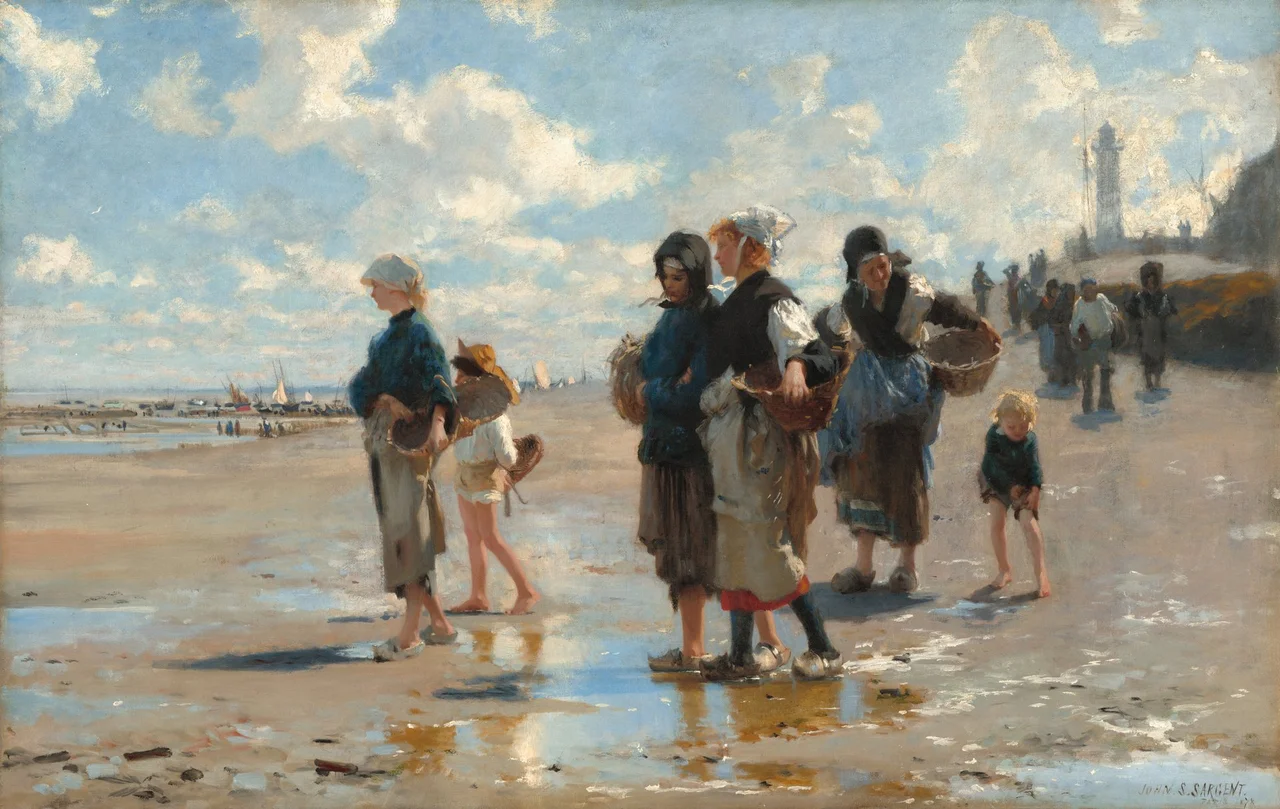

John Singer Sargent
The bare shoulder ruined his career, or so he thought at the time. In 1884, at the Paris Salon, John Singer Sargent unveiled a full-length portrait of the American expatriate Virginie Gautreau in a black evening gown. One strap had fallen off her right shoulder. Parisian society reacted with a fury that surprised even Sargent. Commissions dried up. He told friends he was thinking of giving up painting for music or for business. Instead, he moved to London, repainted the strap to its proper place, and within five years was the most sought-after portraitist in the English-speaking world.
Born in Florence
Sargent was American by parentage and European by upbringing. His father FitzWilliam, an eye surgeon from Gloucester, Massachusetts, had given up his hospital post in Philadelphia in 1854 after the death of an infant daughter sent his wife Mary into a breakdown. The Sargents went abroad to recover and never went home. Their second child was born in Florence on 12 January 1856 because a cholera epidemic had stopped them passing through. The family lived modestly on a small inheritance, moving between Paris, Florence, the German spas, and the Italian coast, with the children pulled out of school after school. Young John spoke English, French, Italian, and German fluently. His mother, herself an amateur watercolourist, gave him sketchbooks and turned every gallery and church into a classroom. He was thirteen when she wrote that he sketched quite nicely and had a remarkably quick and correct eye.
Paris and Madame X
At eighteen, Sargent passed the entrance examination for the École des Beaux-Arts on his first attempt and joined the atelier of the young portraitist Carolus-Duran. Carolus-Duran's method was direct: paint from life, lay the oil straight onto the canvas, build the form with light rather than line. Sargent absorbed it and surpassed his teacher within a few years. His 1879 portrait of Carolus-Duran himself drew admiring crowds at the Salon. Henry James, meeting him soon after, wrote that here was a talent which at the very threshold of its career had nothing more to learn. Sargent's friend Julian Alden Weir called his drawings the equal of the old masters. Then came Madame X. The portrait of Virginie Gautreau, with her famously white-powdered skin, arrogantly turned head, and that fallen strap, was meant to consolidate his Parisian reputation. It did the opposite. Sargent later called it the best thing he had ever done. He kept it in his studio until 1916, when the Metropolitan Museum of Art bought it.
Chelsea and the Wertheimers
Sargent moved to London in 1886, taking over James McNeill Whistler's old quarters at 33 Tite Street in Chelsea. In 1900 he bought 31 Tite Street next door and turned it into a larger studio. Tite Street would be his home and workshop for nearly forty years. The English warmed to him slowly. Critics complained at first that his handling was too clever, too French, too metallic. Then in 1887 his Carnation, Lily, Lily, Rose, a luminous garden scene of two girls lighting paper lanterns in the Cotswolds, was bought immediately by the Tate. After that, the commissions never stopped. He worked at the rate of fourteen full portraits a year through the 1890s, charging about five thousand dollars each, which is roughly a hundred and thirty thousand in modern money. In 1898 the Bond Street art dealer Asher Wertheimer asked him to paint twelve members of his family. The Wertheimer portraits, now mostly at Tate Britain, were the largest single commission of Sargent's life and show a relaxed warmth absent from his grander society sittings.
Beyond the Studio
Around 1900, Sargent began to tire of formal portraiture. He travelled instead. To Venice constantly, painting from gondolas. To the Tyrol with his sisters Emily and Violet. To the Middle East, where he painted Bedouins and goatherds. To Maine, Florida, the American West. He produced more than two thousand watercolours, executed with what one critic called the intensity of a dream. His murals for the Boston Public Library, the Museum of Fine Arts Boston, and Harvard's Widener Library occupied him for nearly thirty years; he never finished the Boston Public Library cycle, partly because his 1919 panels representing Church and Synagogue drew justified protests from Boston Jews who saw their faith depicted in medieval allegorical terms as a defeated blind hag. He was hurt by the criticism but never altered the work. In 1918 the British Ministry of Information sent him to the Western Front as a war artist. His niece Rose-Marie had been killed that Good Friday in the shelling of the St Gervais church in Paris. The painting that came out of his time at the front, Gassed, shows a line of blinded British soldiers walking single-file with hands on each other's shoulders to a dressing station. It is among the great paintings of the First World War.
Tite Street, 1925
John Singer Sargent died of heart disease at his Tite Street home in the early hours of 15 April 1925. He was sixty-nine. He had spent the previous evening reading and was about to leave for the United States to install murals in Boston. Memorial exhibitions opened at the Museum of Fine Arts in Boston that same year, and at the Metropolitan Museum and at the Royal Academy and Tate in London in 1926. The critic Roger Fry, leading light of the Bloomsbury Group, dismissed his work at the 1926 retrospective as a mere wonderful performance, lacking aesthetic quality. For decades the modernists agreed. Then, beginning in the 1980s, exhibitions of his previously hidden male nudes and his sympathetic studies of figures like the African-American elevator operator and World War One veteran Thomas McKeller pushed scholars to reassess. Andy Warhol said of him in 1986 that he made everybody look glamorous. Taller. Thinner. But they all have mood, every one of them has a different mood. The estimate stands. Tite Street is still there, the studio still standing, the blue plaque still on the wall.
From the Air
Tite Street, Chelsea, London SW3, sits at approximately 51.486°N, 0.166°W on the north bank of the Thames between Royal Hospital Chelsea and Battersea Bridge. The article's geohash gcpe also reaches into Wimbledon and parts of south-west London. Class A controlled airspace covers all of central London; this is heliroute country only. Nearest GA airfields are EGTF Fairoaks 17 nautical miles south-west, EGLF Farnborough 25 nautical miles south-west, EGKB Biggin Hill 13 nautical miles south-east. Visual landmarks at altitude include the Thames itself, the Albert Bridge, the Royal Hospital, and Battersea Power Station.
Nearby Stories
- Silvertown Tunnel 0.6 km away
- Uxbridge 5.3 km away
- Amberley Museum & Heritage Centre 8.8 km away
- Hever Castle 9.9 km away
- Russian Memorial, Lewes 11 km away
- Portchester Castle 16 km away
- Ufton Nervet rail crash 20 km away
- Abingdon-on-Thames 24 km away