,_Johns_Hopksins_Hospital,_601_N._Broadway,_Baltimore,_MD_21205_(49026493738).jpg)
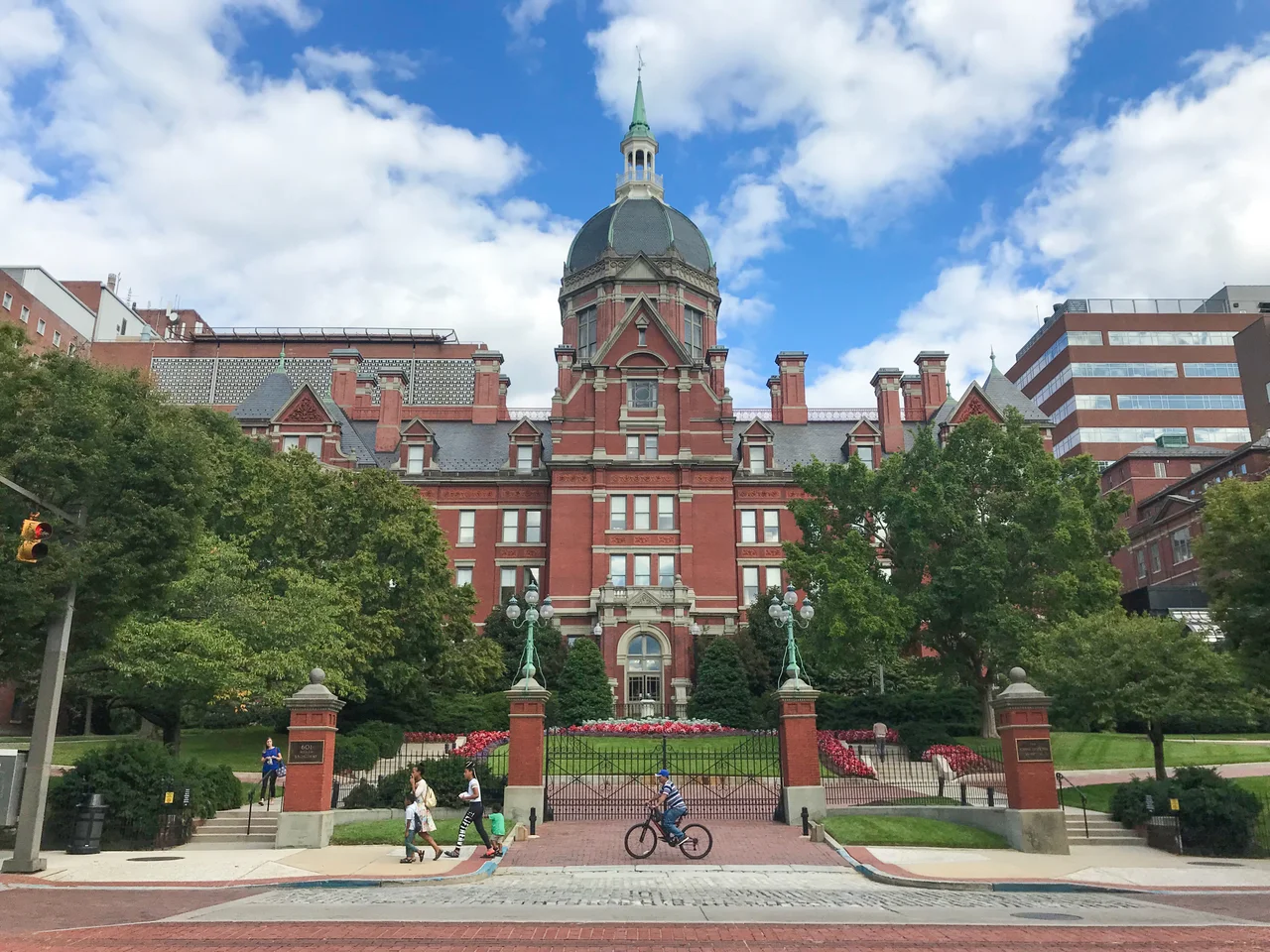
Johns Hopkins Hospital
Johns Hopkins - the Baltimore Quaker merchant and banker whose actual name was Johns - died on Christmas Eve 1873, leaving an estate of about $7 million. It was the largest philanthropic bequest in American history to that point. His will directed that the money go to found three institutions: a hospital, a university, and an orphanage for Black children. The hospital opened on May 7, 1889 on a thirteen-acre tract bounded by Broadway, Wolfe, Monument, and Jefferson Streets in east Baltimore that Hopkins had personally selected. The medical school opened four years later in 1893. The two institutions together are widely considered the founding institutions of modern American medicine. The teaching methods they invented - the residency, the grand rounds, the bringing of medical students into the wards to learn from actual patients - became the global model for how doctors are trained.
Hopkins's Bequest
Johns Hopkins was born in 1795 in Anne Arundel County to a Quaker family with a complicated relationship to slavery. His grandfather manumitted nine enslaved people in 1778, and the family's Quaker faith shaped a tradition of gradual emancipation — but recent archival research has established that Hopkins himself owned enslaved people as late as 1850, complicating the long-held narrative of the family as abolitionists. He moved to Baltimore at seventeen to work in his uncle's grocery wholesale business. He built a substantial mercantile fortune, expanded into Baltimore and Ohio Railroad investments, and never married. As his life approached its end he assembled twelve prominent Baltimore residents as trustees and laid out specific instructions for what he wanted built. The hospital, he wrote, should compare favorably with any other institution of like character in this country or in Europe. The trustees were to secure for its service physicians and surgeons of the highest character and greatest skill. The completed hospital cost about $2 million in 1889 dollars, considerably less than the bequest. The remaining funds endowed the medical school. The orphanage Hopkins specified for Black children was less successfully realized; it operated in various forms for decades but never achieved the scale of the medical institutions.
The Four That Came
The hospital's first four physicians shaped its character for a generation. William Osler, a Canadian who became the first chief of medicine, invented the medical residency - the system by which new physicians work as supervised house staff for years after graduation, learning at the bedside. He brought medical students into the wards rather than confining them to lectures. He coined the term grand rounds for the daily practice of leading physicians discussing the most difficult cases in front of the assembled staff and students. William Halsted, the first chief of surgery, established surgical residency and pioneered radical surgery techniques that defined oncology for the next century. William Welch, the first dean and chief of pathology, built the school's research culture. Howard Kelly, the first chief of gynecology, made foundational contributions to radium therapy - though Kelly's use of radium was sometimes catastrophic; he sewed radium points directly into tumors, and some of his patients died of radiation exposure rather than the cancers they came in with.
Why Women Studied Here First
Johns Hopkins School of Medicine became one of the first American medical schools to admit women, in 1893 - and it did so because it had to. The Baltimore and Ohio Railroad stock that had funded most of the hospital construction had been used up, and there wasn't enough money left to open the medical school. Four daughters of the original trustees - Mary Elizabeth Garrett, Martha Carey Thomas, Mamie Gwinn, and Elizabeth King - offered to raise the necessary funds. Their condition: the school had to admit qualified women on equal terms with men. After heated debate, with William Welch the only original dean openly resisting, the trustees accepted. Garrett alone provided the bulk of the funding. The first class of women entered in 1893. Welch later wrote that those who had not been enthusiastic about coeducation at the beginning were now sympathetic and friendly, and that the higher the character of the education, the more obvious the necessity for coeducation became. He had not changed his views from principle. The example proved him wrong.
Blalock, Thomas, and Taussig
In November 1944, surgeon Alfred Blalock performed the first blue baby operation at Johns Hopkins - a procedure that saved infants whose congenital heart defects starved them of oxygen. The technique was developed in collaboration with cardiologist Helen Taussig, who had identified the condition, and surgical technician Vivien Thomas, who designed the actual surgical method through years of laboratory work on dogs. Thomas was African American, hired in 1929 as a janitor at Vanderbilt before Blalock recognized his extraordinary surgical aptitude. Thomas did not have a college degree. He trained an entire generation of Hopkins surgical residents in the procedure he had invented, often standing on a step behind Blalock during operations to coach him through difficult moments. Thomas was not given an academic appointment at Hopkins until 1976, nine years before he died. The operation is now formally called the Blalock-Thomas-Taussig Shunt, Thomas's name finally added in the 2020s — a 2022 JAMA Surgery article made the formal case, and institutions began adopting the new name — to correct a long-standing historical omission. Robert Heyssel's 1980s expansion of the hospital and Vivien Thomas's 1976 portrait commission marked, in different ways, Hopkins finally acknowledging the contributions it had long downplayed.
The Hospital Now
Johns Hopkins Hospital occupies about 20 of the 60 buildings on the medical campus in east Baltimore. The complex has more than 80 entrances and receives about 80,000 visitors a week. It holds over 1,000 beds and employs more than 30,000 people, including over 1,700 physicians. The hospital was ranked the best in the United States by U.S. News and World Report for 21 consecutive years from 1991 to 2011 - the longest such streak in the magazine's history. The Charlotte R. Bloomberg Children's Center tower and the Sheikh Zayed Tower opened in 2012 as part of a $1.1 billion campus redevelopment. The HeLa cell line, derived in 1951 from the cervical cancer cells of Henrietta Lacks - a Black woman from Turner Station, Maryland whose cells were taken without her consent or her family's knowledge - was developed at Hopkins. The Lacks family received no compensation for decades while HeLa became the foundation of countless medical advances; a 2023 settlement between the family and Thermo Fisher Scientific finally addressed some of the long-standing grievance. The hospital that invented the modern teaching hospital is also where many of medicine's most consequential ethical reckonings have been forced. Both legacies are real.
From the Air
Johns Hopkins Hospital is located at 600 North Broadway in east Baltimore, at approximately 39.2972 N, 76.5928 W. The medical campus covers about 60 buildings around the original 13-acre block bounded by Broadway, Wolfe, Monument, and Jefferson Streets. The site sits well outside the Washington Flight Restricted Zone and Special Flight Rules Area. BWI Marshall (KBWI) is 11 miles southwest. Martin State Airport (KMTN) is 4 miles east. From altitude, the campus is identifiable as a dense cluster of high-rise medical buildings around the original 1889 Billings Building with its distinctive copper dome - the dome that has become the visual symbol of Hopkins medicine.
Nearby Stories
- Takoma Park, Maryland 5.2 km away
- Annapolis 5.5 km away
- Adkins Arboretum 7.8 km away
- Murders of Katherine and Sheila Lyon 28 km away
- Fort Delaware: The Island Prison Where 33,000 Confederates Waited Out the War 32 km away
- Battle of Gettysburg 35 km away
- Memorial Hall (Delaware State) 36 km away
- Three Mile Island: The Accident That Stopped Nuclear America 71 km away