
Johns Hopkins University
Daniel Coit Gilman, the inaugural president of Johns Hopkins University, opened the institution on February 22, 1876 with an idea no American university had yet implemented: that a university should produce new knowledge through research, not just transmit existing knowledge through teaching. Gilman had studied at the University of Berlin in the 1850s and watched the German research university model transform European scholarship. Hopkins's founding bequest gave him the rare freedom to design something genuinely new. The result was the first true research university in America - and the template that Stanford, Chicago, MIT, and nearly every other major American research institution would follow over the next half-century. The university's research expenditures have led all American universities for more than four consecutive decades. Hopkins effectively invented the model that now defines American higher education.
Gilman's Inaugural Address
Daniel Coit Gilman was 44 years old when he accepted the Hopkins presidency. He had been president of the University of California at Berkeley for three contentious years and had quit in 1875 over disputes with the regents. The Hopkins trustees offered him something neither Berkeley nor any other American university could: the freedom to design a research-focused institution from scratch, with private money rather than political appropriations. Gilman's inaugural address argued that the university's purpose was the discovery and dissemination of truth - words that sounded innocuous but were programmatically revolutionary at the time. American universities in 1876 were primarily teaching colleges, modeled on Oxford and Cambridge, focused on undergraduate moral formation and classical education. Gilman wanted Hopkins to be more like Heidelberg or Berlin, where faculty did original research and graduate students apprenticed in their discipline rather than memorizing existing texts. The faculty he hired - mathematician James Joseph Sylvester, biologist Henry Newell Martin, classicist Basil Gildersleeve - were chosen for their research records rather than their teaching credentials.
Homewood and the Move
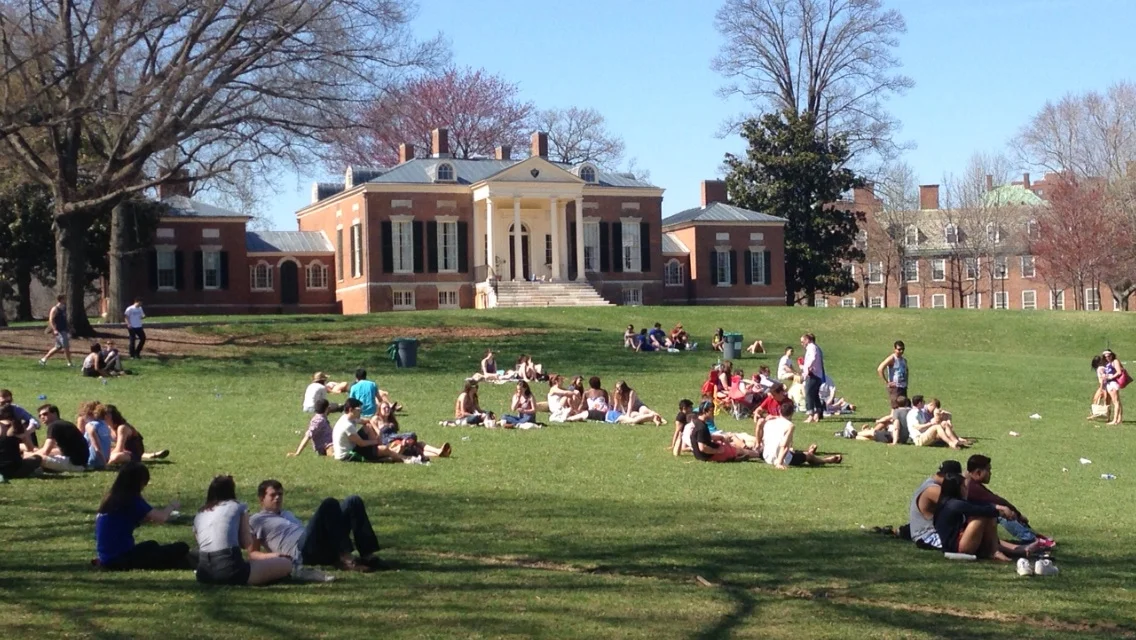
Hopkins's original campus was a cluster of converted downtown buildings near Howard and Centre Streets in Baltimore. By the early 1900s the original site was cramped and the trustees were looking for room to expand. In 1902, the William Wyman estate north of the city - 140 acres of rolling parkland between Charles Village and Roland Park - was offered to the university through a partial donation. The new Homewood campus, designed by Parker, Thomas & Rice in red brick Georgian Revival, opened gradually after 1916. Gilman Hall, the main classroom building, was completed in 1915. The Homewood House, built in 1801 as the country estate of Charles Carroll Jr. - son of the Charles Carroll of Carrollton who signed the Declaration of Independence - still stands at the southwest corner of campus as a museum. The Federalist architecture of the original Carroll house influenced the Georgian Revival style chosen for the new campus buildings, giving Homewood a visual coherence that is unusual among American universities.
The Applied Physics Laboratory
In 1942, the U.S. Navy contracted with Hopkins to develop the proximity fuze - a small radar that could detect when an artillery shell was close to a target and detonate it automatically, dramatically increasing the effectiveness of anti-aircraft fire. The Applied Physics Laboratory that was established for the work survived after the war and grew into one of the largest university-affiliated research centers in the country. APL now occupies a 461-acre campus in Laurel, Maryland, employs about 9,000 people, and works on space missions, missile defense, biomedical engineering, and undersea warfare. The Pluto-flying New Horizons probe was managed from APL. The Parker Solar Probe, which has flown closer to the Sun than any spacecraft in history, was built at APL. The Double Asteroid Redirection Test (DART), which successfully changed the orbit of an asteroid in 2022, was an APL mission. Hopkins's relationship with national security work is older than most of its peer institutions' and has been more central to its identity since World War II than the general public realizes.
The Twenty-Nine Nobels
As of 2024, 29 Nobel laureates have been affiliated with Johns Hopkins University as faculty, fellows, residents, or graduates. Seventeen are tied to the medical school, two to the chemistry department, and the rest distributed across other disciplines. Woodrow Wilson, who earned his PhD in political science from Hopkins in 1886, would later win the 1919 Nobel Peace Prize as the 28th President of the United States. Adam Riess won the 2011 Physics Nobel for the discovery that the universe's expansion is accelerating. The Bloomberg Distinguished Professorships - 50 endowed chairs created in 2013 with funding from Michael Bloomberg, recruiting scholars whose work crosses disciplinary boundaries - have brought a new generation of Nobel-track scholars to the university. The pattern Gilman established in 1876 - research-active faculty pursuing original work in partnership with graduate students who become the next generation of researchers - is now so embedded in American higher education that it's hard to remember it was once revolutionary.
Bloomberg's University
Michael Bloomberg is, to be exact about it, Johns Hopkins's largest donor by an enormous margin. The financial information services billionaire and former mayor of New York earned his undergraduate degree from Hopkins in 1964 and has since given more than $4 billion to the university across his lifetime. The Bloomberg Distinguished Professorships, the Bloomberg School of Public Health (renamed in 2001 after a $300 million gift), the Bloomberg Center for Government Excellence, and most recently the July 2024 $1 billion gift to make medical school tuition free for most students - the scale of Bloomberg's giving has reshaped what Hopkins can afford to do. The university has used the money for both expansion and access. Need-blind admissions and substantially expanded financial aid have made Hopkins more economically diverse than most of its peer institutions. The Homewood campus undergraduates, organized in the Krieger School of Arts and Sciences and the Whiting School of Engineering, are admitted from a pool that is far less white and far less wealthy than it was a generation ago. What Gilman opened as a tiny research-focused graduate school in 1876 is now, 150 years later, a global university with ten divisions, four campuses in Baltimore, and outposts in Italy, China, and Washington.
From the Air
The Johns Hopkins University Homewood campus, the main undergraduate site, is located at approximately 39.330 N, 76.621 W in north-central Baltimore, between Charles Village and Roland Park. The medical campus in East Baltimore (39.299 N, 76.592 W) and the Peabody Institute in downtown Baltimore are separate sites. The Applied Physics Laboratory is at 39.165 N, 76.898 W in Laurel, Maryland - 25 miles southwest. All Hopkins campuses sit well outside the Washington Flight Restricted Zone. BWI Marshall (KBWI) is 12 miles southwest of Homewood. Martin State Airport (KMTN) is 6 miles east. From altitude, the Homewood campus is identifiable as a green Georgian-Revival campus immediately north of the Baltimore Museum of Art.
Nearby Stories
- Takoma Park, Maryland 5.2 km away
- Annapolis 5.5 km away
- Adkins Arboretum 7.8 km away
- Murders of Katherine and Sheila Lyon 28 km away
- Fort Delaware: The Island Prison Where 33,000 Confederates Waited Out the War 32 km away
- Battle of Gettysburg 35 km away
- Memorial Hall (Delaware State) 36 km away
- Three Mile Island: The Accident That Stopped Nuclear America 71 km away