
Jones Island
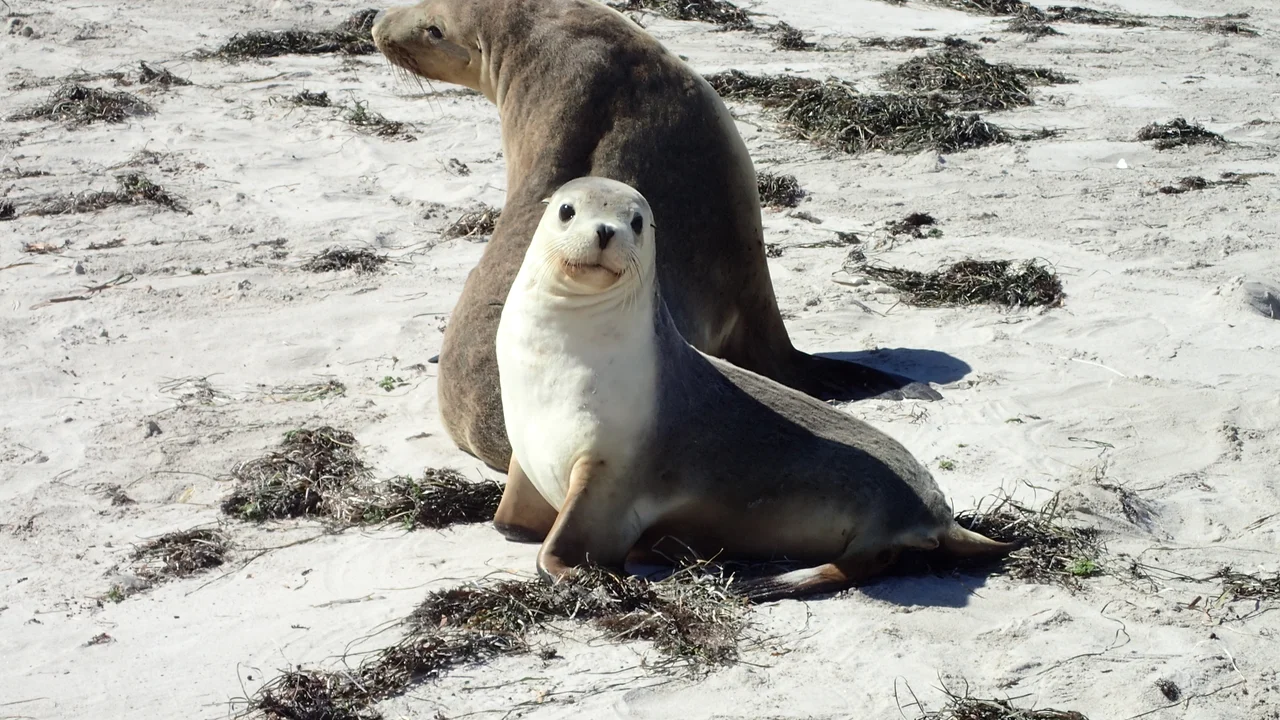
Most wildlife stories on this coast are about decline. Jones Island is the rare exception. In the calm, shallow water off its sheltered shore, an Australian sea lion colony is not just surviving but expanding, with 32 pups born in a single recent season and pup counts rising for more than a decade. For an endangered animal whose numbers fall almost everywhere else, that makes this unremarkable-looking lump of rock at the mouth of Baird Bay one of the most quietly hopeful places on the Eyre Peninsula.
The Last of a Drowned Wall
Jones Island is small, about 600 metres long and no more than 400 metres wide, sitting at the northern end of Anxious Bay where Baird Bay opens to the ocean. Its southeastern face is sharp cliff, exposed to the full weight of the Southern Ocean swell; its northwestern side is a sheltered ledge. Geologists read the island as the remnant of a calcarenite wall that once held back the ocean from the low-lying valley to the north, a natural sea barrier most of which has since been worn away or drowned. What remains is the permanently exposed crest of a submerged reef system that runs southwest for roughly 12 kilometres. The island is, in effect, the high point of a sunken ridge, calcarenite over a granite base, the part too stubborn to disappear.
A Colony Against the Odds
Australian sea lions are among the rarest sea lions on the planet, and their populations have been falling for years, hit by bycatch, disease, and a famously slow breeding cycle. Against that backdrop, Jones Island is an outlier worth celebrating. It is one of the few colonies in the country where pup numbers have climbed year after year, which is why scientists watch it closely. The island also serves as a breeding colony for Australian pelicans, those improbable birds with the enormous bill, while many other species use its shores as a roost. The richness extends beyond the island itself: Jones Island marks the edge of an area covering the whole of Baird Bay that has been listed as a wetland of national importance since at least 1996.
Look, Don't Land
The island itself is closed to people, off-limits for the sake of the animals that breed there, and that boundary is the whole point. Sea lions are curious and trusting, qualities that have not always served them well around humans. But just offshore, in the protected shallows of Baird Bay, small groups of visitors are allowed into the water on guided tours to meet the colony on the sea lions' own terms, often joined by wild dolphins crossing the bay. The encounter has become one of South Australia's most celebrated. The arrangement is deliberate and careful: the breeding ground stays sacrosanct, while the experience happens in the water alongside, where a sea lion can approach if it chooses and leave when it likes.
A Name From the Paperwork
The island's human history is briefer than its natural one. It was named in 1908 after James W. Jones, secretary to the Commissioner of Public Works, an official whose name attached itself to a rock he very likely never set foot on. Protection came in stages. The island gained protected status in 1967 and has been part of the Baird Bay Islands Conservation Park since 1972. In 2012 the waters around it were folded into a habitat protection zone within the West Coast Bays Marine Park, extending the shelter from the land out into the sea where the sea lions actually live. Layer by layer, the law caught up with what the colony needed.
A Garden of Salt and Stone
For all that the sea lions dominate the story, the island has its own quiet botany. A 1983 survey found vegetation in five groupings, hardy coastal plants built for salt, wind, and thin soil: coast daisy-bush, nitre-bush, Austral stork's bill, round-leaved pigface, and a patch of introduced pasture on the gentler northwestern side. None of it is showy. All of it is tough, the kind of low, grey-green growth that clings to exposed rock where almost nothing else will. Around the island, the shallow sheltered waters of Baird Bay sit in sharp contrast to the open ocean beyond, calm enough for dolphins and sea lions to gather, productive enough to anchor a wetland of national importance. The island is the visible keystone of a larger living system, most of it underwater and out of sight.
From the Air
Jones Island lies at roughly 33.18 degrees south, 134.37 degrees east, at the mouth of Baird Bay on the western Eyre Peninsula, about 45 km south-southeast of Streaky Bay. From the air it appears as a small island guarding the bay entrance, cliffed on its ocean-facing southeast side, with the line of the submerged reef trailing southwest. Best viewed at 1,500 to 3,000 feet; morning light catches the cliff face and the white water along the exposed shore. Nearest aerodrome is Streaky Bay (YKBY) to the north; Elliston (YELN) lies to the south and Wudinna (YWUD) inland to the east. The bay water is sheltered and calm even when the open ocean is rough, a contrast often visible from above.
Nearby Stories
- Streaky Bay, South Australia 25 km away
- Flinders Island 35 km away
- Nuyts Archipelago 67 km away
- St Francis Island 93 km away
- Acraman Impact Structure 104 km away
- Port Augusta 268 km away
- Baudin expedition to Australia 304 km away
- Israelite Bay 934 km away