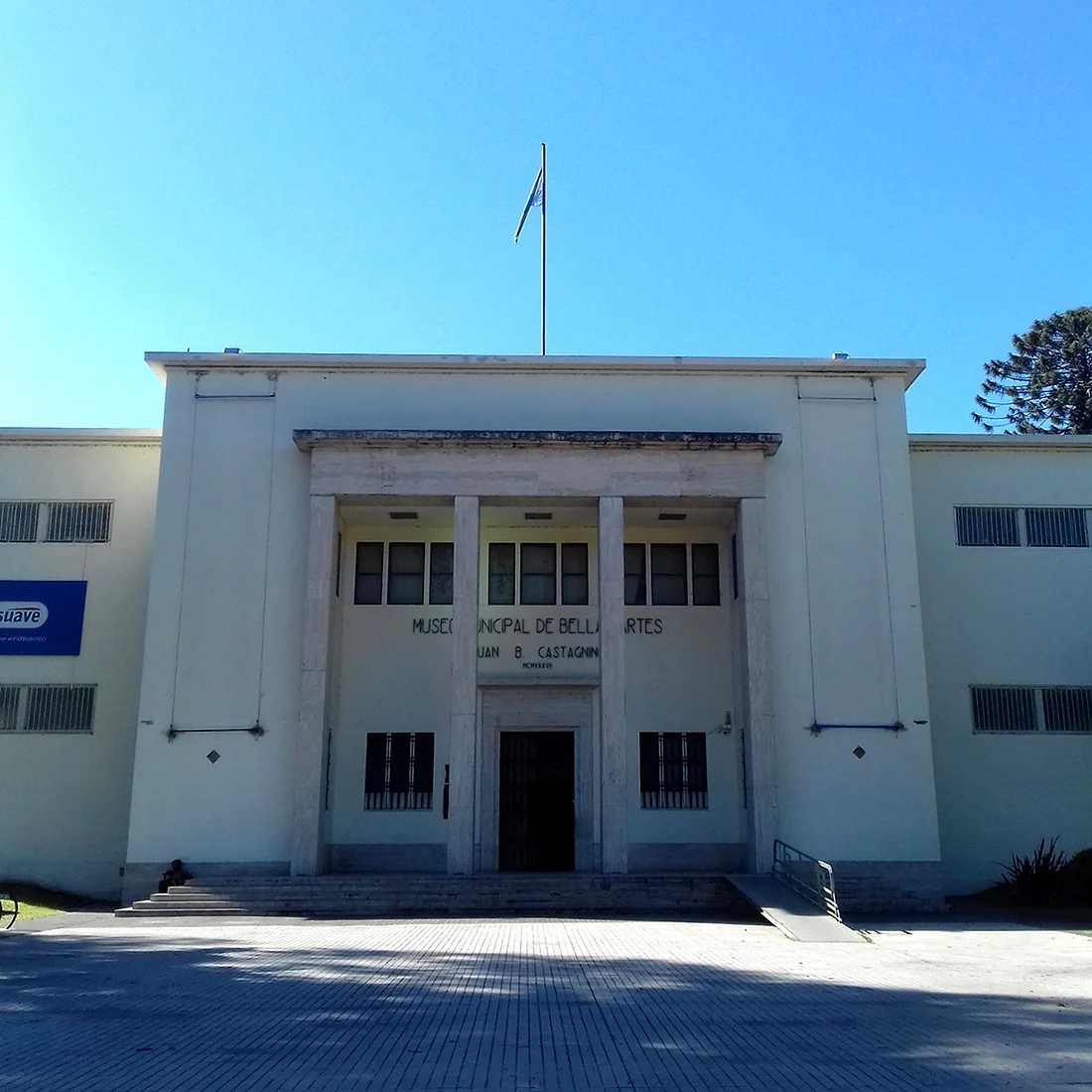

Juan B. Castagnino Fine Arts Museum
It began with a mother who outlived her son. Juan Bautista Castagnino was a young art critic and collector in Rosario, a man with an eye for paintings, who died before his time. To keep his name alive, Rosa Tiscornia de Castagnino gave the city a museum in his memory. Inaugurated on December 7, 1937, on the green edge of Rosario's largest park, the Juan B. Castagnino Fine Arts Museum became the most important art collection in Argentina's interior and second in the entire nation. Step inside, and you find Goya and Flemish masters hanging quietly nine hundred kilometers from Buenos Aires, in a river city most foreigners cannot place on a map.
A Memorial in Marble and Light
The building was designed by the architects Hilarión Hernández Larguía and Juan Manuel Newton and opened in 1936, a year before it became a museum. It sits inside the Parque de la Independencia, the grandest of Rosario's urban parks, where the Oroño and Pellegrini avenues meet just beyond the city center. The setting matters. This is not a stern institution tucked among office blocks but a temple to art set among lawns, lakes, and rose gardens, the kind of place where a family stroll on a Sunday afternoon might end among Renaissance saints and Impressionist riverbanks. The grief that created it has softened, over the decades, into something gentler: a gift the whole city shares.
Masters in the Pampas
The collection is larger than its provincial address suggests, more than three thousand works spread across two floors, thirty-five rooms, and seven hundred linear meters of wall. The story is European art, and Argentine art of the nineteenth and twentieth centuries, gathered from private donors, augmented by the city and the museum's foundation. Among the treasures are Flemish panels from the sixteenth century, attributed to masters such as Mabuse and Gerard David, Italian and Spanish Baroque canvases, and a complete series of Francisco de Goya's prints, the great Spaniard's biting, dreamlike etchings hanging far from the Spain that produced them. To stand before a full Goya series in a museum on the Argentine pampas is to feel the long reach of European art into the New World.
A Local Eye
What gives the Castagnino its character, though, is not the European names but the local ones. Alongside the imported masters hang works by Argentine artists and by painters from Rosario itself, recording the world up to the 1930s, the city, the river, the people of the littoral. The collection insists that Rosario is not merely a place that imports great art, but a place that makes it. When the museum's holdings of more recent, contemporary work outgrew the building, the city did not crowd them in. It gave them a museum of their own, the Museum of Contemporary Art of Rosario, MACRo, which opened in 2004 on the waterfront. The Castagnino kept its older treasures and its quiet dignity.
The Habit of Beauty
There is something telling in the fact that Rosario, a working river port built on grain and trade, has long taken its art this seriously. The Castagnino is not a tourist showpiece so much as a civic habit, a museum that generations of Rosarinos have wandered through as schoolchildren and returned to as adults. The original holdings came together from the gifts of private collectors and the contents of an earlier municipal art museum, then grew steadily through the decades as the city and the museum's foundation kept buying. A grieving mother set the whole thing in motion almost a century ago, asking the city to remember her son. The city did more than remember him. It built, around his name, one of the great art collections of provincial South America, gathered Goya and the Flemish masters and its own local painters under one roof, and then kept faith with all of them across the better part of a hundred years.
From the Air
The museum stands within the Parque de la Independencia in central Rosario, Santa Fe Province, at roughly 32.95°S, 60.66°W, where Oroño Boulevard meets Pellegrini Avenue. From the air the park itself is the landmark: a large rectangle of green, with lakes and tree-lined avenues, set into the dense grid of the city a short distance inland from the Paraná River. The nearest airport is Rosario – Islas Malvinas International Airport (ICAO: SAAR, IATA: ROS), about 13 km west-northwest, an easy approach over the western suburbs. Buenos Aires lies roughly 300 km to the southeast. Best appreciated at lower altitude in clear weather, when the park's greenery contrasts sharply with the surrounding streets.
Nearby Stories
- Battle of Cepeda (1859) 19 km away
- Battle of the Tonelero Pass 24 km away
- Abadía del Niño Dios 45 km away
- Ramallo Massacre 60 km away
- Sa Pereira Rail Disaster 126 km away
- San José Palace 152 km away
- Battle of Quebracho Herrado 185 km away
- The Pampas 212 km away