
Kabara, Mali
Timbuktu has a problem that has shaped its entire history: it sits in the desert, eight kilometers from the river that gives it life. The solution, for seven hundred years, has been Kabara, a small port town on the Niger where boats unloaded the goods that made Timbuktu rich, the salt and gold and books, before camels and porters carried them the last stretch across the sand. Without Kabara, Timbuktu is a city stranded. With it, Timbuktu was once the meeting point of the river and the desert, and of half the known world.
A Canal Across the Sand
The land between river and city was never reliable. In wet years the Niger's floodwaters reached the western edge of Timbuktu itself; in dry years the connection failed entirely. So rulers dug canals to bridge the gap. The emperor Sonni Ali, who seized Timbuktu in 1468, cut a channel toward Kabara, and a later extension reached up toward the city, nicknamed the 'Hippopotamus Canal.' Keeping water flowing was a constant fight against silt and sand. The harbor of 1929 was little more than a circle of water surrounded by dunes, navigable only when the river ran high. A small canal wound up to Timbuktu when the Niger flooded, though those who drank its untreated water risked the misery of guinea-worm disease.
The Port at the Edge of the World
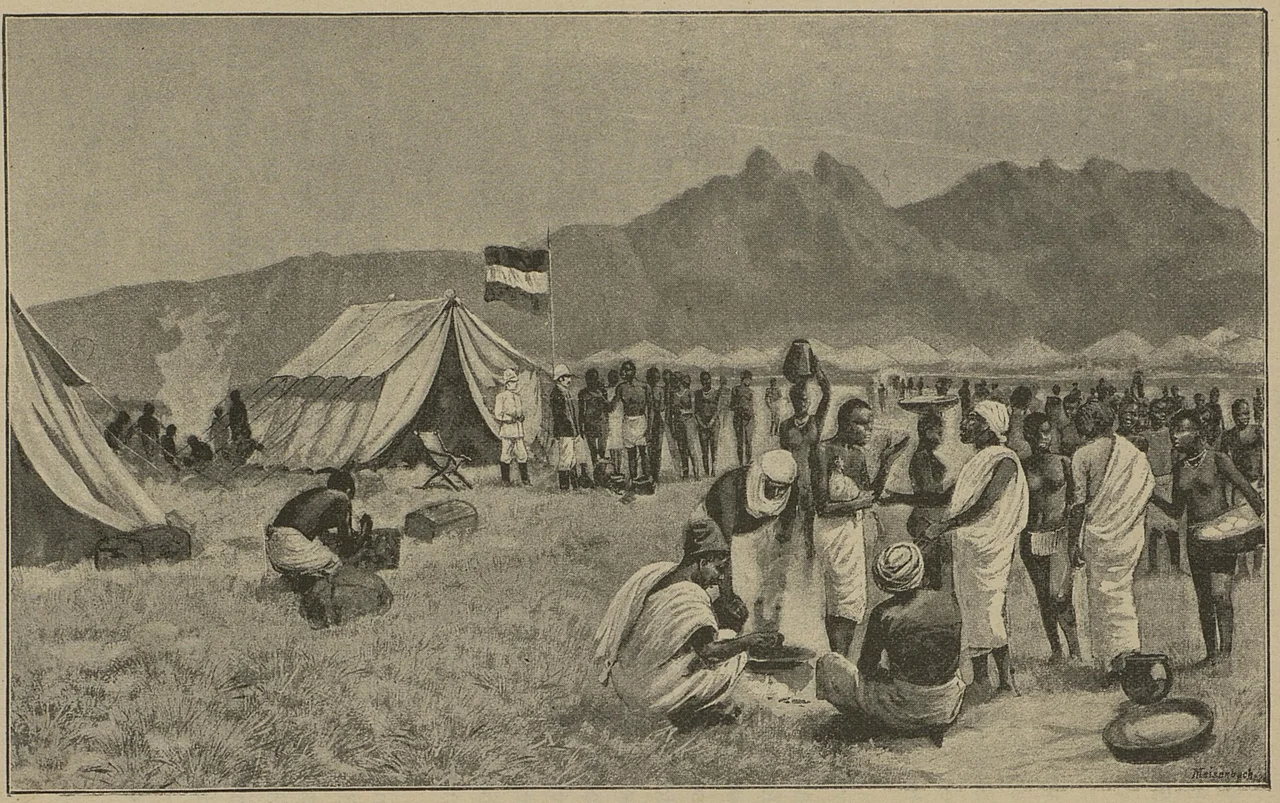
For travelers, Kabara was the threshold of the legendary city beyond. In 1353 the Moroccan wanderer Ibn Battuta passed this way, the first to leave a written record, and mistakenly believed the Niger was the upper Nile. Centuries of European explorers fixated on reaching Timbuktu through this port. Mungo Park reached Kabara in 1805 but pressed on downstream rather than entering the city, and never returned, dying at the Bussa rapids. Gordon Laing reached the city in 1826 only to be killed trying to leave. René Caillié, in 1828, became the first European to visit and survive to tell of it. When the German explorer Heinrich Barth arrived in 1853, the canal was so shallow his passengers had to climb out while boatmen dragged the vessel forward, and he found the fields around Kabara green with watermelons.
Salt, Customs, and Captivity
Kabara was where Timbuktu collected its dues. A customs inspector here gathered much of the city's revenue, taxing the river trade that flowed up from the merchant towns downstream. Under the Songhai Empire, two officials governed the port, one commanding the soldiers, the other collecting the levies. But the trade that passed through Kabara was not only in goods. It was also a market for enslaved human beings. Alfred Diban, who would become the father of the historian Joseph Ki-Zerbo, was born in what is now Burkina Faso, captured as a young man, and sold at the Kabara slave market, traded for salt before being driven into the desert. He survived, escaped, and lived to old age, but his ordeal is a reminder that this prosperous port profited from human suffering, and that real people endured it.
A Port in Retreat
The story of Kabara is also the story of a river pulling away. The 1911 encyclopedia described steamers bringing cereals, gold, wax, and ivory up the Niger to the port of Timbuktu. By 1929 the town was already in decline, its calabashes and pottery less in demand. Then came the great droughts. From the 1970s the Niger's waters dropped, and the canals choked with sand and ceased to fill. A Libyan-financed project reopened a stretch of canal in 2007, but without constant maintenance the desert reclaims its own. Today the channel to Kabara is often unnavigable in the low-water months, and boats divert to nearby Korioumé. The port that once anchored Timbuktu to the world now fights, like the city it served, simply to stay connected to the river.
From the Air
Kabara lies at 16.71°N, 2.99°W on the northern fringe of the Niger River floodplain, about 8 km south of Timbuktu, Mali. The nearest airport is Timbuktu (ICAO: GATB), roughly 15 km to the north. From the air, look for the silvered channels and seasonal basins of the Niger threading between desert dunes; in high-water months the port and its canal stand out as bright water against tan sand, while in the dry season they may shrink to faint traces. The river itself is the principal navigation reference. Visibility is best in the dry season but degraded by harmattan dust from late autumn into spring.
Nearby Stories
- Essakane 13 km away
- Liptako 18 km away
- Tondidarou 86 km away
- Hand of Fatima (rock formation) 159 km away
- Lake Débo 184 km away
- Hombori 187 km away
- Festival au Désert 332 km away
- Oualata 374 km away