
Kalavryta
The clock on Kalavryta's cathedral has been stopped at 2:34 p.m. It marks the moment on 13 December 1943 when German soldiers machine-gunned the male population of the town. That frozen hour is the most famous thing about Kalavryta, but the town has been at the center of Greek history for far longer than the twentieth century. The flag of the 1821 revolution was raised four kilometers from here. Frankish barons held the surrounding barony in the Middle Ages. Byzantine emperors and Ottoman governors each left their mark. Kalavryta is a small mountain town, and it has lived through an extraordinary amount.
A Town Above the Gorge
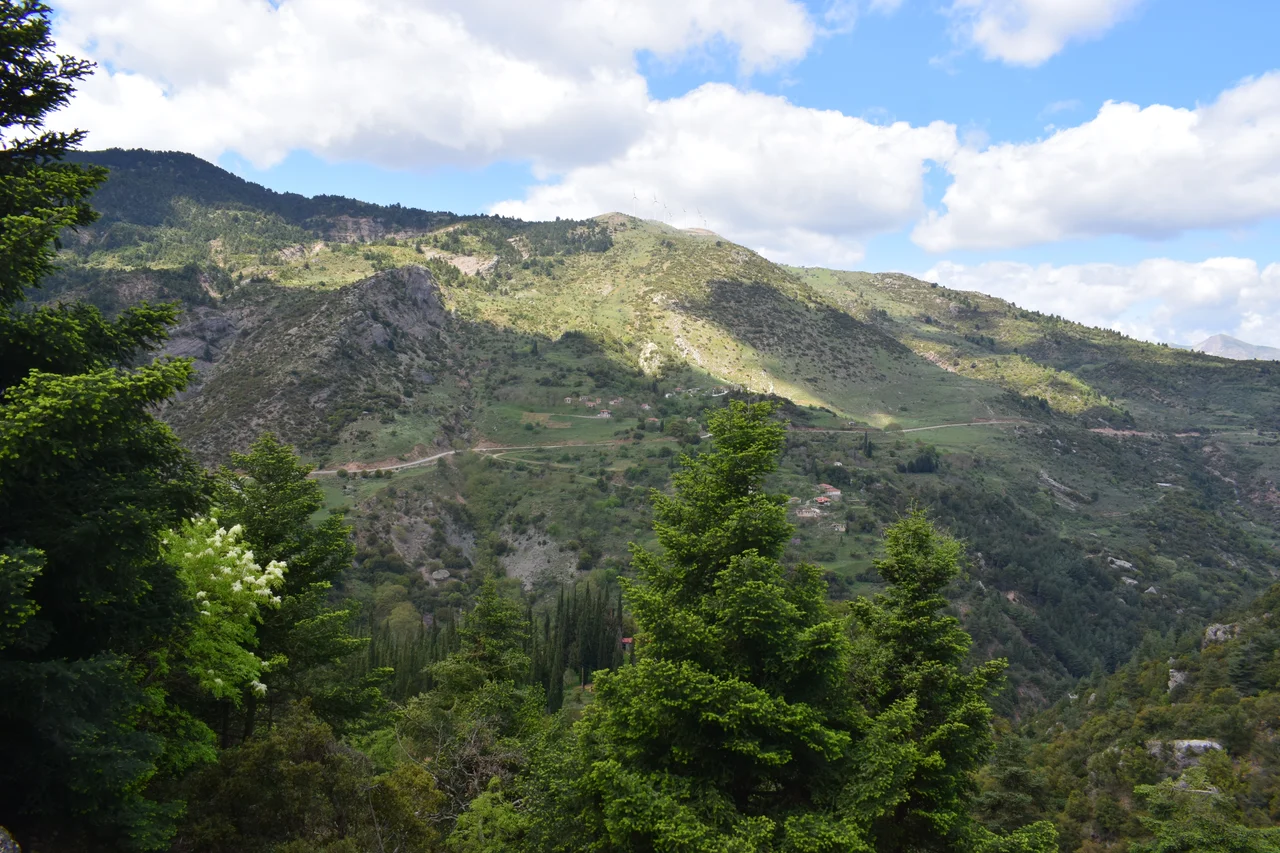
Kalavryta sits on the right bank of the Vouraikos river, roughly 750 meters above sea level, in the mountainous east-central part of Achaea. The Peloponnese highlands fold around it — Mount Erymanthos to the west, Aroania (or Chelmos, rising to 2,341 meters) to the southeast. The town is 24 km south of Aigio on the coast, 40 km southeast of Patras, 62 km northwest of Tripoli. Its relative isolation — surrounded by steep terrain and connected to the coast by a dramatic river gorge — has shaped its history repeatedly, making it a place that armies and partisans have approached through mountain passes, always with difficulty. The town is built near the site of the ancient city of Cynaetha, which the historian Polybius described as the most turbulent city in the Peloponnese.
The Birthplace of a Revolution
On 25 March 1821 — or 21 March, as some local sources give — the flag of the Greek War of Independence was raised at the monastery of Agia Lavra, 4 km southwest of town, by Bishop Germanos of Patras. The call was Eleftheria i Thanatos: Freedom or Death. Kalavryta had been under Ottoman rule since 1460, with a brief Venetian interlude, after centuries of Byzantine and Frankish control. The town had produced a generation of revolutionary leaders — the Petimezas family, the Zaimis dynasty, the Fotilas brothers — who fought through the decade-long war and emerged into positions of political and military leadership in the new Greek state. Alexandros Zaimis, a descendant of that generation, later served as prime minister of Greece six times.
December 1943
In December 1943, the German Army's 117th Jäger Division converged on Kalavryta as part of a reprisal operation following the execution of German prisoners by Greek resistance fighters. On the morning of 13 December, soldiers rounded up all male residents aged 14 and older and marched them to a field above the town. The women and children were locked in the school and the building set on fire. The women escaped. Then the machine guns opened fire. The town burned. The following day, Agia Lavra monastery burned as well. In total, 693 civilians were killed across twenty-eight communities during the operation. No German commander was ever prosecuted for the crime.
The Rack Railway and the Cave
Kalavryta is the southern terminus of the Diakopto–Kalavryta railway, one of the most remarkable rail journeys in Europe. Built by Italian engineers between 1889 and 1895, the line climbs from the Gulf of Corinth coast through the Vouraikos gorge, gaining nearly 700 meters of altitude in 22 kilometers using a rack-and-pinion system. The journey through the limestone gorge — its walls narrowing to nearly vertical cliffs in places — takes about an hour. A short distance away, at Kastria in the municipal unit of Kleitoria, the Cave of the Lakes (Spilaio ton Limnon) opens into a system of chambers filled with natural lake terraces and strange mineral formations. The two sites together — a nineteenth-century engineering feat and an ancient geological wonder — draw visitors to a town that also has a ski center on the slopes of Chelmos east of town.
Memory and Continuity
Kalavryta today is a functioning community of a few thousand people. The Municipal Museum of the Sacrifice of the People of Kalavryta maintains the record of December 1943. The memorial site on the hill above town — the field where the men died — is kept and visited. In April 1948, the town became the site of a major battle in the Greek Civil War, when Democratic Army fighters seized it from its government garrison. German President Johannes Rau came in 2000 to express sorrow. Each December 13, the town gathers. What Kalavryta demonstrates — not as a lesson imposed from outside but as a fact visible in how the place lives — is that memory and ordinary life are not opposites. The train still climbs the gorge. Skiers come in winter. The clock on the cathedral remains stopped.
From the Air
Kalavryta is at approximately 38.03°N, 22.11°E, roughly 750 meters above sea level in the Achaean highlands. From altitude, the Vouraikos gorge cutting north toward the coast is a clear landmark. The Chelmos/Aroania massif rises prominently to the southeast. Nearest major airport: LGRX (Araxos), approximately 60 km northwest at 38.15°N, 21.42°E. In clear conditions, the ski area on the Chelmos slopes east of town is visible, as is the town's small but distinct urban footprint against the surrounding forested mountains.
Nearby Stories
- Pellene 3.9 km away
- First Siege of Missolonghi 5.5 km away
- Battle of Manolada 8.4 km away
- Barony of Akova 8.7 km away
- Desfina 11 km away
- Panagia Skafidia Monastery 15 km away
- Battle of Naupactus 15 km away
- Tomb of Clytemnestra 24 km away