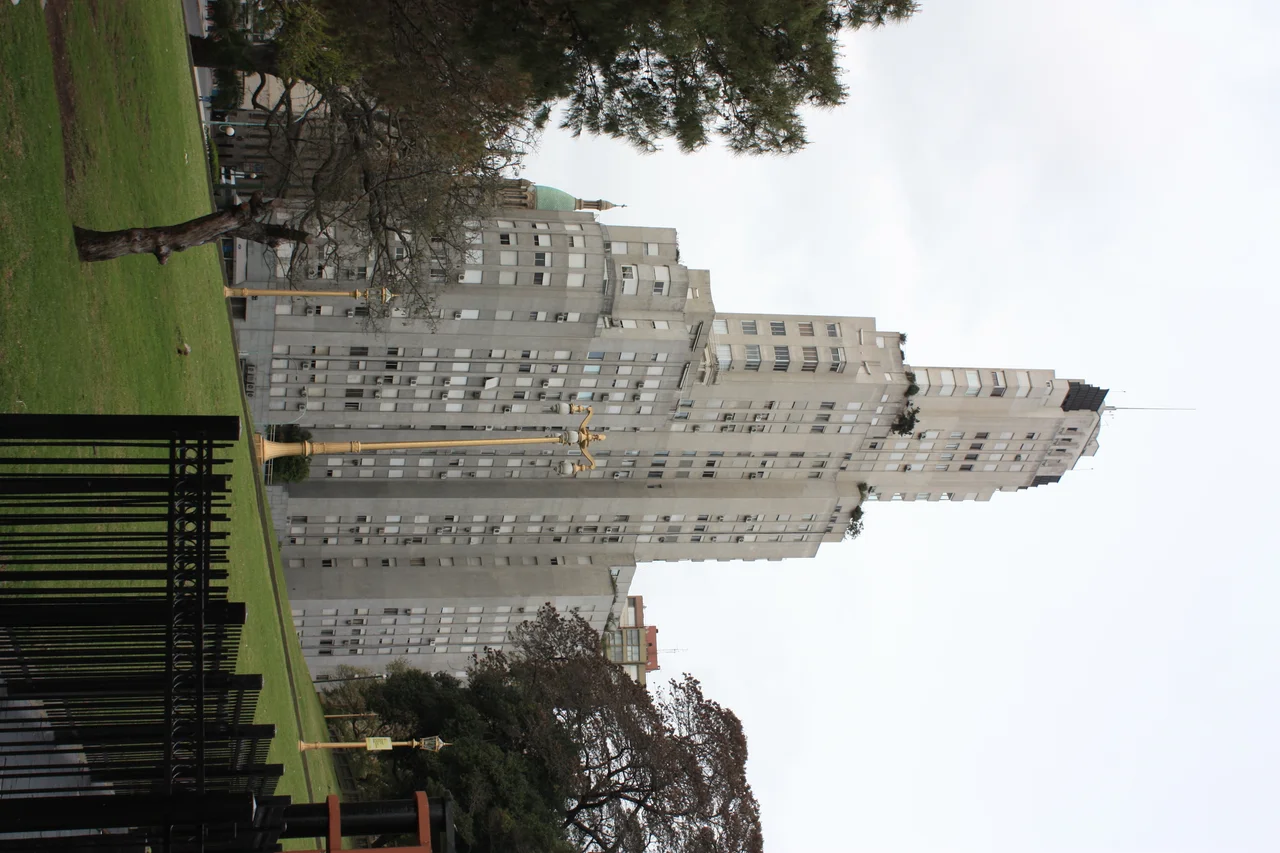

Kavanagh Building
The story porteños tell goes like this: a woman scorned by an aristocratic family built a skyscraper out of spite, positioning it precisely to blot out their view of the basilica they had commissioned. It is a perfect Buenos Aires legend, romantic and vengeful and almost certainly untrue. What is true is stranger and more impressive. In 1934, Corina Kavanagh, a millionaire of Irish descent, sold two of her cattle ranches at the age of thirty-nine and used the money to erect her own skyscraper, the tallest building in Latin America, raised from foundation to crown in just fourteen months.
The Tallest Thing in Latin America
When the Kavanagh was inaugurated in 1936, it stood 120 meters above Florida Street in the elegant Retiro district, overlooking the green sweep of Plaza San Martín. It surpassed Montevideo's Palacio Salvo to become the highest building on the continent, and it held a more remarkable distinction: it was the tallest building in the world with a reinforced concrete structure. The engineers who calculated its skeleton were working at the frontier of their science. Soil mechanics, the discipline that tells you how much weight the ground can bear, was in its infancy, and the tools for predicting how wind would push against such a slender tower barely existed. They built it anyway, and it has stood for nearly ninety years.
Austerity as Beauty
Designed by the local architects Gregorio Sánchez, Ernesto Lagos, and Luis María de la Torre, the Kavanagh broke sharply with the ornate Belle Époque mansions surrounding it. There are no flourishes, no carved garlands, no classical columns. Instead the building rises in great clean prisms, stepping back in symmetrical setbacks as it climbs, its surfaces shrinking toward the sky. The critic Fabio Grementieri of La Nación called it a "masterful synthesis of rationalism and Art Deco, of renewal and tradition, of Paris and New York." The contrast with the genteel neighborhood scandalized some, but the rationalist style it championed soon swept Buenos Aires in the 1930s. The Kavanagh is now considered the apex of early Modernism in Argentina, and it was created, in the architects' phrase, from the outside in.
The Legend and the Facts
The revenge story refuses to die, and it is worth telling honestly. As the tale has it, Corina fell in love with a son of the powerful Anchorena family, who deemed her wealthy but not nobly born enough, and forbade the match. In retaliation she supposedly placed her tower to obscure the Anchorenas' view of the Basílica del Santísimo Sacramento. It is a marvelous story. It is also unsupported by evidence. Mercedes de Anchorena, the matriarch cast as the villain, died in 1920, sixteen years before the building opened, and no record survives of any romance or feud. The legend endures not because it happened but because it captures something real about the woman herself, a single, determined heiress who built a monument no one could ignore.
The City's Favorite
Affection for the Kavanagh runs deep and is not merely a matter of architectural reputation. In a 2013 survey by the newspaper Clarín, six hundred ordinary porteños, none of them architects or builders, named the Kavanagh the building they loved most in all of Buenos Aires. The American Society of Civil Engineers declared it a Historic Civil Engineering Landmark in 1994, and Argentina named it a National Historic Monument in 1999. Nearly a century after Corina Kavanagh traded her ranches for a place in the skyline, her building remains exactly what she intended: impossible to overlook, and impossible not to admire.
From the Air
The Kavanagh Building stands at 34.595°S, 58.375°W in the Retiro district of Buenos Aires, overlooking Plaza San Martín near the city's northern waterfront. From the air, look for a tall, pale, stepped tower set among the trees of the plaza, just inland from the port and the broad Río de la Plata. Its symmetrical setbacks make it recognizable even amid the dense downtown grid. Best viewed at 1,500-3,000 ft on a clear day; afternoon light from the west sharpens its prismatic faces. Aeroparque Jorge Newbery (ICAO: SABE) lies about 3 km north along the river, its single runway 13/31 running parallel to the shore; Ezeiza international (ICAO: SAEZ) is roughly 30 km southwest. Plaza San Martín and the nearby Retiro rail terminus make useful visual anchors when navigating the city center.
Nearby Stories
- Ezeiza Massacre 1.9 km away
- Luján, Buenos Aires 5.1 km away
- Curutchet House 13 km away
- Colonia del Sacramento 17 km away
- Martín García Island 28 km away
- Atucha Nuclear Power Plant 37 km away
- Lobos 43 km away
- Cry of Asencio 87 km away