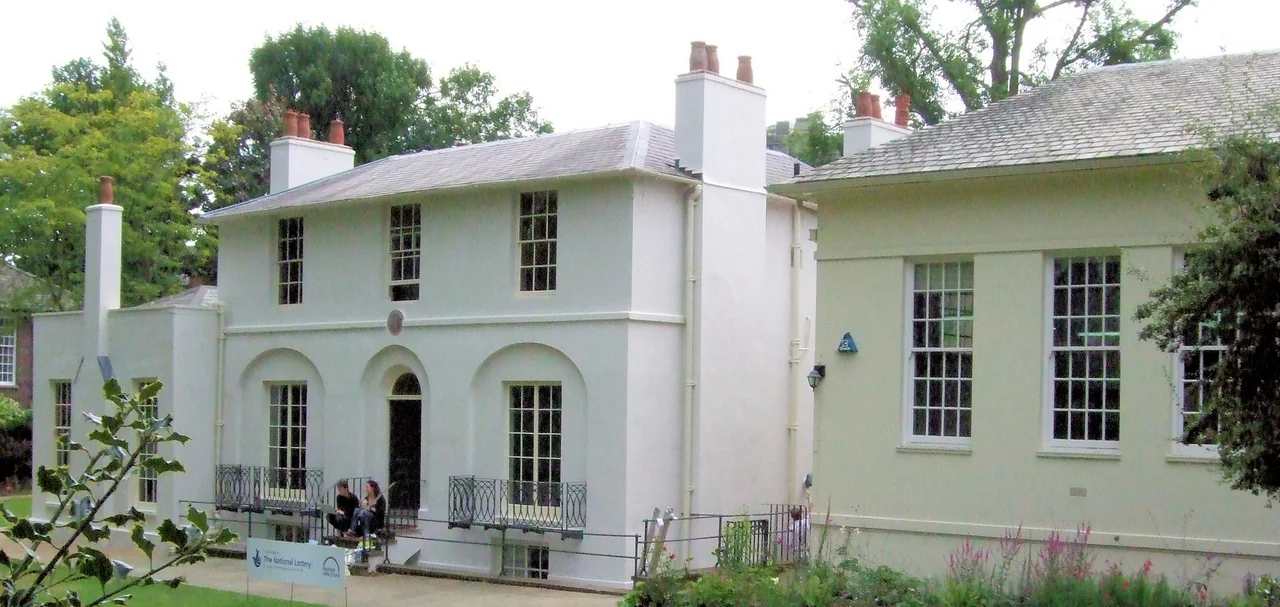

Keats House
One spring morning in 1819, John Keats sat under a plum tree in the garden of his Hampstead lodgings and wrote 'Ode to a Nightingale.' His friend Charles Brown, in whose half of the house Keats lived, described the scene: Keats had gone outside after breakfast with some scraps of paper and returned two or three hours later with the poem nearly complete. Keats was twenty-three. He had perhaps two years left to live. The plum tree is long gone. The house remains.
Wentworth Place
The building now called Keats House was originally a pair of semi-detached houses known as Wentworth Place, constructed in the early 19th century on what was then John Street in Hampstead — the road has since been renamed Keats Grove. Charles Brown occupied one half; the Brawne family occupied the other. Keats first lodged with Brown from December 1818 to May 1820 — the most productive years of his short life. He then moved briefly into the Brawne side of the house from August to September 1820, shortly before leaving London altogether. These eighteen months produced not only 'Ode to a Nightingale' but 'Ode to a Grecian Urn,' 'To Autumn,' 'La Belle Dame sans Merci,' and much of the verse that established his reputation in the century after his death. He lived in rented rooms and wrote some of the most celebrated poetry in the English language, in a garden that is now a public museum.
Love in a Thin Wall
Fanny Brawne lived on the other side of that thin partition wall. She was eighteen when they met, Keats twenty-three; he fell in love with her almost immediately. Their engagement was an open secret among their friends, though the two were never able to marry — Keats had no reliable income, his health was deteriorating, and the social conventions of the time required stability he could not provide. The engagement ring he offered her is among the objects now on display in the museum. His letters to her, passionate and at times anguished, survived and were eventually published; Fanny Brawne kept his letters until late in her life. The division of the house — lovers in adjacent rooms, separated by convention and walls — gives Keats House its particular emotional charge. The spaces where this courtship unfolded are small, domestic, and now preserved with remarkable fidelity to their early 19th-century character.
After Keats
Keats left London in September 1820 on medical advice, sailing for Italy in the hope that a warmer climate might arrest the tuberculosis that had been consuming him since at least 1818. He died in Rome in February 1821, unmarried, aged twenty-five. The house he had left behind went through several subsequent occupants, among them the piano manufacturer Charles Cadby and the physiologist William Sharpey. A Royal Society of Arts plaque was added in 1896. By the early 20th century, the house faced demolition. It was saved by public subscription — a fundraising campaign that drew contributions from admirers of Keats's poetry around the world, including from the United States and Australia — and opened to the public as the Keats Memorial House on 9 May 1925. The adjacent building, which now houses the Ten Keats Grove community library space, occupies the site of the original kitchen garden and coach house. Some of the museum's artifacts were donated by descendants of Charles Brown who had emigrated to New Plymouth, New Zealand, in the last year of his life.
What Remains
The museum holds Keats's engagement ring, a copy of his death mask, and manuscripts that connect the house to the poems written in it. A mulberry tree in the garden is believed to date from the 17th century — if so, Keats would have seen it, though he mentioned it only once in a letter, referring to a white mulberry tree in passing. The house is a Grade I listed building, administered by the City of London Corporation. Regular poetry and literary events continue in the museum's programme, and the garden remains accessible to visitors who come, as readers have come since 1925, to stand in the place where the poems happened. Hampstead itself has changed enormously in two centuries — it is now one of the more expensive addresses in London. But the garden behind Keats Grove retains something of what Brown described: a place quiet enough to hold a nightingale's song.
From the Air
Keats House is located at 51.5555°N, 0.1679°W in Hampstead, north London. From the air, Hampstead is visible as a dense residential area on high ground north of the city, with Hampstead Heath — London's largest open space — immediately to the east. Keats Grove is a quiet residential street near the southern edge of the Heath. Nearest Underground stations are Hampstead (Northern line) and Belsize Park (Northern line). Nearest airport is London City (LCY), approximately 16km east. Recommended viewing altitude: 1,500–2,000 feet.
Nearby Stories
- Stevenage 5.7 km away
- Malling Abbey 5.7 km away
- 1952 Farnborough Airshow Crash 7.7 km away
- Ingatestone Hall 8.2 km away
- Hellfire Caves 9.1 km away
- The Carrington Event: The Solar Storm That Could Happen Again 9.8 km away
- Bletchley Park 16 km away
- Castle Hedingham 23 km away